
5 Books You Need To Read That Heal The Body
Shocking truth: 91% of people buy healing books but never apply what they learn. I’m going to make sure you’re not one of them by showing you exactly which books work and how to actually use them.
You know that overwhelming feeling when you’re scrolling through Amazon, desperately searching for something—anything—that will help you understand what’s happening in your body? I’ve been there.
Four years ago, I was dealing with severe agoraphobia and the aftermath of a traumatic brain injury. I felt completely betrayed by my own body. Traditional “positive thinking” approaches weren’t working, and I was exhausted from trying to think my way out of what my nervous system was screaming.
That’s when I discovered body-based healing.
I’ve since read over 15 books on somatic healing, nervous system regulation, and trauma recovery. I tested their techniques during my darkest days, and discovered what actually creates lasting change.
Today, I’m sharing the 5 books that fundamentally shifted my relationship with my body and my recovery.
Disclaimer: Please note, this post contains affiliate links. If you purchase through these links then I will be rewarded at no extra cost to you.
What Makes A Body-Healing Book Actually Work
Before we dive in, let me save you from the mistake I made early on: buying books that sounded good but didn’t match where I was in my healing journey.
The best books that heal the body share these qualities:
Clarity Over Complexity: They explain what’s happening in your body without requiring a medical degree. When Dr. Claire Weekes explained panic as simply “tired nerves,” something clicked that years of technical explanations hadn’t.
Body-First Approach: They work WITH your body’s signals rather than trying to override them with mental techniques.
Practical Application: Theory helps, but you need concrete practices you can use when you’re actually in distress. The books I’m recommending include techniques I still use daily.
Compassionate Tone: They validate your physical symptoms rather than making you feel broken.
5 Books That Actually Heal The Body (Reviewed)
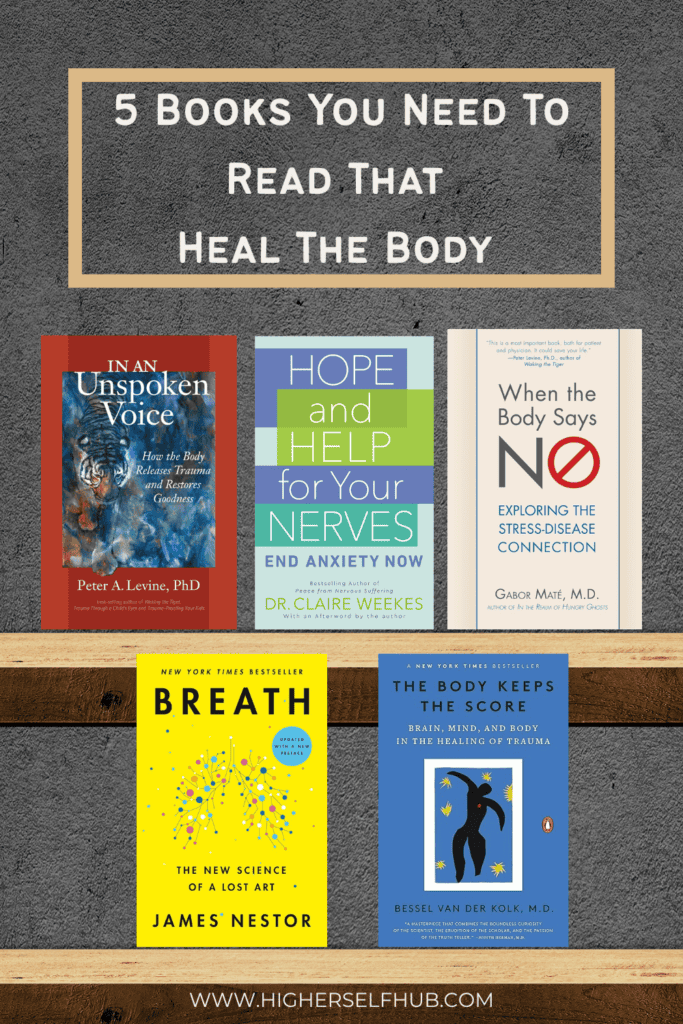
1. Hope & Help for Your Nerves by Claire Weekes
This book found me during a particularly rough panic episode. What makes it different is Dr. Weekes’ uncanny ability to describe exactly what panic feels like, and then explain it in a way that removes the fear. This is by far my favorite of all the healing books I’ll share!
Best for: Anyone experiencing panic, anxiety, or physical symptoms of nervous system activation
What Works:
- Her four-step approach (face, accept, float, let time pass) became my daily mantra during panic attacks
- The calm, reassuring tone that feels like a wise grandmother talking you down
- Practical exercises I could use in the moment, not just theory
- The explanation of “sensitization” finally made my symptoms make sense
What to Know:
- The language feels dated (written in the 1960s), but concepts are timeless
- It’s a manual to return to, not a one-time read
How I Actually Used This Book:
Here’s what worked for me: I treated it like a manual, not a novel. I wrote Dr. Weekes’ four steps on index cards and kept them everywhere: in the car, on the bathroom mirror, and on the nightstand. During panic, I’d grab a card and literally read:
- Face: Don’t run away from the sensations
- Accept: Stop fighting what’s happening
- Float: Don’t tense up against the feelings
- Let Time Pass: This will end
I even found YouTube videos of her reading her book aloud, in her own voice. This primed my nervous system with her calm perspective before the day started. I even recorded myself reading her explanations of panic, during episodes, and hearing my own voice say “Wobbly legs are still good legs.” was oddly comforting.

The biggest mistake I made? Trying to use “float” before truly accepting. You have to accept first, then float. Order matters.
2. The Body Keeps the Score by Bessel van der Kolk, M.D.
This book gave me something I desperately needed: validation that my physical symptoms weren’t “all in my head.”
Best for: Anyone who wants to understand WHY trauma shows up in the body
What Works:
- Understanding that hypervigilance wasn’t a character flaw, it was my nervous system trying to protect me
- Learning about bottom-up healing approaches (working through the body, not just the mind)
- Real-life case studies that helped me recognize patterns in my own experience
What to Know:
- Emotionally intense. I had to take breaks from the heart-wrenching case studies
- More educational than practical (you’ll learn WHY, not necessarily HOW)
How I Actually Used This Book:
I almost gave up on this book in the first few chapters. It’s 400+ pages of dense neuroscience and emotionally heavy case studies. I tried reading it like a normal book and felt overwhelmed.
Here’s a breakdown of highlight chapters:
- Chapter 3 (brain imaging): Mind-blowing explanation of how trauma changes the brain
- Chapter 5 (body-brain connections): Finally understood why my body reacted before my mind
- Chapter 8: Practical approaches to resetting the nervous system
- Chapter 13 (rhythm and healing): Led me to incorporate rhythmic movement into daily life
The case studies were hard, but eye-opening. When van der Kolk described hypervigilance in a veteran, I saw my own pattern of constantly scanning for danger. This helped me understand I wasn’t paranoid; my amygdala was just doing its job.
I started a simple practice log after reading about bottom-up healing:
- What I tried (yoga, breathing, EMDR with my therapist)
- Physical sensations during practice
- What changed afterward
Real Talk: Some weeks I couldn’t read it at all, it was just too activating. The survivors’ stories brought up grief but also gave me hope. These people went on to heal and live full lives. That’s what I held onto.
This book works best alongside therapy, not instead of it. The understanding it gave me made my therapy sessions infinitely more productive.
3. When the Body Says No by Gabor Maté, M.D.
This book called me out in the best way. Reading about how suppressed emotions and people-pleasing can manifest as physical illness felt like Dr. Maté was describing my entire life.
Best for: Anyone dealing with chronic stress, burnout, or unexplained physical symptoms
What Works:
- The compassionate tone. This isn’t about blame, it’s about awareness
- Understanding how my inability to set boundaries was connected to my physical symptoms
- Learning to view symptoms as messages rather than problems to eliminate
What to Know:
- More observational than prescriptive. You’ll understand connections but need other resources for techniques
My Experience: This book helped me understand why my agoraphobia developed when it did, right after I closed my cafe and lived through the Covid years. My body literally stopped me from leaving the house because I wouldn’t stop myself.

Reading about healing is step one. My free Somatic Starter Kit is step two: practices you can feel today.
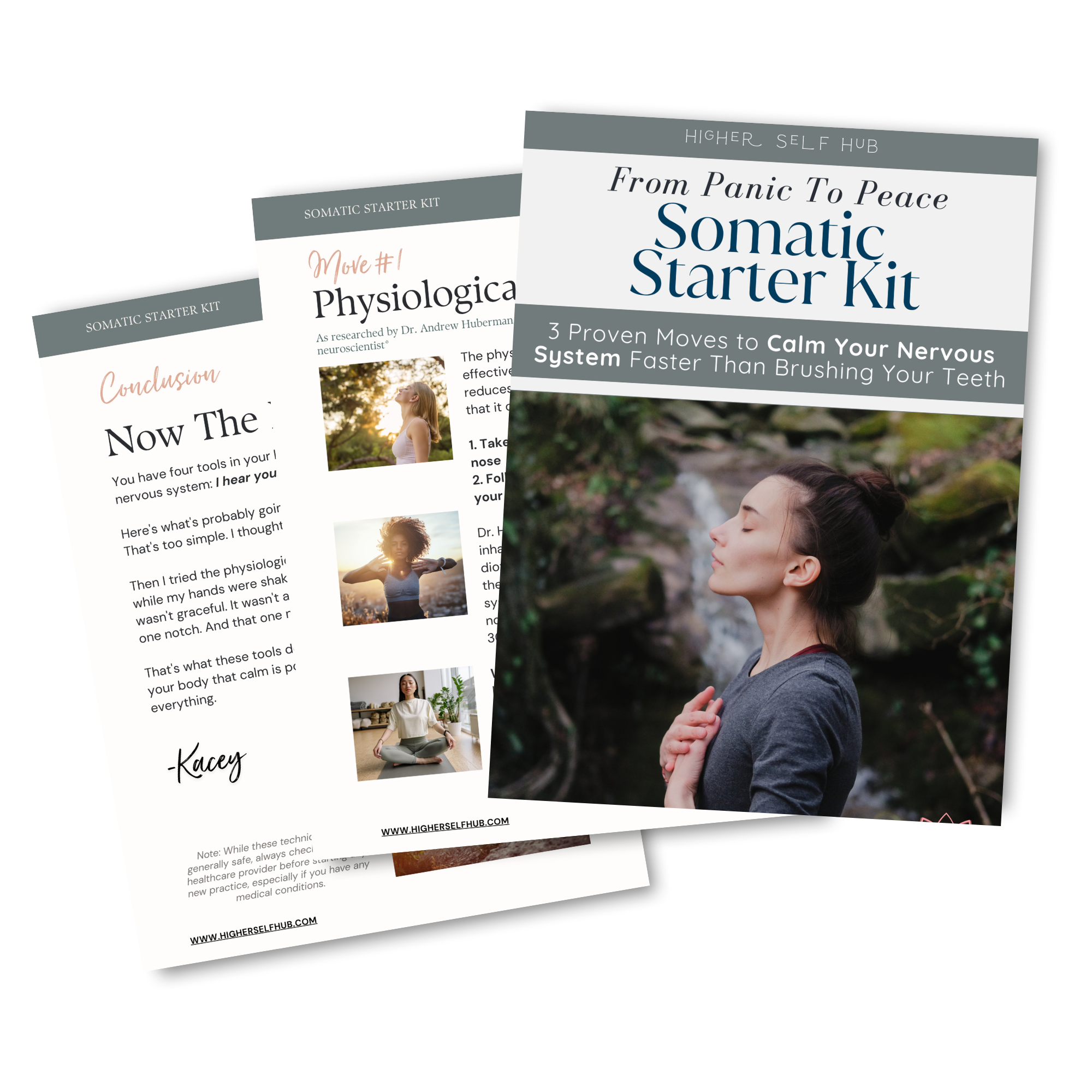
Your Free Somatic Starter Kit
3 science-backed tools to go from panic to peace in under 60 seconds.
Your inbox stays calm, too. Unsubscribe anytime. We respect your privacy.
4. In an Unspoken Voice by Peter A. Levine, Ph.D.
This book revolutionized how I understood “stuck” energy in my body. Those trembles and shakes I’d been trying to suppress? They were actually my nervous system trying to complete what trauma had interrupted.
Best for: Readers ready to go deeper into somatic trauma work
What Works:
- The explanation that trauma isn’t the event, it’s the incomplete biological response
- Learning to trust physical sensations instead of fearing them
- Understanding how animals naturally release trauma through movement
What to Know:
- Intermediate to advanced text; do read other somatic books first
- Exercises are subtle and require patience
My Experience: The section on “discharge” helped me stop fighting the trembling during panic. Instead of tensing up, I started allowing my body to shake it out. The relief afterward was undeniable.
5. Breath: The New Science of a Lost Art by James Nestor
Changing how I breathed changed everything: my anxiety levels, my sleep quality, even my energy throughout the day.
Best for: Anyone dealing with anxiety, stress, sleep issues, or chronic activation
What Works:
- Concrete techniques I could implement immediately
- Understanding how mouth breathing was making my anxiety worse
- Accessible writing style: part science, part adventure story
What to Know:
- Some breathing techniques require practice to feel comfortable
- Results aren’t always immediate (though some work right away)
How I Actually Used This Book:
My first reaction: “Breathing? Really? That’s supposed to help my anxiety?”
Six months later: “Holy crap, breathing actually connects everything!”
The book includes lots of techniques. Instead of trying them all at once (disaster waiting to happen), I tested ONE per week.

My 4-Week Experiment:
Week 1: Nasal Breathing Discovery: I was mouth breathing constantly, especially at night Change: Started using mouth tape while sleeping (sounds weird, works amazingly) Result: Woke up less anxious and actually rested
Week 2: Box Breathing (in for 4, hold for 4, out for 4, hold for 4) When: During anxiety spikes, before difficult situations Effect: Immediate nervous system calming Mistake: Tried it during full panic (too hard; use it BEFORE panic peaks)
Week 3: Extended Exhale (in for 4, out for 6-8) When: Lying in bed unable to sleep Discovery: This activated my “rest and digest” mode like a switch Game-changer for sleep
Week 4: Slower Breathing (about 6 breaths per minute) Time: 10 minutes daily Effect: Most powerful for reducing general anxiety baseline
The Science That Stuck:
- Your breathing pattern directly affects your nervous system state
- Slow breathing activates the vagus nerve (your calming response)
- Most of us are chronically over-breathing (keeping us in stress mode)
- Nose breathing actually calms the nervous system AND filters air better
Unexpected Benefits:
- Less digestive issues (turns out chronic mouth breathing affects digestion)
- Better focus during work
- My entire gut flora balanced out and helped digestion and upset stomach
The chapter on nasal breathing alone was worth the price of the book. I used to wake up wired and anxious, turns out I was mouth breathing all night, triggering my stress response. Simple mouth tape made a noticeable difference within days.
Frequently Asked Questions
Q: Which book should I start with?
For most people:
- If you have panic/anxiety: “Hope & Help for Your Nerves”
- If you want quick, practical tools: “Breath”
- If you want to understand WHY: “The Body Keeps the Score”
- If you’re dealing with burnout/people-pleasing: “When the Body Says No”
Q: How long before seeing results?
In my experience:
- Breathing techniques: Days to 2 weeks
- Understanding your symptoms: 2-4 weeks
- Nervous system regulation: 1-3 months
- Deep pattern shifts: 6-12 months
Small changes happen quickly. I noticed my morning anxiety improved within 2 weeks of nasal breathing. The bigger shifts took longer.
Q: Do I need to practice every technique in every book?
Absolutely not! Test techniques and keep the ones that work for YOUR body. My “breathing menu” only includes 4-5 techniques from Nestor’s book, but I use them daily.
Q: Can these books replace therapy?
No. I used these books alongside therapy, which was incredibly powerful. The books gave me things to practice between sessions, and my therapist helped me process what came up. If you’re dealing with trauma, please work with a professional.
Q: What if I start feeling worse after reading these books?
This happened to me, especially with “The Body Keeps the Score.” Sometimes understanding what happened can initially increase distress. What helped:
- Slow down, read less per day
- Practice the calming techniques alongside reading
- Take breaks between books
- Consider working with a therapist
Remember: sometimes things feel worse before they get better because you’re finally paying attention.
Q: What if these techniques don’t work for me?
Give them real time. At least 4-6 weeks of consistent practice. “Working” doesn’t mean symptoms disappear overnight. It means:
- You understand your symptoms better
- You catch activation earlier
- You have tools that help even a little
- Your relationship with your body improves
If you’ve genuinely practiced for 2-3 months with zero improvement, explore other approaches with a professional.

Conclusion: Your Body Knows How To Heal
After two years of working with these books, here’s what I know for sure: your body isn’t broken. It’s brilliantly designed to protect you. Sometimes that protection looks like panic, anxiety, or physical symptoms that don’t make sense.
These five books taught me to speak my body’s language.
Where To Start:
If you’re experiencing panic or anxiety → “Hope & Help for Your Nerves“ If you want immediate, practical relief → “Breath“
If you need to understand the why → “The Body Keeps the Score“
But honestly? Get all five eventually. They each offer a unique piece of the healing puzzle.
My final advice: Start small. Pick one book. Practice one technique. Give it time. Your nervous system took years to get dysregulated. It deserves months to heal, not days.
The fact that you’re here, reading this, looking for ways to understand and heal your body? That’s already a huge step.
Have you tried any of these books? What’s been your experience with body-based healing? Drop a comment below. I’d love to hear about your journey.
And remember: You’re not broken. You’re not weak. Your body is doing exactly what it’s designed to do. These books will help you understand the language it’s speaking, and how to speak back.
P.S. If you purchase any of these books, consider starting a practice journal alongside them. Document what you try, what works, and what doesn’t. Six months from now, you’ll be amazed at how far you’ve come.
And while you wait for the library holds to come in, grab the free Somatic Starter Kit below.
Your Free Somatic Starter Kit
3 science-backed tools to go from panic to peace in under 60 seconds.
Your inbox stays calm, too. Unsubscribe anytime. We respect your privacy.