

The 28-Day Somatic Workout Plan for Women Who Want to Feel Calm and Strong
It’s Sunday night. You’re scrolling through somatic exercise videos, saving them for later, telling yourself this week I’ll actually start. Maybe you’ve even done a few. A shake here. A breathing exercise there. It felt good. It worked.
But then Tuesday came. Or Thursday. Or that one morning where the baby was up at 4am and everything fell apart before breakfast.
And the somatic exercises? Gone. Again.
That’s not a motivation problem. A 28-day somatic workout plan is a structured, week-by-week framework of gentle body-based exercises designed to help your nervous system build lasting calm through repetition, not willpower. It’s what happens when you stop relying on random exercises and start building something steady.
If you’ve been doing somatic exercises here and there but can’t seem to make them stick, you don’t need more discipline. You need a structure that’s built for your real life.
Why a Structured Somatic Workout Plan Works Better Than Random Exercises

This isn’t your typical workout routine. Somatic exercises work on a different timeline than regular workouts.
A somatic workout shows progress through how your body feels. Less tension in your shoulders. Fewer stress spirals. Falling asleep faster. Waking up without your jaw clenched.
But those shifts are quiet. Without a plan, it’s easy to miss them entirely and think nothing is changing.
A structured 28-day somatic workout plan solves this in two ways. First, it gives you something to follow on the days your brain can’t decide what to do. Second, it builds in natural progression so your nervous system gets the repetition it needs to actually rewire. Research shows that repeated somatic practices can create measurable changes in nervous system regulation over time (Journal of Traumatic Stress, 2014).
This isn’t about pushing harder each week. It’s about going deeper.
If you want a simple starting point for somatic work, the Somatic Starter Kit walks you through it. It’s free, and it’s yours whenever you’re ready.
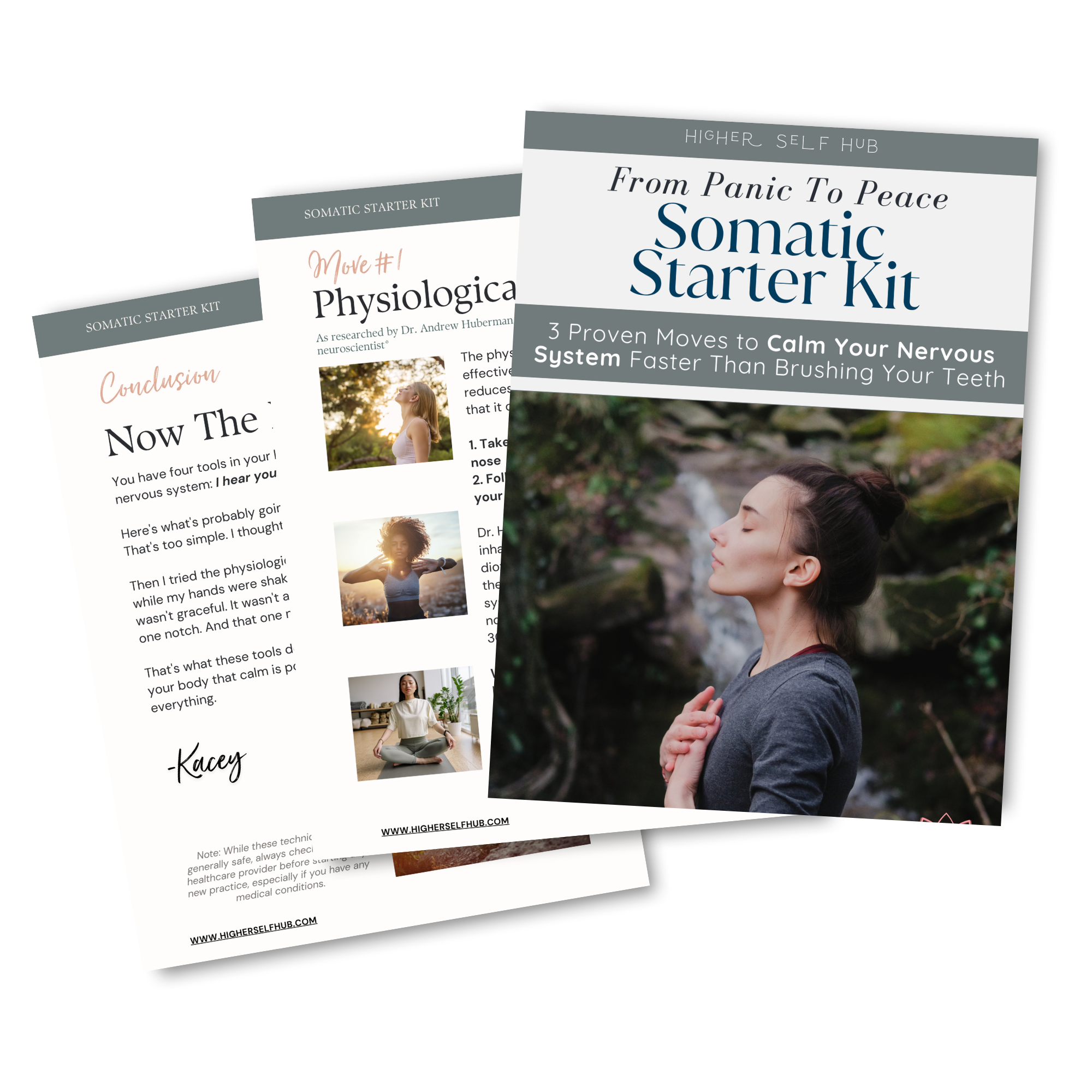
Your Free Somatic Starter Kit
3 science-backed tools to go from panic to peace in under 60 seconds.
Your inbox stays calm, too. Unsubscribe anytime. We respect your privacy.
Your 28-Day Somatic Workout Plan (Week by Week)

A few things before you start. When I set a goal to walk one mile a day for 100 days, I was done with burnout discipline. So I designed the habit for my worst day. My migraine days. The days my body was weak and exhausted. On those days, instead of asking “how do I push through 20 minutes?” I asked, “can I go outside for five?” I didn’t override my body. I collaborated with it.
This plan works the same way. It’s designed for your worst day, not your best one. Every exercise can be done in under 10 minutes. Most take less than 5. If you miss a day, you just pick up where you left off. No restarting. No guilt.
Week 1: Grounding Basics (Getting Into Your Body)

The first week is about reconnection. Your body has probably been running on autopilot for a while. This week, you’re simply saying: I’m here. I notice you.
Daily practice (pick one per day, rotate through):
- Physiological sigh: Double inhale through the nose, long exhale through the mouth. 5 rounds. Takes about 90 seconds.
- Foot grounding: Standing or sitting, press your feet into the floor. Notice the weight. The temperature. Stay there for 60 seconds.
- Body scan check-in: Feet to head, just noticing. Tight spots. Warm spots. Numb spots. No fixing. 3 minutes.
What to notice this week: You’re not looking for big shifts. Just moments where you catch yourself actually in your body instead of three hours ahead in your mind.
Week 2: Building a Rhythm (Your Body Starts to Expect It)

By the second week, something subtle happens. Your body starts anticipating the practice. You reach for it before you think about it. That’s not discipline. That’s your nervous system recognizing a pattern of safety.
Daily practice (5-7 minutes):
- Shake-off: 60 seconds of shaking your whole body. Arms loose. Jaw slack. Bounce on your knees.
- Crossbody movement: Swing your arms across your body, left to right. This re-engages both hemispheres of the brain and helps your prefrontal cortex come back online when you’re feeling reactive.
- Wall push: Stand facing a wall, press both palms flat, and push firmly for 10 seconds. Release. Repeat 3 times. This activates your body’s natural “push back” response and can help discharge stored fight energy.
What to notice this week: Are you sleeping differently? Holding your jaw less? Catching a stress spiral earlier than usual?
Week 3: Deeper Release (What’s Been Hiding Underneath)

This is where the work gets quieter. The first two weeks cleared the surface tension. Week 3 is about what’s underneath it.
Daily practice (7-10 minutes):
- Hip release: Lie on your back, knees bent, feet flat. Let both knees fall gently to one side. Hold for 5 breaths. Switch sides. Your hips store more tension (and emotion) than almost any other part of your body.
- Jaw release: Open your mouth wide. Stick out your tongue. Make a “ha” sound on the exhale. The jaw holds years of unspoken words and swallowed reactions.
- Extended exhale breathing: Inhale for 4 counts, exhale for 6-8 counts. 10 rounds. This activates the parasympathetic nervous system and signals safety to your vagus nerve.
What to notice this week: Emotions may surface. That’s not a sign something is wrong. It’s a sign your body is finally safe enough to let go.
Week 4: Integration (Making It Yours)

The last week isn’t about adding more. It’s about noticing what your body gravitates toward and building your own practice from the exercises that felt most helpful.
Daily practice (your choice, 5-10 minutes):
- Look back at weeks 1-3. Which exercises did you reach for most?
- Build a “personal three” rotation: one grounding exercise, one release exercise, one breathing exercise.
- Practice your personal three daily this week.
What to notice this week: This is the week where the practice starts to feel like yours, not something you’re following.
That shift from “doing the plan” to “doing what my body needs” is the entire point.
What Happens After 28 Days?

You don’t stop. But you also don’t need to keep following a rigid plan.
By the end of 28 days, you’ll have a handful of exercises your body trusts. You’ll know what works when you’re wired. What works when you’re heavy. What works in the car, in bed, at the kitchen counter.
The goal was never to complete a program. It was to build a relationship with your body that doesn’t disappear when life gets hard. Microhabits for a healthy nervous system are what make somatic work sustainable. Small enough to survive a bad day. Repeatable enough to rewire over time.
If you want the full printable version of this plan with daily tracking pages, space for body check-in notes, and a built-in way to see your own patterns over time, the 28-Day Somatic Exercise Habit Tracker & Wellness Journal lays it all out for you. Nothing complicated. Just a simple structure that keeps you going.
Messy Counts

Miss a day? Pick up where you left off. Do the same exercise every day for a week because it’s the only one you can manage? That counts. Make it to day 14 instead of 28? Your nervous system still benefited from every single one.
This somatic workout plan isn’t about perfection. It’s about repetition. And repetition, even imperfect, messy, some-days-I-forgot repetition, is what teaches your body that calm is available.
Start with Week 1. Just today.
Grab the free Somatic Starter Kit to get your first week of exercises in one place.
Your Free Somatic Starter Kit
3 science-backed tools to go from panic to peace in under 60 seconds.
Your inbox stays calm, too. Unsubscribe anytime. We respect your privacy.