
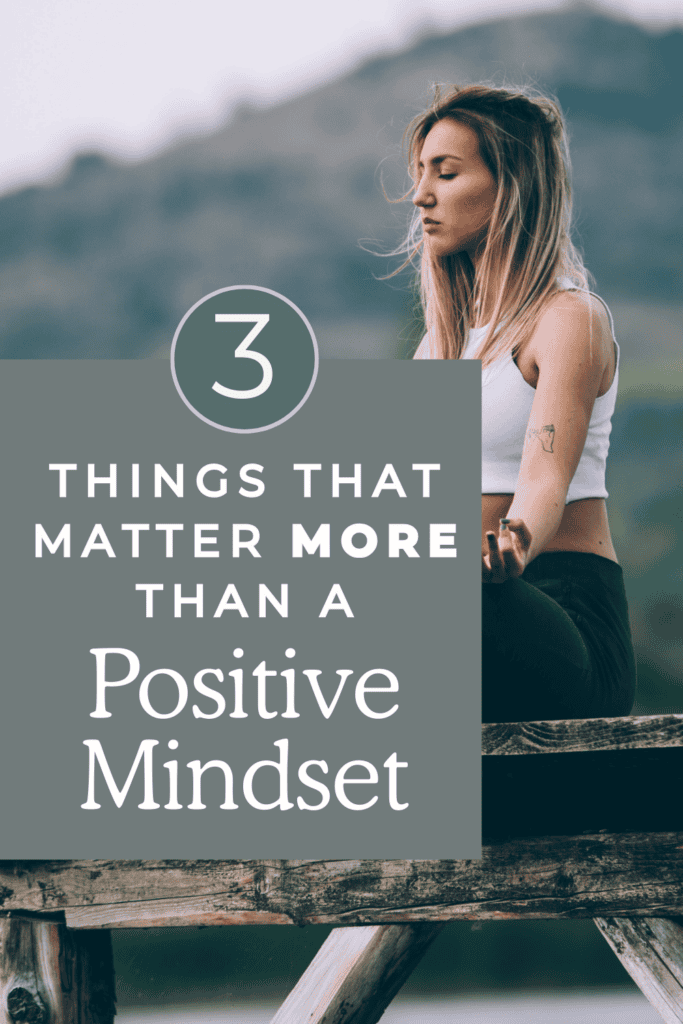
3 Things That Matter More Than a Positive Mindset (And the One Place It Still Wins)
I came to a harsh realization when I realized that I couldn’t think myself out of overthinking. Despite my best efforts, my nervous system crashed in 2021 and I needed more than positive thinking to pull me out.
I was doing all the ‘right things.’ Positive affirmations on the mirror. Gratitude journals. Telling myself everything happens for a reason while my body was screaming at me to pull out of the school pickup line.
It felt like I was doing the work. But my hands were still shaking. My chest was still tight by noon. And no amount of reframing my thoughts could touch what was happening underneath.
So I stopped trying to think my way into feeling better. And I started paying attention to what my body actually needed instead.
That’s what this post is about. Three things I’ve found that go deeper than a positive mindset. They’re quiet. They’re simple. And none of them require you to pretend you’re okay when you’re not.
There’s also a bonus at the end, one place where a positive mindset genuinely still matters. It might not be the one you’d expect.
Why a Positive Mindset Alone Wasn’t Enough
For a long time, I thought I had my healing routine figured out. The breathing exercises were helping. The journaling was going okay. Why change anything?
But I realized I wasn’t really getting better. I was just… maintaining. Comfortable, but stuck. And I think a lot of us live there longer than we realize.
When I was deep in my agoraphobia recovery, I had a handful of tools that got me through the worst days. They were good tools. But at some point, the progress slowed to a crawl. Not because the tools stopped working, but because I needed something different.
It wasn’t until I started experimenting with new, body-based practices that things shifted again. Not in a dramatic, overnight way. More like the kind of shift where one day you notice you just drove across the bridge without white-knuckling the steering wheel. And you almost didn’t catch it because it felt so… normal.
That quiet shift is what I want to talk about.
If you’ve been feeling like your progress has stalled, even just a little, I put together a free guide that explains what might actually be going on in your nervous system: Why Calming Down Doesn’t Work (And What Finally Will)
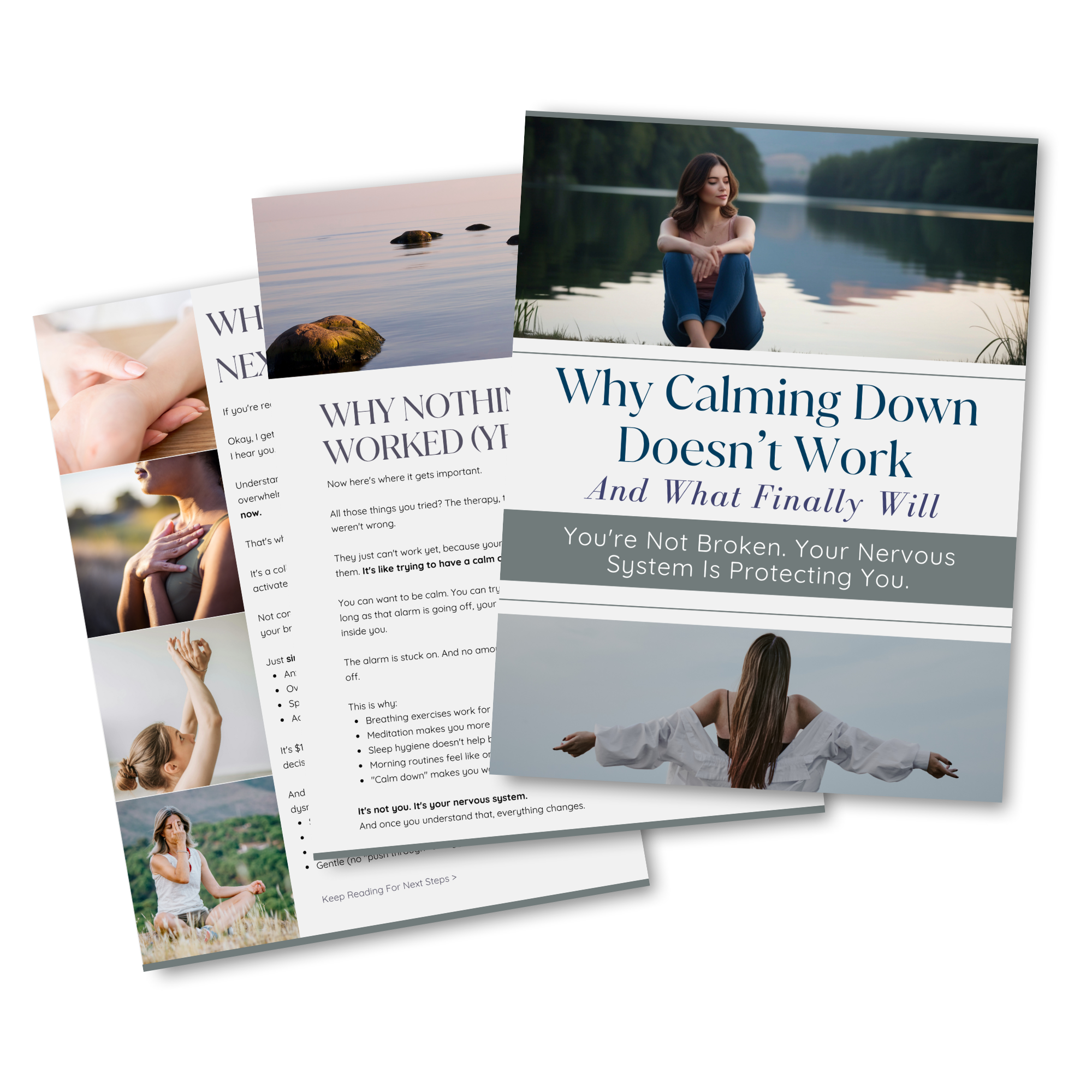
Free Guide: Why Calming Down Doesn’t Work
(And What Finally Will)
You’re Not Broken. Your Body Is Protecting You.
Your inbox stays calm, too. Unsubscribe anytime. We respect your privacy.
#1. Somatic Orienting
This is the simplest thing I’ve ever tried. And honestly, it’s the one that surprised me the most.
All it takes is just… noticing what’s physically around you. That’s it. No deep breathing. No meditation. No trying to find a positive thought to replace a negative one.
Somatic orienting is simple: you look around the room and name what’s real. The floor is brown. The window is open. My feet are on the floor. My hands are warm.
It removes the judgment piece. No positivity; no negativity. Just neutral, present-moment awareness.
I started doing this after realizing how much time I spend completely in my head. I’ll be standing in the kitchen, hands in the dishwater, and my brain is three counties away replaying something someone said last week. Twenty minutes gone before I even notice I left.
A lot of advice tells us to replace those spiraling thoughts with positive ones. Choose a better thought. Reframe it. But sometimes you can’t get to positive. You just can’t. What you can get to is neutral. And neutral is enough.
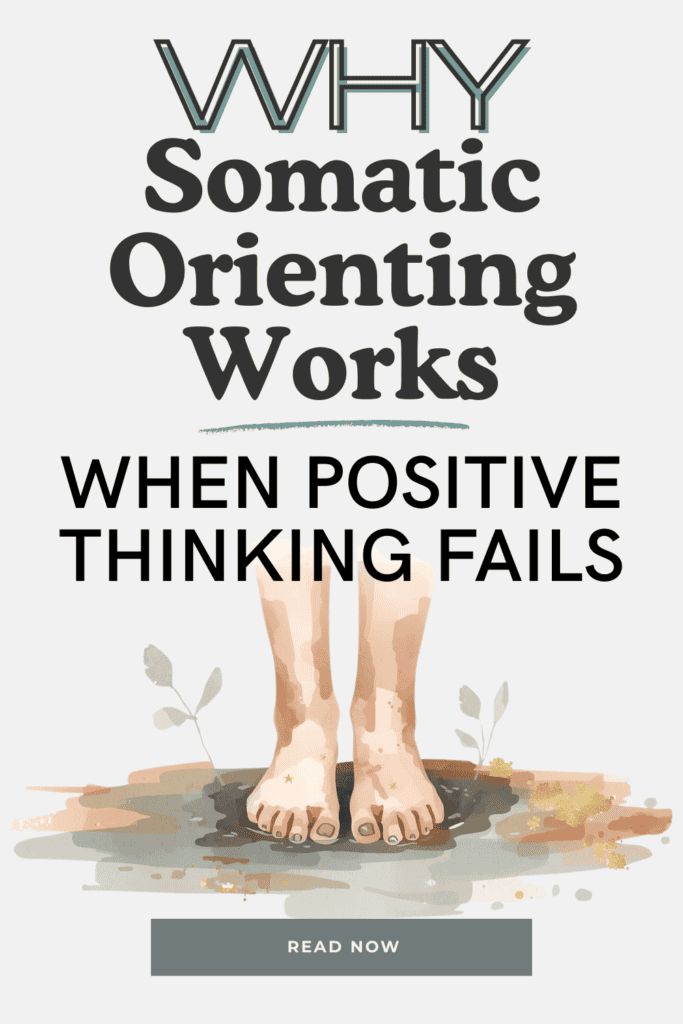
Here’s what’s actually happening when you orient:
Your amygdala (the part of your brain that runs your fight-or-flight response) is in charge during those spirals. Your prefrontal cortex, the part that thinks clearly, has literally gone offline. When you name real, physical things in your environment, you’re gently signaling to your nervous system that you’re safe. You’re bringing the thinking brain back without forcing anything.
The part I love most is that nobody has to know you’re doing it. You can orient in the middle of a conversation. While driving. In a meeting. With your kids hanging off your legs.
Next time you catch yourself looping, skip the affirmation. Just name five things that are physically true about where you are right now.
If you want more practices like this, 10 Super Simple Ways to Lower Cortisol (Without Positive Thinking) is full of them.
#2. Sunlight
I resisted this one for a while. It sounded too simple. Too obvious. Another thing someone on the internet was telling me to do.
But the more I learned about what’s actually happening in our bodies, the harder it became to ignore.
Our daily lives are so far from what human bodies were built for. We sit at screens all day. At work we sit for hours under fluorescent & LED lights. Our evenings are spent staring at a smaller screen. And then we wonder why we can’t fall asleep. Why we’re so irritable by dinner.
It’s no wonder that everything feels harder than it should.
Andrew Huberman’s research is what finally clicked for me. When you get sunlight in your eyes first thing in the morning, it starts a hormonal balancing clock in your body. It helps your cortisol peak when it’s supposed to (morning, not 2am). It tells your body when to start producing melatonin so you can actually fall asleep at a reasonable hour. It’s not a trend. It’s basic biology that we’ve accidentally designed out of our lives.
Here’s what I noticed once I started being more intentional about it:
- Falling asleep got easier (and I stay asleep longer)
- My mood is steadier by mid-morning
- I have more patience in the afternoon
- That 3pm crash isn’t as brutal
- I actually want to be outside, which feeds into everything else
It doesn’t have to be complicated. A 10-minute walk first thing. Coffee on the porch instead of at the counter. Taking the kids outside before checking your phone. Getting some sun on your skin while you’re already out there.
Your body was made for this. It’s free. And you already have access to it.
If you want to pair this with a simple walking practice, The Walking Habit: Your First Step to Nervous System Regulation is a really gentle place to start.
#3. Systems (Because Motivation Isn’t Coming to Save Us)
This one is personal.
After my traumatic brain injury, I lost the ability to juggle things the way I used to. Before the accident, I managed a full school schedule, a varied work schedule as a restaurant server, and a busy social life. I was a straight-A student. Things came naturally easy to me.
And then they didn’t.
To this day, I rely on writing things down. If it’s not written, I will forget it. I need systems, or my brain gets overwhelmed and just… stalls. That feeling where you have ten things to do but you can’t start any of them? I live there if I don’t have structure.
So when people talk about a positive mindset as the key to consistency, I always think: but what about the days when your mindset isn’t there?
Because some days, it’s just not. Some days you’re exhausted. Others, your body is telling you to stay on the couch. Some days you don’t have the energy to choose the right thing, let alone feel positive about it.
That’s where systems matter more than mindset.
A routine so simple that you don’t have to be in a good mood to follow it. Something your body knows how to do, the way it knows how to reach for the coffee pot in the morning without really thinking about it.
The women I’ve connected with through Higher Self Hub who are making the most steady progress? They’re not the most motivated. They’re the ones who made their practices small enough that doing them became easier than skipping them.
That’s why I created the 28-Day Somatic Exercise Habit Tracker & Wellness Journal. Not because you need another thing to do. But because I’ve seen, in my own life first, that focusing on a one percent improvement each day gets you further than going all-in for a week and burning out. A quiet system you can lean on, even on the hard days. That’s what actually builds the kind of consistency that sticks.
Bonus: The One Place a Positive Mindset Still Wins
After all of that, am I saying a positive mindset is useless?
No. Not at all.
There’s one place where a positive mindset genuinely, scientifically matters. And it’s this: believing that you can change.
After my brain injury, the specialists gave me a pretty bleak outlook. They said I would never operate the same way again. That my brain was permanently altered.
I decided I wasn’t going to accept that.
I started learning about neuroplasticity. How our brains physically rewire themselves through repetition and practice. And this isn’t wishful thinking. It’s well-documented science. Our brains are so incredibly plastic that neural pathways can be strengthened, rerouted, and rebuilt over time.
This is where a positive mindset earns its place. Not in forcing yourself to feel happy. Not in pasting affirmations over real pain. But in holding onto the quiet belief that it doesn’t have to stay like this.
Because every time you practice somatic orienting, that pathway gets a little stronger. Every time you take that morning walk in the sunlight, your body learns that regulation is accessible. Every time you show up for your system, even imperfectly, your brain is literally reshaping itself.
No matter how clumsy you feel at any of these things right now, your brain is moldable. Capable of building new responses. That’s not toxic positivity. That’s neuroscience.
So keep the positive mindset for this one thing: knowing that every repetition counts, even the messy ones.
A Few Things to Take With You
This shift doesn’t require you to overhaul your routine. You don’t have to master all three of these at once. And the best part? You don’t have to be in a good mood to start.
Pick one that sounds like the least amount of effort. Try it for a few days. See how your body responds. That’s all.
If a positive mindset hasn’t been enough on its own, you’re not doing it wrong. You might just be ready for something that meets your body where it actually is.
Save This To Come Back To
If you want to understand more about why calming down doesn’t always work (and what does), I break it all down in this free guide: Why Calming Down Doesn’t Work (And What Finally Will)
Free Guide: Why Calming Down Doesn’t Work
(And What Finally Will)
You’re Not Broken. Your Body Is Protecting You.
Your inbox stays calm, too. Unsubscribe anytime. We respect your privacy.
And if you’re looking for a simple, quiet system to build somatic practices into your daily life, the 28-Day Somatic Exercise Habit Tracker & Wellness Journal was made for exactly that. Small steps. No pressure. Just a place to show up for yourself.






I love this! Having a system makes sense. Great information! Thank you!
This was a great read! It’s definitely a process trying to refocus on what your body needs with so many distractions around us. Thank you for sharing!