

10 Super Simple Ways to Lower Cortisol (Without Positive Thinking)
I can’t relax. I don’t have time for self-care. My body just won’t cooperate. I’ve tried everything to lower my cortisol.
Sound familiar?
You’re not alone. Thoughts like these are common when you’re dealing with chronic stress and nervous system dysregulation. We all have fears when our body feels stuck in survival mode.
And you know they’re holding you back from feeling grounded, energized, and present in your life.
For years, I believed that managing stress meant I had to meditate for an hour daily or completely overhaul my life. That pressure just added more cortisol to my already overloaded system, keeping me stuck in the same exhausted, wired-but-tired cycle.
Since then, I’ve learned that regulating your nervous system doesn’t require perfection. It requires presence. And I can’t wait to share it all with you.
So take a deep breath and settle in to learn 10 actionable ways to lower cortisol naturally without having to force yourself through another 30-day meditation challenge you’ll abandon by day three.
Yes, you can calm your nervous system, and I’m going to show you how.
1. Set Gentle Goals for Nervous System Regulation
When you’re working toward lowering cortisol and regulating your nervous system, it can be easy to get lost in the details and forget about the primary goal.
Your primary goal of feeling safe and calm in your body should always be front and center. Otherwise, you risk adding more stress to an already overwhelmed system.
Here’s the thing about goal-setting when your nervous system is fried: traditional SMART goals can actually trigger your stress response. Instead, try “somatic goals” that focus on how you want to feel rather than what you want to accomplish.
For example:
- Instead of “meditate 20 minutes daily,” try “notice 3 moments of ease in my body today”
- Instead of “eliminate all sugar,” try “eat one meal this week without rushing”
- Instead of “fix my cortisol in 30 days,” try “create one pocket of calm in my day”
Pro Tip: Write your gentlest goal on a sticky note where you’ll see it daily. Your bathroom mirror, laptop, or dashboard works great. The daily reminder will help your body remember it’s safe to slow down.
Want a simple place to start? The 7-Day Guide to Lower Cortisol gives you one small, body-based practice per day, plus a place to track what you notice. No overhaul required.
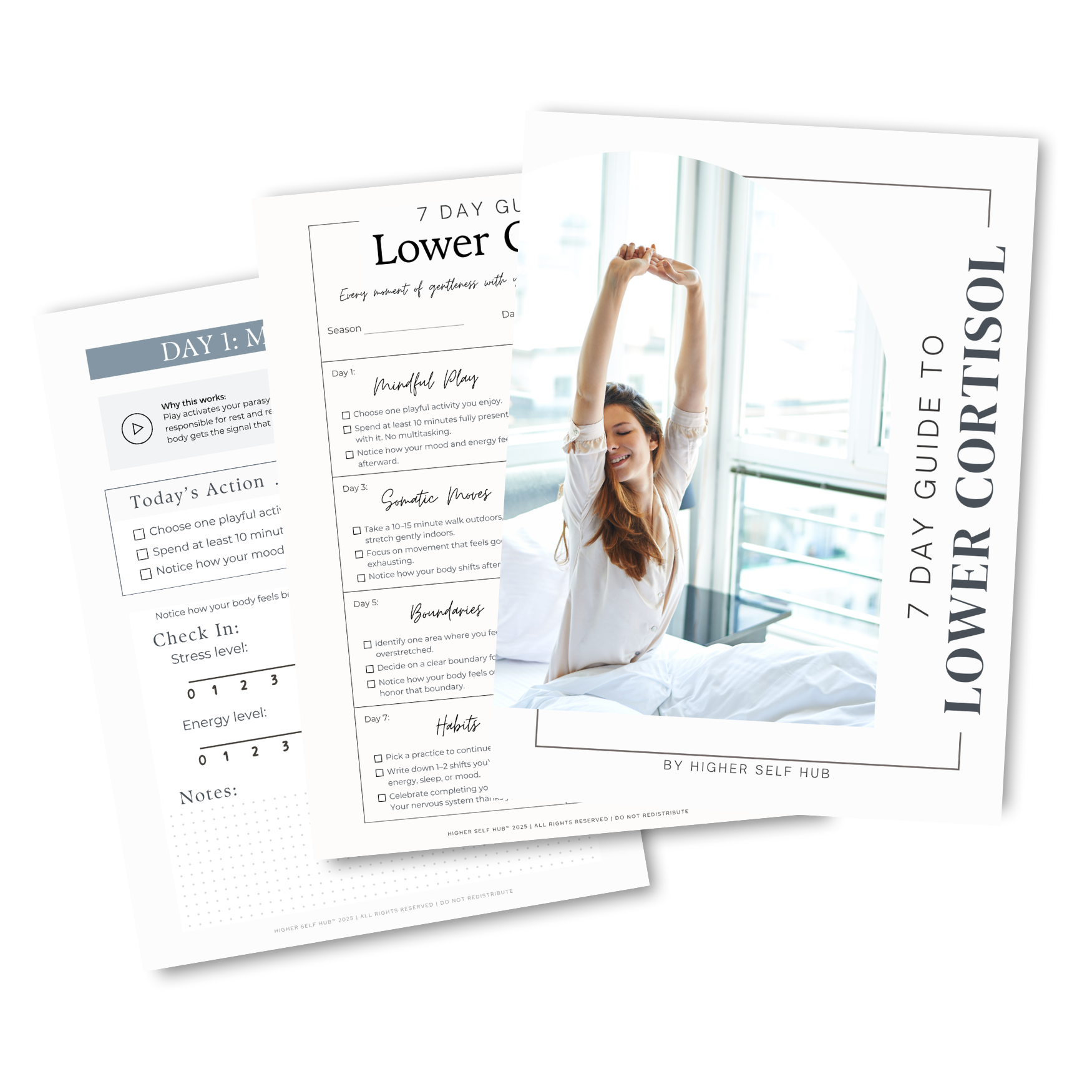
Free 7-Day Guide To Lower Your Cortisol
The Hormone Balancing Guide That Works For Women In The Thick of It.
Your inbox stays calm, too. Unsubscribe anytime. We respect your privacy.
2. Collaborate with Your Body (Not Against It)
Do you think you have to force your body into submission to lower your cortisol?
Your body isn’t the enemy. It’s your wisest teacher.
It’s a whole lot more effective (and less exhausting) when you collaborate with your nervous system instead of fighting it. Think about what your body is trying to tell you through tension, fatigue, or that wired feeling. Notice the times of day when you naturally have more energy versus when you need to rest.
You can even track your energy patterns throughout your menstrual cycle to work with your hormones instead of against them.
When I was deep in agoraphobia, I spent years trying to “think positive” and push through my body’s signals. It wasn’t until I started actually listening, noticing when my shoulders crept up, when my breath got shallow, when my body was screaming for rest, that real healing began.
Here are a few things to keep in mind as you start collaborating with your body:
First, get curious instead of critical. When you notice tension or overwhelm, pause and ask, “What is my body trying to protect me from right now?” This shifts you out of shame and into awareness.
Second, start a simple body-based check-in routine. Three times a day (morning, midday, evening), take 30 seconds to scan your body. Where are you holding tension? Is your jaw clenched? Are your shoulders up by your ears? Just notice rather than try to fix.
Third, honor your body’s “no.” If your body is telling you it needs rest, and you push through anyway, you’re essentially telling your nervous system it’s not safe to trust its own signals. This keeps cortisol elevated.
Fourth, track your cycle if you menstruate. Your cortisol naturally fluctuates with your hormones. What feels manageable in your follicular phase might feel impossible during your luteal phase. That’s not weakness. That’s biology.
Fifth, remember that collaboration takes practice. You’ve likely been ignoring or overriding your body’s signals for years. It will take time to rebuild that trust.
Pro Tip: Your body has been trying to communicate with you through symptoms for a long time. Be patient as you learn its language. This isn’t something you master overnight. It’s a lifelong relationship you’re rebuilding.
3. Remember to Move Your Body (Not Exercise It Into Submission)
You may be thinking to yourself, “I don’t have energy for exercise,” but if you don’t move the stress out of your body, you won’t be able to lower those cortisol levels no matter how many supplements you take.
Instead, make sure you prioritize gentle, restorative movement that feels good rather than punishing workouts that spike cortisol even higher.
According to the American Psychological Association, moderate movement helps metabolize stress hormones, but intense exercise when you’re already depleted can actually increase cortisol and keep you in a chronic stress state.
Movement doesn’t have to mean a gym membership or spin class. It can be:
- A slow walk where you actually notice your surroundings
- Shaking out your arms and legs for 2 minutes
- Dancing in your kitchen to one song
- Gentle stretching on your living room floor
- Simple yoga poses that focus on opening your chest and hips (where we store stress)

You will thank me later when you realize you can lower cortisol without exhausting yourself further.
Pro Tip: Not everyone in your family will understand why you’re “just walking” instead of doing a “real workout.” That’s okay. Your nervous system knows the difference. Trust your body over gym culture.
4. Always, Always, Always Listen to Your Body’s Shutdown Signals
No matter what your end goal is, pay attention when your body is trying to tell you it needs to stop because ignoring these signals is what keeps cortisol chronically elevated.
If you feel resistance to pausing, that voice that says “I should be able to handle this” or “I’m being lazy,” just remember that your body’s shutdown response is actually protective. It’s trying to keep you safe. And the more you honor these signals early, the less your body needs to scream at you through complete exhaustion or illness.
Here’s how to recognize and honor your body’s shutdown signals before you hit total burnout:
First, learn the early warning signs: difficulty making decisions, increased irritability, wanting to cancel all plans, feeling “foggy,” craving isolation, or that sensation of being “too much” for yourself.
Second, give yourself permission to do less. Not next week. Today. Cancel one thing. Simplify one meal. Lower one expectation.
Third, practice the phrase “My body needs rest, and that’s not negotiable.” You don’t need to explain or justify this to anyone.
Fourth, understand that rest is not a reward for productivity; it’s a biological requirement. Your body doesn’t care about your to-do list.
Fifth, recognize that pushing through shutdown signals is what creates the chronic stress cycle. Your body will keep raising the stakes until you listen.
Pro Tip: The culture that taught you to ignore your body’s limits is the same culture that profits from your burnout. Honoring your shutdown signals is an act of love.
5. Avoid Toxic Positivity At All Costs
Overwhelmed women aren’t the only ones who suffer from toxic positivity’s harmful effects.
That doesn’t mean you will inevitably stay stuck in stress just because you’re not “thinking positive.”
Real cortisol reduction comes from actually processing your stress and emotions, not bypassing them with forced gratitude or affirmations. When you try to positive-think your way out of genuine distress, you’re essentially gaslighting your nervous system, which keeps it on high alert.
I spent years trying to “manifest” and “think positive” my way out of trauma and burnout. All it did was add shame to my stress when the positive thinking didn’t work. Real healing started when I finally let myself feel the hard things and gave my body permission to be exactly where it was.
Stop trying to talk yourself out of what your body is genuinely experiencing. Your nervous system can’t heal what you won’t acknowledge.
And remember: Feel it to heal it. Your emotions need completion, not correction.
6. Upgrade Your Breathwork Practice
Do you know you could lower your cortisol in under 60 seconds with the right breathing pattern? What are you waiting for?
Consider this your official permission slip to slow down your exhale. An excellent resource for understanding the science behind this can be found at the HeartMath Institute’s research on heart rate variability and stress.

The key is extending your exhale beyond your inhale. This activates your parasympathetic nervous system (rest and digest) and signals to your body that it’s safe to relax.
Try the 4-7-8 breath: Inhale for 4 counts, hold for 7, exhale for 8. Just three rounds can lower cortisol.
Box breathing also works: Inhale 4, hold 4, exhale 4, hold 4. This creates balance in your nervous system.
An example of how I apply this: When I notice my shoulders creeping up toward my ears while driving (a clear sign my sympathetic nervous system is activated), I’ll do three rounds of extended exhale breathing. My body remembers it’s safe, and I can keep going from a grounded place instead of a stressed one.
7. Why Should You Track Your Nervous System State?
Look, I hear you, tracking your nervous system state takes attention and awareness. I’ve been there and avoided it. I thought I should just “know” how I’m feeling.
However, without awareness of your nervous system state, you’ll keep responding to stress on autopilot, which means cortisol stays elevated even when the actual threat is gone.
Don’t snooze on learning your patterns, when that could be the ticket to freedom.
There are a few things I’ve tried that are huge energy-savers with this:
#1: Use the traffic light system Green = ventral vagal (calm, connected, safe) Yellow = sympathetic (anxious, activated, stressed) Red = dorsal vagal (shutdown, numb, exhausted)
Just check in three times a day and notice your color. That’s it. No fixing required yet, just awareness.
#2: Try the How We Feel app
This free app helps you identify emotions and track patterns over time. You’ll start noticing what situations, people, or times of day consistently dysregulate you, and which ones genuinely help.
#3: Practice the mantra “Name it to tame it” Simply identifying your nervous system state, saying “I’m in my sympathetic response right now,” begins to create separation from the stress and activates the prefrontal cortex, which helps lower cortisol.
“Between stimulus and response there is a space. In that space is our power to choose our response.” — Viktor Frankl
8. Good News: You Can Lower Cortisol in Under 2 Minutes with Bilateral Stimulation
Don’t worry if you haven’t heard of bilateral stimulation.
Part of what makes bilateral stimulation so effective for lowering cortisol quickly is that it’s relatively simple and works directly with your nervous system instead of trying to think your way out of stress.
Thankfully, I’m here to share all about regulating your nervous system through body-based techniques.
This is a Somatics Simplified toolkit to get you started with quick nervous system regulation, but now on with our final 2 ways to lower cortisol.
Bilateral stimulation means alternating left-right activation, like tapping your knees alternately, butterfly hugging yourself (hands on opposite shoulders, alternating taps), or even walking. This cross-lateral movement helps integrate both hemispheres of your brain and signals safety to your nervous system.

9. Don’t Skip Sleep for Productivity
The temptation to cut corners by sacrificing sleep to get more done can be great, but it creates a vicious cortisol cycle that makes everything harder.
When you’re sleep-deprived, your cortisol levels stay elevated all day, making you feel wired and exhausted at the same time. Then you can’t sleep at night because your cortisol is still high. Rinse, repeat.
Prioritize your sleep window the same way you’d prioritize an important meeting. Your body literally cannot heal a dysregulated nervous system without adequate rest.
10. Always Give Yourself Permission to Be Human
Lowering cortisol can be hard. This is why it’s essential to keep up the momentum and good humor by remembering you don’t have to do any of this perfectly!
All kidding aside, the pressure to “do nervous system regulation right” can itself become a source of stress. The goal isn’t perfection. Its presence. It’s noticing when you’re in a stress response and having a few tools to support yourself back to baseline.
There you have it!
If you’re a woman who’s been running on stress hormones for so long that exhaustion feels normal, I see you. I’ve been there, in the thick of agoraphobia and burnout, when my body felt like a prison instead of a home.
These somatic tools helped me reclaim my nervous system, and they can help you too. You don’t need to have it all figured out. You just need to start honoring what your body is trying to tell you.
Did you find these tips helpful? Share your biggest cortisol-lowering challenge in the comments below!
And finally, I created a 7 Day guide to help you lower your cortisol naturally. Grab it below:
Free 7-Day Guide To Lower Your Cortisol
The Hormone Balancing Guide That Works For Women In The Thick of It.
Your inbox stays calm, too. Unsubscribe anytime. We respect your privacy.