
How to Map Your Monthly Energy Cycle As A Woman
I was seven years deep into a decade-long cycle of being pregnant, nursing, or both.
My hormones were doing acrobatics. My energy levels changed by the hour. And every productivity guru kept telling me to “just stay consistent.”
As I was nursing baby #3, I found a book on Audible that changed everything: Do Less by Kate Northrup.
That’s when I learned the truth: our bodies don’t work on a 24-hour cycle the way men’s do. We ride a roughly 28-day cycle wave.
And suddenly, my “inconsistency” wasn’t a character flaw. It was biology.
This last week I saw this image that brought it all home:
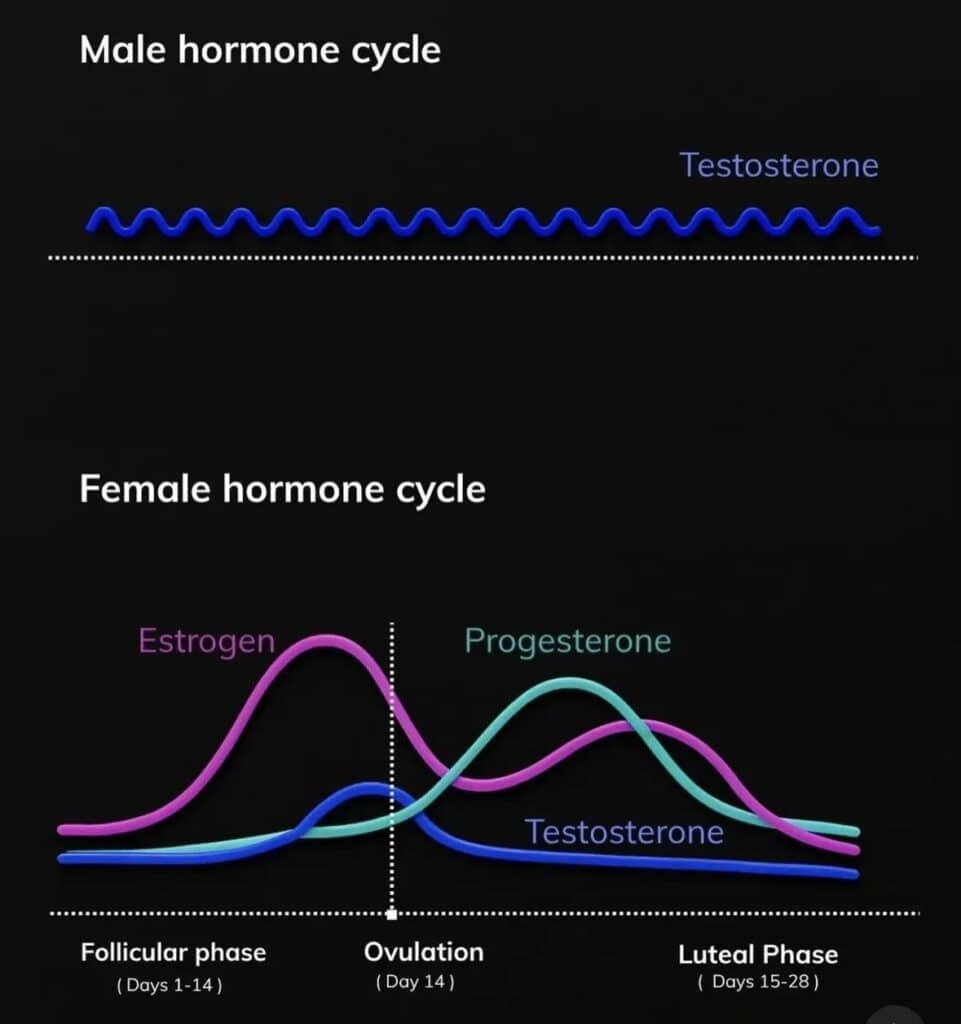
Men’s testosterone rides a gentle wave that resets every 24 hours. Women’s hormones? They’re on a month-long roller coaster with four distinct phases. Each brings completely different energy levels, focus abilities, and emotional landscapes.
Forcing ourselves to function on a 24-hour schedule when our bodies operate on a monthly? That’s the reason we feel depleted.
No wonder we feel like we’re failing.
The Real Problem: We’re Living Like We Have Male Hormones
Some days you wake up feeling unstoppable—creative, social, energized. You schedule all the meetings, say yes to all the plans, and wonder why you ever struggled with anything.
Then two weeks later, you can barely answer emails. You cancel plans and feel guilty for not producing at the same level. You wonder what’s wrong with you.
Nothing is wrong with you.
You’re just in a different phase of your cycle. Nobody taught you that each phase requires different things from you.
The corporate world was built around male hormone cycles. Most productivity advice was designed for people whose energy resets daily.
The “hustle culture” you’re trying to keep up with assumes your capacity stays consistent.
But your body is cyclical, not linear. And when you try to force linear productivity onto a cyclical system, you end up exhausted, frustrated, and blaming yourself.
This is where understanding your menstrual cycle becomes a powerful tool for nervous system regulation.
I spent years thinking I was lazy during the second half of my cycle. Turns out, I was just trying to operate like I had testosterone instead of estrogen and progesterone.
The solution isn’t to fix yourself. It’s to map your energy cycle and work with your hormones instead of against them.
Free Guide: Why Calming Down Doesn’t Work
(And What Finally Will)
You’re Not Broken. Your Body Is Protecting You.
Your inbox stays calm, too. Unsubscribe anytime. We respect your privacy.
Understanding Your Four Phases (And What They Mean for Your Nervous System)
Your menstrual cycle has four distinct phases, each unique. When you understand these phases, you can support your nervous system rather than pushing against your body’s natural rhythms.
Phase 1: Menstrual Phase (Days 1-5)
This is when your period starts. Both estrogen and progesterone are at their lowest levels.
Energy signature: Low to moderate energy, inward focus, need for rest and reflection.
Nervous system state: Your body is in a parasympathetic-dominant state. This is your natural reset time. You’re not supposed to be “on” right now. Your body is literally shedding and rebuilding, which requires soft and slow energy.
This is the phase for gentle movement, extra sleep, and saying no to non-essential demands.
I used to fight this phase so hard. I’d load up on caffeine and power through. Now I clear my schedule as much as possible during days 1-3 and honor what my body needs. My nervous system thanks me for it.
Phase 2: Follicular Phase (Days 6-14)
Estrogen starts rising, building toward ovulation. This is your “spring” season.
Energy signature: Rising energy, increased creativity, improved mood, more social desire.
Nervous system state: You’re moving into a more sympathetic-friendly state, but in a healthy, mobilized way. Your ventral vagal system is online. You feel safe, connected, and capable.
This is when you feel like your best self. You’re more optimistic, tasks feel easier, and you naturally want to connect with others. Your brain processes information faster, and you have more stamina for challenging work.
This is my favorite phase for starting new projects, having important conversations, and scheduling social activities. Everything just feels more possible.
Phase 3: Ovulation (Days 14-16)
Estrogen peaks right before ovulation. This is your absolute peak energy time.
Energy signature: Maximum energy, peak confidence, heightened communication skills, strongest libido.
Nervous system state: Your sympathetic nervous system is activated in the best way. You feel energized, not anxious. You’re in flow, connected, and magnetic.
This 2-3 day window is when you feel most magnetic, articulate, and capable. If you have something important to do—a presentation, a difficult conversation, a big creative push—schedule it here if possible.
I now schedule any recordings or important meetings, and anything requiring high energy during this window. The difference is night and day.
Phase 4: Luteal Phase (Days 17-28)
Progesterone rises while estrogen drops. This is your “autumn” season, preparing for either pregnancy or menstruation.
Energy signature: Gradually declining energy, more introverted, detail-oriented, need for completion and rest.
Nervous system state: You’re moving back toward parasympathetic dominance. Your body is preparing for menstruation, and that’s work. Pushing through this phase dysregulates your nervous system.
This phase gets divided into two parts. The early luteal phase (days 17-23) can still feel pretty good. You’re productive but more focused on completion than initiation. The late luteal phase (days 24-28) is when PMS symptoms can show up. Energy drops significantly, and you need way more rest.
This is the phase I used to beat myself up about. Why couldn’t I maintain my mid-cycle productivity? Because my body was preparing for menstruation, which is physiological work.
Now I schedule admin tasks, reflection time, and gentle activities during this phase. I also give myself permission to cancel plans when I’m in late luteal and my body is screaming for rest.

How To Use This To Your Advantage
Now that you have this overview of how the typical cycle flows, it’s time to track yours. You’ll can see where your energy is the highest, and when your body and nervous system deserve more comfort.
Step 1: Track Your Cycle
Before you can map your energy, you need data. And that means tracking.
Start with the basics: when does your period start? Count that as Day 1. A typical cycle is 28 days, but anywhere from 21-35 days is normal. Your cycle might not match the “textbook” phases exactly, and that’s okay.
For a complete cycle, track three things daily:
Energy levels: Rate your energy 1-10 each day. Morning, afternoon, and evening if you want to get detailed.
Mood and nervous system state: Are you feeling calm or anxious? Grounded or scattered? Connected or withdrawn?
Physical symptoms: Headaches, cramps, breast tenderness, skin changes, appetite shifts—all of these tell you where you are in your cycle.
You can use period tracking apps like Clue or Flo, or just keep notes in your phone or journal. I personally love my Moon Cycle Period tracker. It gives you a beautiful journal for tracking your cycle alongside the moon phases—more on that in a minute.
The goal isn’t perfection. The goal is noticing patterns.
Do you have tons of energy on days 8-15? Maybe you’ll notice anxiety and overwhelm every month around day 24. Or you might see that your creativity peaks right after your period ends.
This information is gold.
Step 2: Identify Your Personal Energy Patterns
After 2-3 months of tracking, patterns will emerge. Your cycle won’t look exactly like the textbook description, and that’s normal.
Some women feel their best energy in the follicular phase. Others find their luteal phase productive in a different way—less expansive, more focused. Some women have longer follicular phases and shorter luteal phases, or vice versa.
The point is to understand your unique rhythm, not to force yourself into someone else’s pattern.
Step 3: Adjust Your Life to Match Your Cycle (This Is Where the Magic Happens)
Here’s where most people get stuck. They start to see their patterns, but don’t actually change anything.
Cycle awareness without schedule adjustments is just interesting information. The transformation happens when you start planning your life around your phases.
From a nervous system perspective, this is huge. When you work with your cycle instead of against it, you stop constantly flooding your system with stress hormones. No more trying to push through low-energy phases. You create safety in your body.
Schedule Around Your High-Energy Phases
If you know days 8-17 are your power days, protect that time for your most important work. Schedule:
- Important meetings and presentations
- Creative projects and brainstorming
- Difficult conversations
- Social events and networking
- Starting new projects
- Job interviews or pitches
Don’t waste your peak energy on busywork or admin tasks you can do in a low-energy phase.
Honor Your Low-Energy Phases
If you know days 1-3 and days 24-28 are low energy, stop scheduling demanding activities during those windows. Instead:
- Build in rest days
- Schedule lighter workloads
- Batch simple tasks
- Plan solo time instead of social events
- Say no to non-essential commitments
- Allow for flexibility and cancellations
I used to feel guilty about needing to cancel plans during my late luteal phase. Now I just don’t schedule much during that week. Problem solved. My nervous system stays more regulated.

Step 4: Support Each Phase with Somatic Tools
Different phases need different support. What helps during ovulation might not help during menstruation.
This is where somatic and nervous system work really shine. Each phase benefits from specific practices:
Menstrual Phase (Days 1-5):
- Restorative yoga or gentle stretching
- Extra sleep and naps
- Warm baths and heating pads
- Grounding breathwork
- Nutritious comfort foods
- Minimal screen time
Follicular Phase (Days 6-14):
- Higher intensity workouts
- Creative brainstorming
- Social activities
- Starting new habits
- Energizing breathwork
- Foods that support rising estrogen
Ovulation (Days 14-16):
- Peak performance activities
- Important conversations
- Intense workouts or dance
- Socializing and connecting
- Power poses before big moments
- Foods that support detox
Luteal Phase (Days 17-28):
- Moderate exercise that doesn’t deplete
- Magnesium supplementation
- B-vitamins for PMS support
- Detail-oriented completion tasks
- Earlier bedtimes
- Calming nervous system practices
- Reduced caffeine and sugar
Having these tools ready for each phase means you’re supporting your body instead of fighting it.
Your Cycle + The Moon: A Deeper Layer of Wisdom
Here’s where it gets really interesting. Once you understand your menstrual cycle, you can layer in moon tracking.
The moon cycles through phases every 29.5 days—almost the same as your cycle. Now you don’t need to “sync” your period with the new moon or ovulation with the full moon to benefit. Tracking both rhythms together deepens your awareness.
In my Moon Cycle Period Tracker, I walk you through how to track both your body’s cycle and the moon’s cycle together. Here’s what you’ll notice:
- Your energy feels different when you’re menstruating during a new moon vs. a full moon
- Certain moon phases amplify your natural energy patterns
- Your intuition spikes during specific combinations of your cycle phase and the moon phase
This isn’t woo-woo. It’s simply paying attention to rhythms, both internal and external.
Your Cycle Is Your Superpower (Not Your Problem)
The biggest shift for me was realizing that my cycle isn’t something to overcome. It’s wisdom to harness.
Yes, it means I’m not the same person every day. But that’s actually an advantage.
I have a week every month when I’m ridiculously productive and creative. There’s a week when I’m detail-oriented and focused on completion. And finally, I have a week when I naturally turn inward for reflection and rest. Then there are those golden few days when I’m at my absolute peak.
Men don’t have that variety. They have steady-state energy that’s pretty similar day to day.
We have range. Different strengths available at different times. We have natural rhythms that, when honored, make us more effective. Not less.
The world told us our cycles make us inconsistent and unreliable. But what if they actually make us dynamic and adaptable?
Start Your Monthly Energy Mapping Journey
Your body has been trying to tell you something every month. It’s time to start listening.
Small changes compound. You don’t need to overhaul your entire life today.
Want support for your cycle mapping journey? Find out why your nervous system responds the way it does during each phase of your cycle. Knowing this allows you to with your body instead of against it.
Free Guide: Why Calming Down Doesn’t Work
(And What Finally Will)
You’re Not Broken. Your Body Is Protecting You.
Your inbox stays calm, too. Unsubscribe anytime. We respect your privacy.
Lasting Encouragement
You aren’t inconsistent or broken. It’s not that you’re lazy half the month.
You’re cyclical. And that’s exactly how you’re supposed to be.