
What Emotional Burnout Actually Feels Like (And What Your Body Is Trying to Tell You)
There’s a two-mile bridge between my home and the nearest town. It’s not dramatic. Not dangerous. But once you’re on it, there are no exits. No turnarounds. You commit.
One day, after pushing myself further than usual, going into stores I normally avoided, staying out longer than I felt comfortable, I found myself pulled over before the bridge. My hands were shaking. My vision narrowed. My mind started looping: What if I pass out? What if I cause a wreck?
But underneath that was something deeper. Something quieter and much heavier: What if I’m dangerous? What if I’m incapable? What if I can’t even handle something “normal” people do every day?
That was the real spiral. Because fear is one thing. Shame is another.
Emotional burnout is what happens when your nervous system has been carrying more than it was designed to hold for so long that it starts shutting down the parts of you that feel. Not because you’re broken, but because feeling takes energy your body no longer has. It’s different from regular tiredness. You can sleep for twelve hours and wake up just as depleted. Because the exhaustion isn’t physical. It’s cellular. It’s in the tissue.
The Part of Emotional Burnout Nobody Talks About
Most burnout content talks about the symptoms. The fatigue, the irritability, the brain fog. And those are real.
But emotional burnout has a layer underneath that rarely gets named: the shame of being burned out in the first place.
The voice that says: I should be past this by now. Other people handle more than this. What’s wrong with me?
That second spiral, the one about the first spiral, is the one that actually shrinks your world. It’s not the panic that did the damage. It was the meaning I assigned to the panic. The story that said: this proves you’re broken.
That second spiral shrank my world more than the first one ever did.
Before I had tools, I avoided town for two to three years. Avoidance feels safe. But it costs more than you think. It costs self-trust. It costs identity. It costs the belief that you are capable.
What Emotional Burnout Feels Like in Your Body
This isn’t a list of symptoms. This is what it actually feels like from the inside.
It feels like being behind glass. You’re watching your life happen. Dinner, bath time, bedtime stories. You’re there, but you’re not. Your body is present. Your emotional self checked out somewhere around 2pm and hasn’t come back.
It feels like your skin is on wrong. Everything is too loud, too bright, too much. The kid asking a question for the fourth time isn’t a kid asking a question. It’s sandpaper on a raw nerve. You know your reaction is disproportionate. That knowledge doesn’t help.
It feels like guilt on a loop. You snapped at your kid. You forgot the appointment. You haven’t called your mom back. You scrolled instead of being present. And then you feel guilty about feeling guilty, because even your self-awareness is exhausting.
It feels like a body that won’t cooperate. Your jaw aches. Your stomach is in knots. Your shoulders haven’t dropped below your ears in weeks. You keep getting headaches. Your immune system gives up every time your kid brings something home from school. Your body is spending all its resources on the internal emergency. Maintenance has been suspended.
It feels like nothing sounds good. Not the bath. Not the book. Not the show you used to love. Not even sleep, because your brain won’t stop scanning for what you forgot. The things that used to refill you don’t reach you anymore. Not because they don’t work. Because your tank has a hole in the bottom.
If this is describing your life a little too accurately, my free guide explains why burnout lives in the body (and what helps when rest isn’t enough).
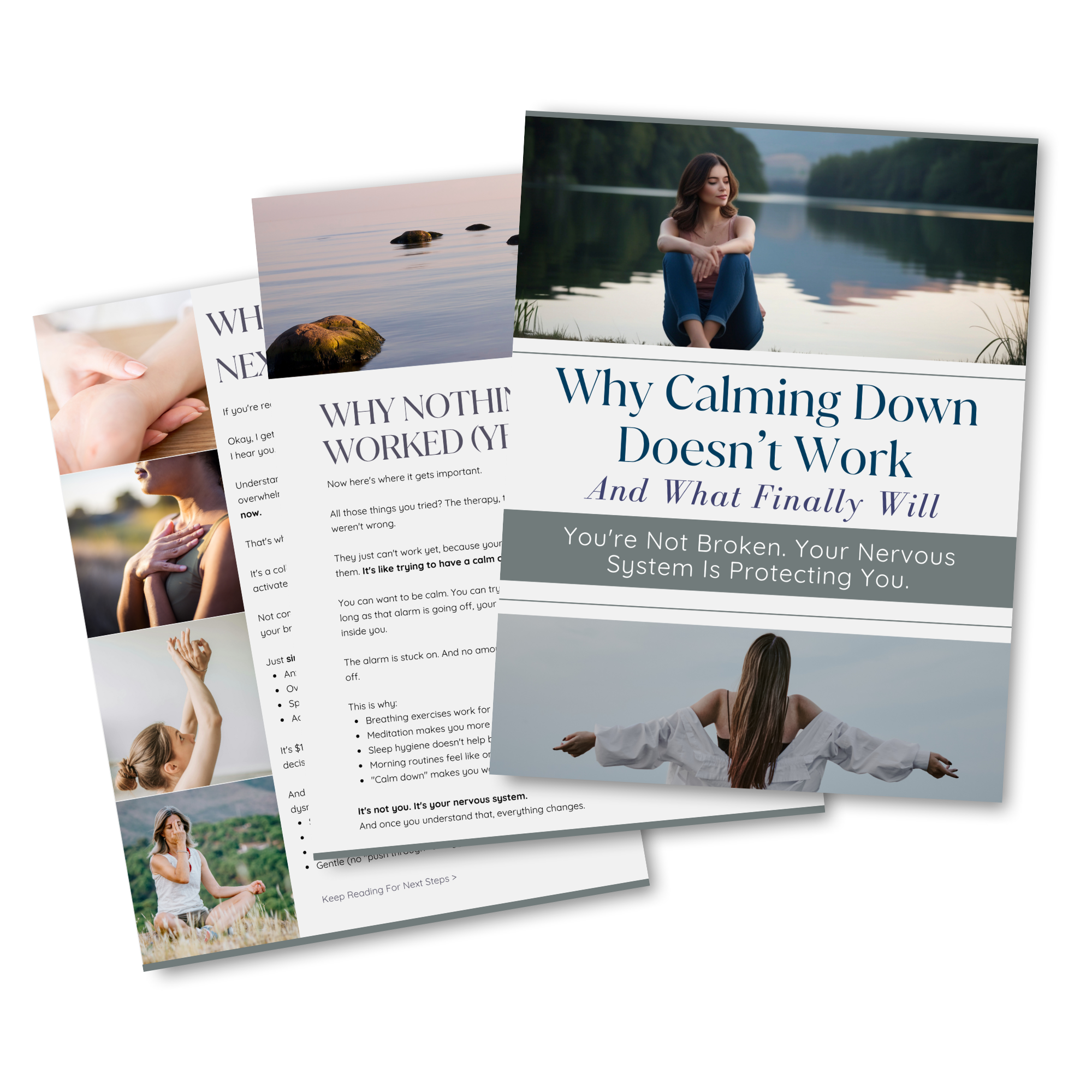
Free Guide: Why Calming Down Doesn’t Work
(And What Finally Will)
You’re Not Broken. Your Body Is Protecting You.
Your inbox stays calm, too. Unsubscribe anytime. We respect your privacy.
Why “Just Rest” Doesn’t Reach Emotional Burnout
When someone tells you to rest, they’re talking to the version of you that’s physically tired. Emotional burnout isn’t physical fatigue. It’s nervous system depletion.
Your body has been running in protection mode. Fight, flight, or freeze (and sometimes all three in the same afternoon). It’s been processing micro-threats all day: the mental load, the kid dynamics, the relationship work, the financial math you do in the shower.
Rest assumes your body knows how to receive it. When you’re emotionally burned out, your nervous system doesn’t trust rest. It reads stillness as exposure. As vulnerability. As one more place where something could go wrong.
That’s why you can have a free evening, a quiet house, and two hours to yourself, and spend the whole time scrolling your phone without registering a single thing you saw. Your body is protecting you from being present, because being present costs energy you don’t have.
I grab my phone and scroll and 30 minutes passes by and I didn’t even realize what I was doing. It’s a protective pattern. Not something to blame yourself for. But a pattern to understand.
What Your Body Is Actually Trying to Tell You About Emotional Burnout
Emotional burnout isn’t a failure of willpower, discipline, or gratitude. It’s a signal.
Your body is telling you that the load exceeded capacity a long time ago, and the system that’s supposed to process it (your autonomic nervous system) ran out of resources.
Every symptom makes sense when you understand what it is:
- The numbness is conservation. Your body is shutting down non-essential functions to protect vital ones.
- The irritability is a system on high alert with no reserves. Everything registers as urgent because your nervous system can’t differentiate anymore.
- The guilt is your brain trying to make sense of why you can’t perform the way you used to. It finds the easiest explanation: something is wrong with you.
- The physical symptoms are cortisol and adrenaline doing exactly what they were designed to do, just for way too long.
Nothing is broken. Everything is doing its job. The job just needs to change.
Coming Back From Emotional Burnout
Recovery from emotional burnout doesn’t start with doing more. It starts with giving your body a different kind of input.
Not a new routine. Not a 30-day challenge. One practice that helps your nervous system feel something other than emergency.
A physiological sigh in the car. A crossbody tap while waiting for the coffee. Ten seconds of deliberately relaxing your toes under the table. These aren’t coping mechanisms. They’re signals to a system that’s forgotten what safety feels like.
I didn’t override my body. I collaborated with it. And at the end of that day, I didn’t feel heroic. I felt trustworthy. That was new.
You don’t have to heal all at once. You don’t have to figure out why you’re here or how you got this way or what needs to change. You just have to give your body one small moment today where it’s allowed to feel something other than on.
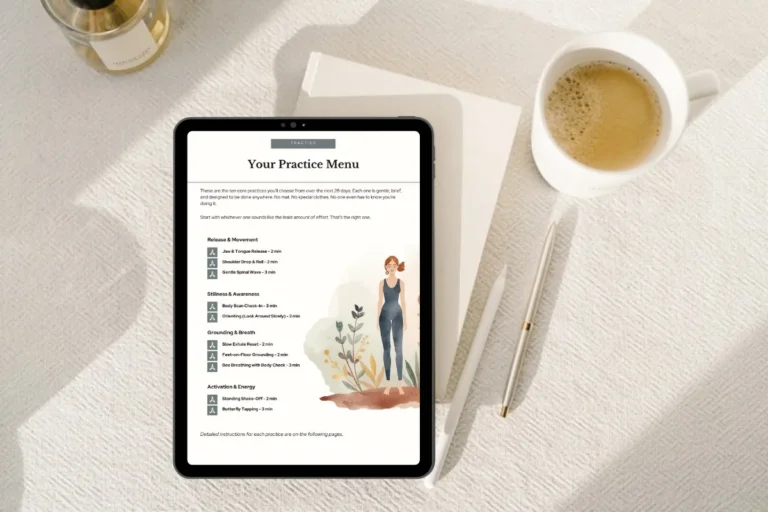
The Somatic Starter Kit is a good place to begin. It’s free. It’s five minutes. And it works with your body instead of asking your brain to push through one more thing.
The Part That Surprised Me
Here’s what nobody tells you about the other side of emotional burnout:
What looked like collapse was integration.
The season that felt like falling apart was actually the season where I processed emotions I’d buried for decades. The panic on the bridge. The shame about needing help. The grief of realizing I couldn’t do what I used to do.
That processing didn’t feel like healing. It felt like crumbling. But it made my marriage stronger. It made me more honest with my children. It made me stop performing capability I didn’t have and start building the real thing, slowly, from a place that was actually true.
So if you’re in the middle of it right now, if this whole post felt like reading a page from your own journal, I want you to know:
What’s happening is not proof that something is wrong with you. It’s your body finally processing what it’s been carrying. And that is different from breaking down. Even when it feels exactly the same.
That’s it. That’s what nobody tells you.
Related posts:
- Your Burnout Recovery Plan: A Somatic Approach (when you’re ready for next steps)
- 9 Signs of Burnout You Should Know (the signals your body is sending)
- The 3-Day Burnout Recovery Guide for Moms (tiny tools that work in the cracks of real life)
- 3 Easy Everyday Practices That Help Regulate Your Nervous System (body-first tools for daily use)
And if you’re too tired to figure out the next step, I made it small: grab Why You Can’t Calm Down below.
Free Guide: Why Calming Down Doesn’t Work
(And What Finally Will)
You’re Not Broken. Your Body Is Protecting You.
Your inbox stays calm, too. Unsubscribe anytime. We respect your privacy.