

The 3-Day Burnout Recovery Guide for Moms Who Can’t Just “Rest”
You finally get the kids down. The house is quiet. You have maybe an hour before you collapse into bed yourself.
Someone on the internet says the answer to burnout is rest. Take a bath. Light a candle. Practice self-care.
So you sit on the couch. And your body won’t stop humming. Your brain starts the list. The lunches, the laundry, the appointment you forgot to reschedule. The thing your kid said at dinner that you should probably circle back on. An email you haven’t answered in four days.
You’re not resting. You’re sitting still while your nervous system runs laps.
Mom burnout recovery isn’t about finding more time to rest. It’s about helping your nervous system trust that it’s actually safe to slow down, even when everything around you keeps moving. That takes body-based tools, not bubble baths. And it takes a lot less time than you think.
This 3-day guide is simple and doesn’t take a getaway. It’s a handful of tiny shifts you can do in the cracks of your actual day, while the kids are eating breakfast, in the car at pickup, after the house goes quiet. Three days. A few minutes each.
Before You Start Your Mom Burnout Recovery
A couple things.
If you only do one thing from one day, that counts. This isn’t a checklist to complete. It’s an experiment to try.
Also, none of these require silence, privacy, or a locked bathroom door. They work in the kitchen. In the car. At the table while someone is telling you about Minecraft for the fourteenth time today.
Basic is the point.
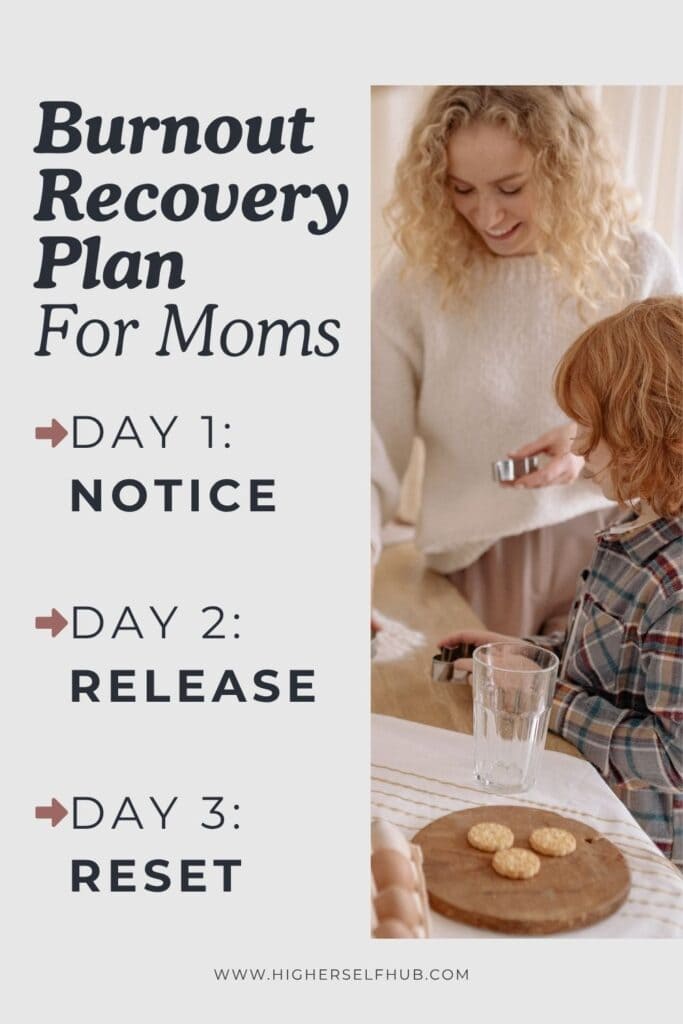
Day 1: Notice
Today isn’t about fixing anything. It’s about paying attention.
Mom burnout lives in the body. But most of the time, you’re so busy managing everything else that you don’t notice what your body is actually doing. Day 1 is about noticing.
Practice 1: The Body Check-In (30 seconds, 3 times today)
Pick three moments that already exist in your day. Waiting for coffee to brew. Sitting in the car before going inside. The 30 seconds after you put the kids to bed.
In that moment, ask yourself three questions:
- Where am I holding tension right now?
- Is my jaw clenched?
- Are my shoulders near my ears?
Don’t fix it. Just notice. That’s the whole practice.
Your autonomic nervous system processes signals in as little as 80 milliseconds (Porges, Polyvagal Theory). It’s been holding tension all day and you probably didn’t know. Just noticing starts to change the relationship.
If noticing is new for you (or if you noticed tension in places you didn’t expect), the Somatic Starter Kit walks you through what to do with what you’re feeling. It’s free, it takes five minutes, and it’s designed for days when you don’t have the bandwidth for anything complicated.
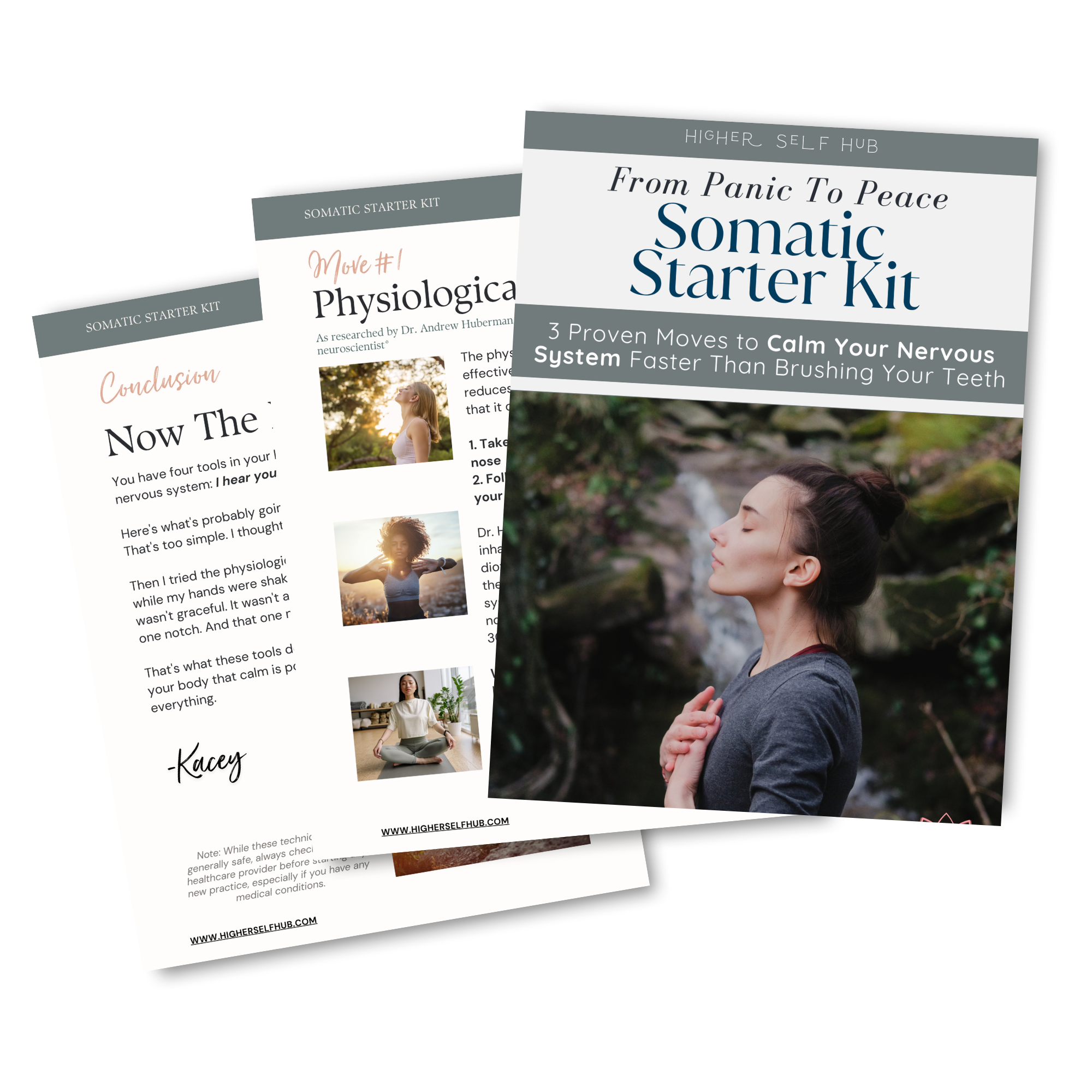
Your Free Somatic Starter Kit
3 science-backed tools to go from panic to peace in under 60 seconds.
Your inbox stays calm, too. Unsubscribe anytime. We respect your privacy.
Practice 2: Name What’s True (10 seconds)
When the mental spiral starts, ground yourself with the simplest awareness check:
It’s Wednesday evening. My feet are on the kitchen floor. The dishes are done. The kids are in bed.
Not affirmations. Not positive thinking. Just what’s true right now. This brings your prefrontal cortex back online so you can think clearly instead of reactively.
Day 2: Release
Yesterday you noticed. Today you give your body permission to let something go.
Practice 1: The Physiological Sigh (60 seconds, do it twice today)
One inhale through your nose. A second small sip of air. Then a long, slow exhale through your mouth.
Research from Stanford Medicine shows that extended exhale breathing activates the parasympathetic nervous system within 90 seconds. You can literally feel the shift. Not dramatic. Not magic. Just a notch down from where you were.
Do it once in the morning before the kids wake up. Once at night after they’re down. Those are your two windows.
Practice 2: The Reset Walk (5 minutes)
Not a workout. Not a power walk. Just walking. Outside if you can, even if it’s just to the mailbox and back.
Mom needs a reset. I’m going to go outside and walk. No expectations on it solving everything. But it does reset my nervous system.
If you can’t go outside, walk around the house. The movement itself is what completes the stress cycle. Your body needs to physically move through what it’s been holding.
If your kids are awake, bring them. Tell them “we’re all doing a reset.” That language matters more than you think. You’re teaching them that regulation is normal, not something you sneak away to do.
Practice 3: Let Your Toes Go (10 seconds)
This might be the simplest tool in the whole guide. When everything feels clenched and tight and you don’t know where to start, relax just your toes.
Not your whole body. Not your jaw. Just your toes.
It sounds small. It is small. That’s why it works on the days when everything else feels impossible.
Day 3: Reset
You noticed. You released. Today you decide what you’re keeping.
Practice 1: Build Your Calm Toolkit
Look back at the last two days. Which practice felt the most accessible? Which one did you actually do?
The Calm Toolkit is just your 2-3 go-to practices. The ones you’ll reach for in a hard moment without having to think about it. Not the ones that sound impressive. The ones that felt doable.
Write them on a sticky note and put it somewhere you’ll see it. The bathroom mirror. The kitchen cabinet. Or the car dashboard. When your brain is in burnout mode, it can’t think of the basic things. Having them in front of you is the whole point.
When your mind is spiraling, you can’t think of the basic things. That’s why you need them in front of you.
Practice 2: The One-Minute Family Reset
If you have kids, try this today: when things start to escalate (a tantrum, a meltdown, your own rising frustration), pause and say, “Do you want to reset?”
It doesn’t have to be fancy. A reset can be a 5-minute walk. It can be everyone sitting on the floor and taking three breaths. It can be going outside and looking at the sky.
It helps every time with my kids. Literally every time. If we can just go for a five-minute walk, it resets their whole nervous system. And they’re starting to recognize it now and doing it on their own.
This practice isn’t just for them. It’s for you. And it’s building something bigger than a coping strategy. It’s building a calm home. A different pattern. A new default.
Practice 3: Choose One Anchor Moment
Pick one moment in your day that will become your regulation checkpoint. Every day. Not a big commitment. Just one breath, one body check-in, one 10-second toe release.
The moment you already picked from Day 1 works perfectly. Coffee brewing. Car at pickup. Kids in bed.
That’s your anchor. One moment. One practice. Every day.
What Comes After Your 3-Day Mom Burnout Recovery
This guide isn’t designed to “cure” burnout recovery. Three days can’t undo months or years of running on empty.
But three days can prove something to your nervous system: that safety is available. That rest isn’t dangerous. That you can pause for 60 seconds and the world doesn’t fall apart.
That proof matters more than any protocol.
If you want to keep going, the Somatic Starter Kit is free and it walks you through the basics of body-based nervous system work. It’s the thing I wish someone had handed me on one of those nights where I was sitting on the couch, too tired to move but too wired to sleep.
Your Free Somatic Starter Kit
3 science-backed tools to go from panic to peace in under 60 seconds.
Your inbox stays calm, too. Unsubscribe anytime. We respect your privacy.
Perfect Recovery Not Required
It’s alright if you forget Day 2 entirely. You might do the body check-in once and then get pulled into a tantrum and a spilled smoothie and forget the rest.
That’s fine. It’s real life. It’s the joy of being a mom.
Come back to this when you can. It’ll still be here.
And if this post reminded you of someone who needs to hear that she’s not failing at resting (she’s running a nervous system that hasn’t felt safe enough to stop), send it to her.
You know who she is.
📌 Save This For Later
Related posts:
- Your Burnout Recovery Plan: A Somatic Approach That Actually Works (the full roadmap)
- 9 Signs of Burnout You Should Know (before you can recover, you have to recognize it)
- 21 Vagus Nerve Exercises You Can Do in 60 Seconds (more tools for the cracks in your day)