
How to Reset Your Vagus Nerve When You Can’t Sleep
It’s 2 AM and you’re wide awake.
Again.
You’ve tried all the things. The breathing exercises that made you more alert. The progressive muscle relaxation that just reminded you how tense you are. The meditation app that kept you focused on not falling asleep, which of course meant you definitely didn’t fall asleep.
And now you’re lying there, exhausted but wired, wondering what’s wrong with you.
Here’s what I wish someone had told me years ago: insomnia isn’t always a sleep problem. Sometimes it’s a nervous system problem.

A vagus nerve reset for sleep is a set of gentle, body-based practices that help shift your nervous system out of its stress response so your body feels safe enough to rest. It’s not about forcing yourself to relax. It’s about giving your system the signals it needs to stop scanning for danger and start winding down.
When your body doesn’t feel safe enough to let go, no amount of “sleep hygiene” or lavender oil is going to override that. Your system is doing exactly what it’s designed to do — staying alert to keep you protected. The issue is, it’s protecting you from threats that aren’t actually there.
What Insomnia Has to Do With Your Vagus Nerve
Your vagus nerve is the main pathway between your brain and the rest of your body. It’s constantly sending messages back and forth, assessing whether it’s safe to rest or whether you need to stay on guard.
When you’re stuck in a stress response, even a low-grade one you’ve gotten so used to you barely notice, your vagus nerve stays in “alert mode.” That means your heart rate stays slightly elevated, your breathing stays shallow, and your brain keeps scanning for problems.
In other words, your body thinks it’s not safe to sleep yet.

This can happen even when you’re objectively exhausted. Even when your day was fine. Even when there’s no logical reason you should be awake right now.
The good news is that you can work with your vagus nerve instead of fighting against it. You’re not trying to force yourself to relax. You’re just offering your system some information that might help it feel safe enough to let go.
5 Vagus Nerve Resets You Can Do in Bed
These aren’t sleep tricks. They’re somatic practices that help shift your nervous system out of vigilance and into a state where rest becomes possible. You might not fall asleep immediately, and that’s okay. Even supporting your system in this way counts.
1. The Longer Exhale

This one is everywhere for a reason: it actually works.
Lie on your back or your side, whichever feels more comfortable. Breathe in through your nose for a count of four. Then breathe out through your mouth for a count of six or eight.
The key here is making your exhale longer than your inhale. That activates the parasympathetic nervous system (the “rest and digest” mode) and signals to your vagus nerve that there’s no emergency happening.
You don’t need to do this for twenty minutes. Even five rounds can help.
2. Gentle Neck Turns

Tension in your neck can keep your vagus nerve stuck in a stress response, since it runs right through that area.
While lying down, slowly turn your head to the right and let it rest there for 30 seconds or so. Then bring it back to center, and turn it to the left. Move slowly — this isn’t a stretch, it’s a release.
Some people feel a shift pretty quickly. Others don’t feel much at all. Both are fine. You’re not doing it wrong if nothing dramatic happens.
3. Place Your Hand on Your Chest

This one sounds too simple to work, but your nervous system responds to touch, especially self-touch that mimics comfort.
Put one hand flat on your chest, right over your heart. You can leave it there or add a slow, circular motion. The warmth and pressure send a signal that you’re being cared for, which can help your system soften out of hypervigilance.
If it feels awkward or doesn’t do much for you, that’s information too. Not every tool works for every body.
I spent years cycling through the same handful of techniques that every article recommends. Deep breathing. White noise machines. Melatonin. And when those didn’t work, I’d lie there wondering if something was fundamentally wrong with me. It wasn’t until I stopped trying to fix my sleep and started working with my nervous system that anything actually shifted. I put everything I learned into a free guide called Why Calming Down Doesn’t Work (And What to Do Instead). It’s not a sleep hack. It’s a different way of understanding what’s actually happening in your body at 2 AM.
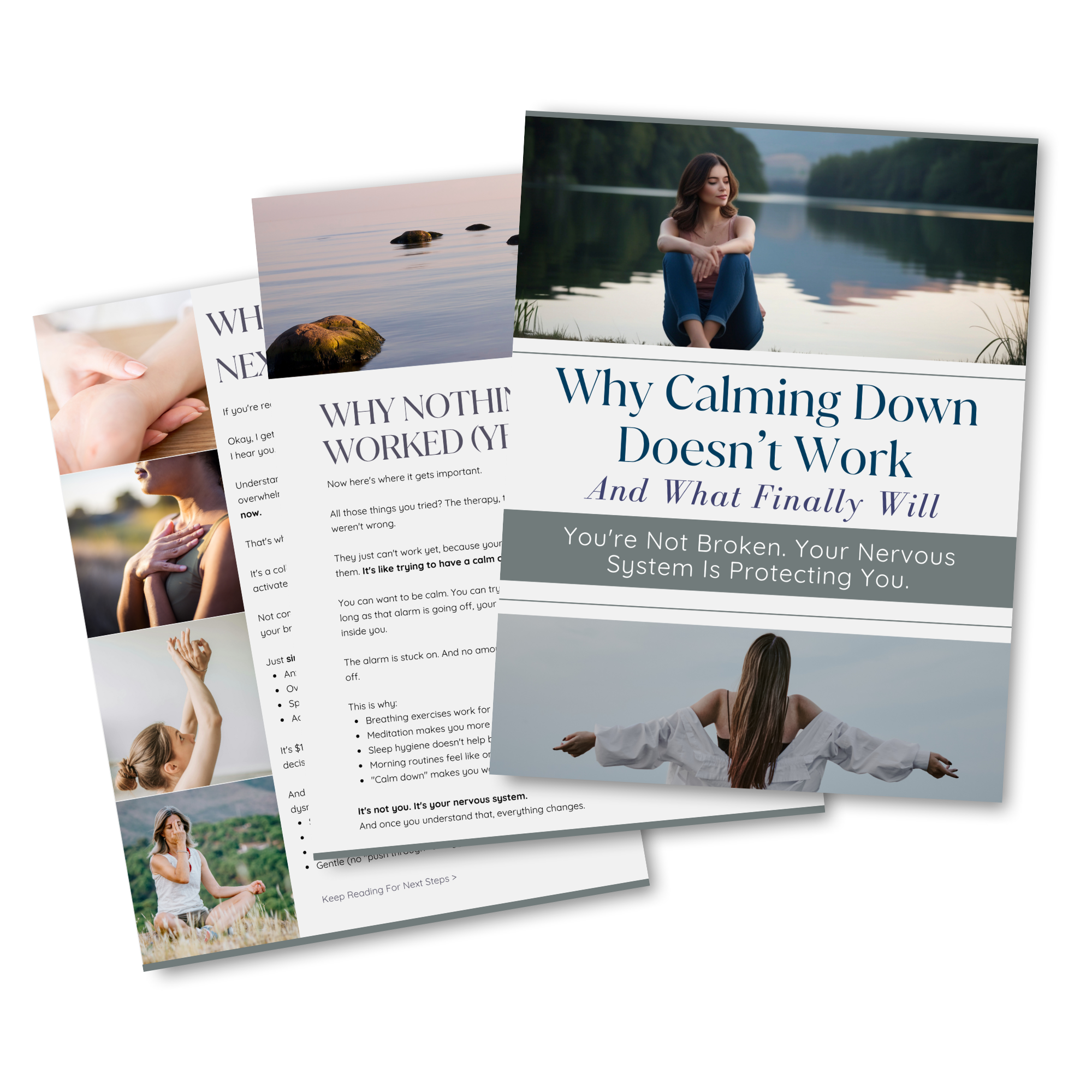
Free Guide: Why Calming Down Doesn’t Work
(And What Finally Will)
You’re Not Broken. Your Body Is Protecting You.
Your inbox stays calm, too. Unsubscribe anytime. We respect your privacy.
4. Hum Into Your Pillow

Remember how humming stimulates the vagus nerve? It works at night, too.
You don’t need to hum loudly. Just make a quiet “mmmmm” sound into your pillow for a few seconds. The vibration in your throat and chest can help shift your system toward calm without requiring you to get up or do anything complicated.
Honestly, it might feel ridiculous. Do it anyway.
5. Let Your Body Be Heavy

This isn’t a visualization. It’s a somatic practice.
Instead of trying to relax, just notice where your body is making contact with the bed. Feel the weight of your legs sinking into the mattress. Your back, your shoulders, your head. Let gravity do its thing.
Sometimes when we’re trying too hard to fall asleep, we’re actually holding ourselves in readiness without realizing it. Letting yourself be heavy — really feeling the support beneath you — can help undo that.
What to Do When Nothing Seems to Help
If you’ve been lying there for a while and these practices aren’t shifting anything, you’re not broken.
Sometimes your nervous system needs more than one night to recalibrate. Sometimes it needs you to get up, move to a different room, and do something gentle (not stimulating) for a bit before trying again. Sometimes it just needs you to stop fighting it.
This video is only a couple minutes and walks you through three very specific practices that are great for sleeping better (and breathing better while you do).

Here’s what I want to be honest about, though. Most of what you’ve probably tried before for sleep falls into two categories:
The “sleep hygiene” list that you could recite from memory at this point. No screens before bed. Cool room. Consistent bedtime. Lavender on your pillow. You’ve done all of it. It helps a little, sometimes. But it doesn’t touch the thing underneath.
The “relaxation technique” grab bag. Progressive muscle relaxation that just made you more aware of how tense you are. Guided meditations where the narrator’s voice was somehow both soothing and irritating. Apps that gamify sleep like it’s something you can win at.
None of those are bad. They’re just not designed for a nervous system that’s stuck in protection mode. They’re treating sleep like a behavior problem when it’s actually a safety problem.
The practices in this post are different because they’re not trying to force your body to do anything. They’re offering the information. That’s a subtle shift, but it’s the one that finally made a difference for me.
Save This For Later
You’re Not Doing Rest Wrong
If the breathing apps and the melatonin and the “no screens after 9 PM” rule haven’t fixed this for you, it’s not because you’re doing rest wrong. It’s because those tools are designed for a nervous system that already feels safe. Yours might not. Not yet.
That doesn’t mean something is broken. It means the approach needs to match what’s actually happening in your body, not just what’s happening on the surface.
I created a free guide called Why Calming Down Doesn’t Work (And What to Do Instead) for exactly this. Not because calming down is bad. But when your system is stuck in overdrive, the standard advice can actually make it worse. This guide explains why, and walks you through what to do instead. No email course. No 30-day program. Just a short guide you can read tonight.
Free Guide: Why Calming Down Doesn’t Work
(And What Finally Will)
You’re Not Broken. Your Body Is Protecting You.
Your inbox stays calm, too. Unsubscribe anytime. We respect your privacy.