

How to Build a Calm Morning Routine That Actually Regulates Your Nervous System
Some mornings your body is already running before your feet even touch the floor. Jaw tight, shoulders pulled up toward your ears, brain three hours ahead of where you actually are. You haven’t done anything wrong. You haven’t even gotten out of bed yet. But your nervous system is already sprinting.
And then the usual advice shows up: wake up earlier, meditate for 20 minutes, journal three pages, drink warm lemon water, exercise before the sun comes up. All of it sounds nice. None of it addresses what’s actually happening in your body.
A calm morning routine isn’t about adding more things to your morning. It’s a simple set of body-based practices that help regulate your nervous system before productivity even enters the picture.
That’s what makes it different from every checklist you’ve tried before.
Because here’s the thing most morning routine advice skips over entirely.
Why Most Morning Routines Don’t Work (And What’s Actually Going On)
Your nervous system doesn’t reset overnight. If you went to bed carrying tension, unresolved conversations, a to-do list that followed you under the covers, your body wakes up where it left off. Not refreshed. Not calm. Just… continuing.
On top of that, cortisol naturally peaks in the first 30 to 60 minutes after waking.
It’s called the cortisol awakening response, and it’s completely normal.
However, for someone whose nervous system is already running a little hot, that natural cortisol spike can feel like waking up in fight-or-flight. Heart already pounding. Thoughts already racing. Body already bracing.
So when you try to stack a productivity-based morning routine on top of an activated nervous system, you’re essentially asking your body to perform while it’s still in protection mode. Your prefrontal cortex (the part of your brain that plans, organizes, and makes decisions) is partially offline. Instead, your amygdala is running the show, scanning for threats, keeping you reactive instead of responsive.
That’s why the most effective calm morning routine doesn’t start with what you do. It starts with helping your body feel safe enough to be present.
If you want to understand more about why calming down doesn’t always work (and what does), I break it all down in this free guide: Why Calming Down Doesn’t Work (And What Finally Will)
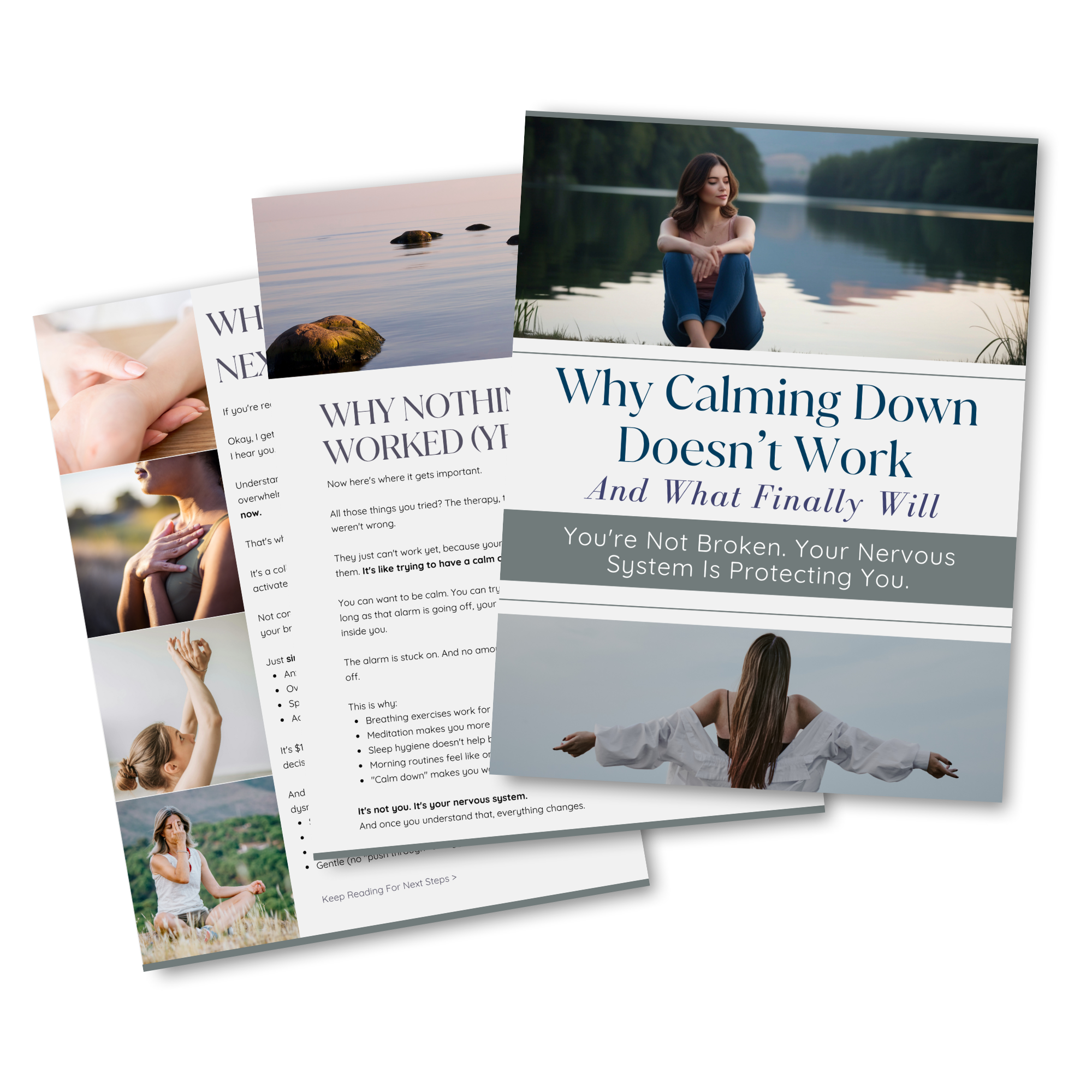
Free Guide: Why Calming Down Doesn’t Work
(And What Finally Will)
You’re Not Broken. Your Body Is Protecting You.
Your inbox stays calm, too. Unsubscribe anytime. We respect your privacy.
5 Body-Based Practices for a Calm Morning Routine
Pick one. Seriously, just one. If your nervous system is already running hot, the last thing it needs is a five-step program. Whichever one makes you think that sounds easy enough, go with that.
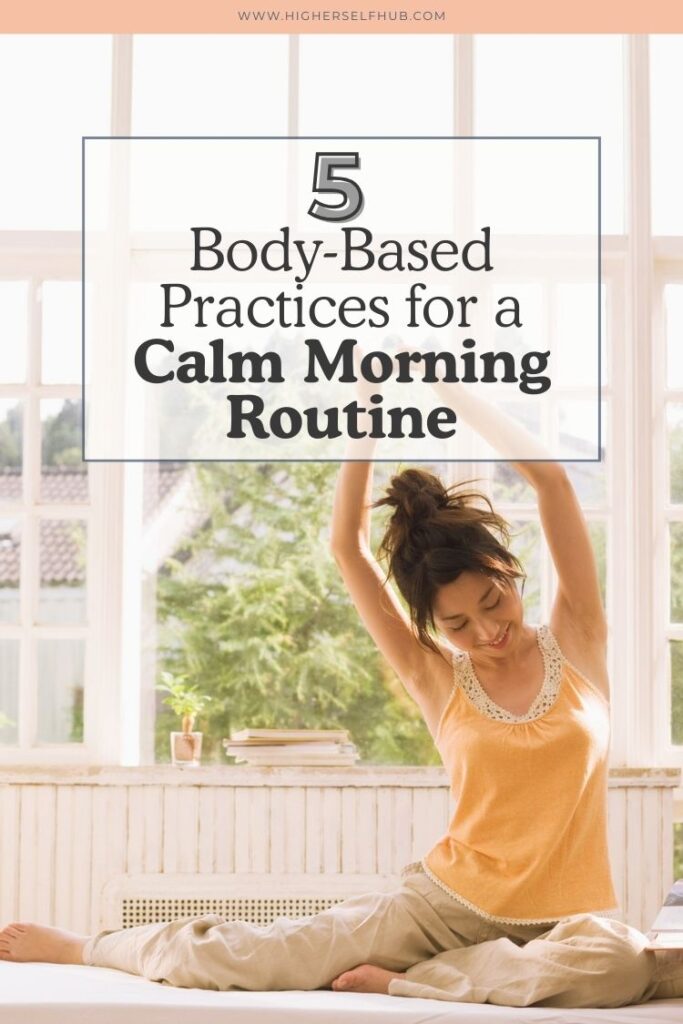
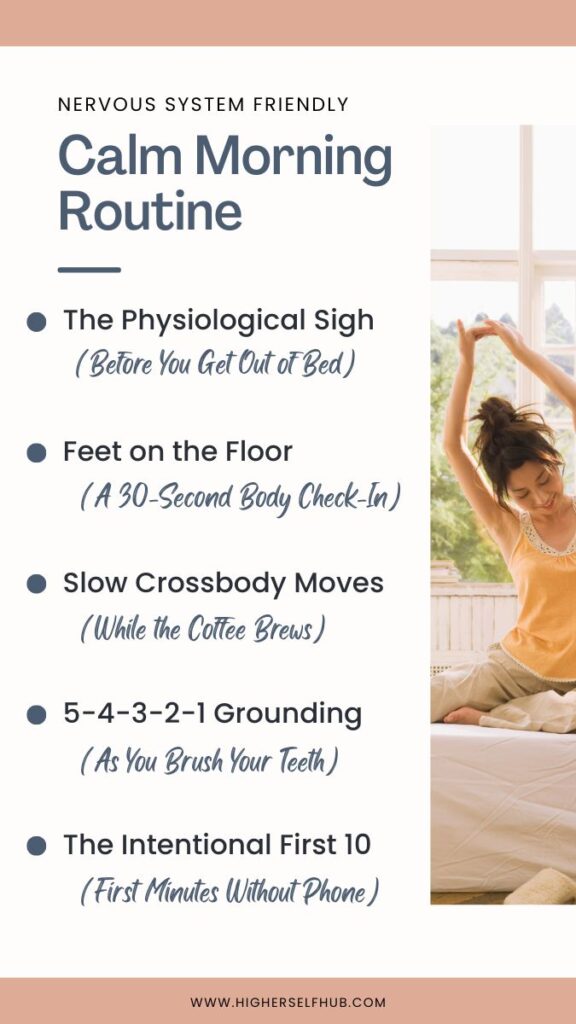
1. The Physiological Sigh (Before You Get Out of Bed)
This is one of the fastest ways to shift your nervous system from activated to regulated. One inhale through your nose, then a small sip of extra air in through your nose, followed by a long, slow exhale through your mouth.
It takes about 10 seconds. You can do it while still lying down, eyes still closed.
What’s happening: that double inhale followed by the extended exhale activates your parasympathetic nervous system. Research from Stanford’s Huberman Lab found that even a single physiological sigh can lower heart rate and cortisol more effectively than several minutes of mindfulness meditation.
Try it once. Then notice if anything shifts. Not a dramatic shift. Just a softening. That’s enough.
2. Feet on the Floor (A 30-Second Body Check-In)
Before you reach for your phone, before you start running through the day, put both feet flat on the floor and feel the ground.
Then do a quick body scan. Not a long, formal meditation. Just a check-in.
Where are you tight? Jaw? Shoulders? Fists? Stomach?
You don’t have to fix anything. Just notice. Noticing pulls you out of your head and back into your body. It tells your nervous system: I’m here. Not in the past. Not in the future. Right here, right now.
This simple grounding practice can interrupt the cortisol-driven spiral before it picks up speed.
3. Slow Crossbody Movement (2 Minutes While the Coffee Brews)
Stand in your kitchen and gently swing your arms across your body, letting your torso rotate left and right. In yoga, this is sometimes called “knocking on heaven’s door.” It’s one of the simplest somatic exercises you can do.
Here’s why it works: when your nervous system is activated, your prefrontal cortex partially goes offline. Crossbody movement helps re-engage both hemispheres of the brain, bringing your thinking brain back online so you can move through your morning with intention instead of reactivity.
This doesn’t require a yoga mat or workout clothes. You just need two minutes and a little bit of floor space. The coffee can brew while you swing.

4. The 5-4-3-2-1 Grounding (As You Brush Your Teeth)
This one layers beautifully onto something you’re already doing: brushing your teeth.
While your hands are busy brushing, name:
- 5 things you can see
- 4 things you can feel
- 3 things you can hear
- 2 things you can smell
- 1 thing you can taste
This practice anchors your awareness in the present moment. For a nervous system that wakes up already three hours ahead, it’s a gentle way of saying: not yet. We’re here first.
Often, the simplest grounding techniques are the most effective ones because they don’t require anything extra. Just awareness of what’s already around you.
5. The Intentional First 10 Minutes (No Phone)
This isn’t about productivity. It’s about giving your nervous system a buffer zone before the world rushes in.
For the first 10 minutes after waking, don’t check your phone. Not even email. Definitely not the news. Even social media. Not the weather. Nothing that asks your brain to process, react, or respond.
Instead, let those 10 minutes be sensory. Feel the blankets. Hear the house. Smell the coffee. Move slowly.
What you’re doing is allowing your nervous system to complete its natural wake-up process without flooding it with external stimulation. Most people skip this entirely, which is why so many mornings feel like they start at full speed. A calm morning routine protects that transition window.
What a Calm Morning Routine Actually Looks Like (Realistically)
Here’s what it doesn’t look like: waking up at 5 a.m. in matching pajamas, sitting in a beam of sunlight journaling for 30 minutes before a green smoothie and a 45-minute workout.
Here’s what it actually looks like:
You wake up. Your jaw is tight. You do a physiological sigh before your eyes fully open. You sit up, put your feet on the floor, and notice where you’re holding tension. You walk to the kitchen, swing your arms a little while the coffee brews, and hold your mug with both hands while you name five things you can see.
Total time: maybe 7 minutes. Probably less.
That’s a calm morning routine. Not a production. Not a performance. Just a few body-based moments that tell your nervous system it’s safe to be here before the day takes over.
If tracking which practices help you feel steadiest sounds useful, a simple morning routine tracker can make that easier. Not a gold-star system. Just a quiet way to notice what works on good days and hard days alike.
You Don’t Have to Overhaul Your Mornings
There’s a version of morning routine advice that says you need to restructure your entire life. Wake earlier. Sleep differently. Become a morning person. Build an elaborate system.
This isn’t that.
A calm morning routine is not about adding more. It’s about adding less with more intention. One practice. Two minutes. Before the world gets loud.
Your nervous system sets the tone for your entire day. And the research supports this: a 2020 study published in Psychoneuroendocrinology found that the first 30 minutes after waking have a disproportionate impact on stress reactivity throughout the rest of the day. What you do in those first few minutes matters more than what you do in the next three hours.
So start small. Start with one practice. Notice what shifts.
That’s it. Five things. None of them require waking up earlier.
📌 Save This For Later
Want to Go Deeper?
If you want to understand more about why calming down doesn’t always work (and what does), I put together a free guide that breaks it all down: Why Calming Down Doesn’t Work (And What Finally Will)
Free Guide: Why Calming Down Doesn’t Work
(And What Finally Will)
You’re Not Broken. Your Body Is Protecting You.
Your inbox stays calm, too. Unsubscribe anytime. We respect your privacy.