The Holistic Healing Practices That Actually Changed How I Feel in My Body
Some mornings you wake up and your body is already bracing. Shoulders pinched, jaw locked, a headache forming behind your eyes before the coffee is even ready. You haven’t done anything yet. But your body is acting like the day already happened. And that pattern is exactly where holistic healing begins.
So you do what you always do. Push through. Get the kids ready. Answer the emails. Ignore the tension because stopping isn’t really an option.
Why Most Wellness Advice Doesn’t Address Holistic Healing
Maybe you’ve tried things. A supplement someone swore by. The meditation app that made you more anxious. Some wellness trend that felt good for a week and then faded. None of it stuck because none of it addressed what was actually going on underneath.
That’s where holistic healing comes in. Not the crystals-and-sage version you might picture. The real version. Holistic healing is an approach to health that treats the whole person, body, mind, and nervous system, rather than chasing individual symptoms in isolation. It’s the difference between taking a pill for a headache and asking why your body keeps producing headaches in the first place.
I came to holistic healing out of desperation, not curiosity. After a traumatic brain injury in 2005, I spent three years in the conventional medical system. I was 21 years old, popping seven pills a day. One for migraines. Another for the anxiety the migraine medication caused. A third for the acid reflux the anxiety medication caused. Around and around.
I wasn’t getting better. I was getting more medicated.
When a friend handed me feverfew tea and it did more for my migraines than a $25 pill that made me nauseous, something clicked. There had to be a better way. There was. It just looked nothing like what the specialists were offering.
Here are the holistic healing practices that actually changed how I feel in my body. Not the trendy ones. The ones I still use on hard days.
7 Body-Based Holistic Healing Practices
These are the practices that taught me my body isn’t just along for the ride. It’s running the show. When I started working with it instead of trying to think my way out of everything, that’s when things actually shifted.
A holistic lifestyle isn’t a destination. It’s a relationship with your body that you keep showing up for.
1. The Physiological Sigh
One inhale through your nose. Another small sip of air in through your nose. Then a long, slow exhale out through your mouth. That’s it.
I learned this from Andrew Huberman and it’s the single most effective physical shift I’ve found. Not a magic pill (because none of these are). But it creates a pattern I can feel in my body of going from highly sensitized to something closer to calm. I do this in the car, in waiting rooms, standing in the kitchen when everything feels like too much.
2. Crossbody Movement
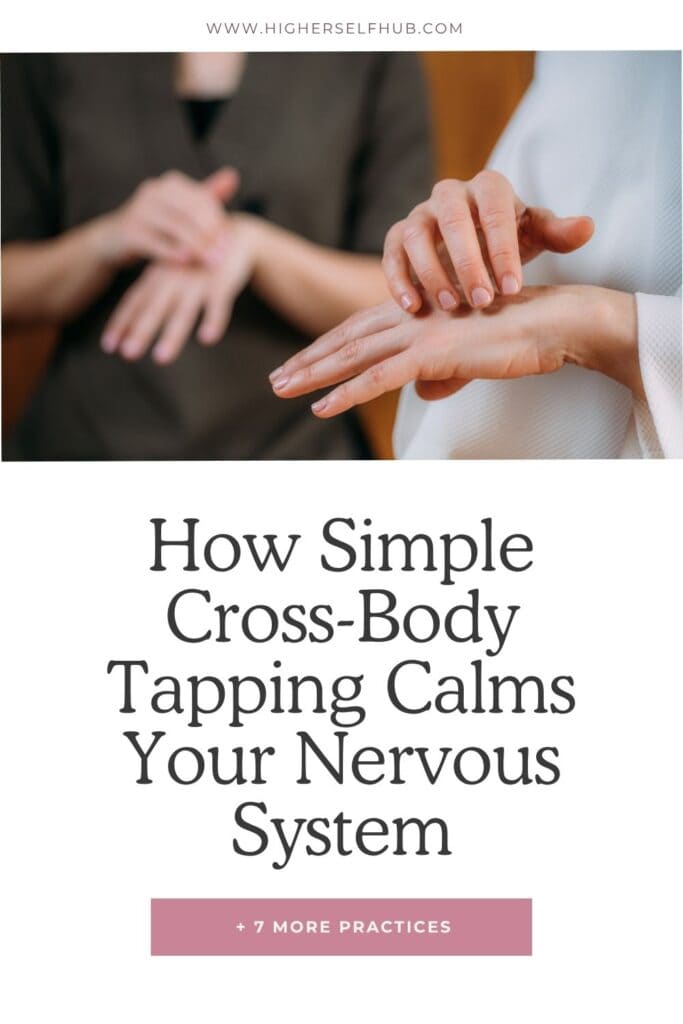
When I’m spiraling, my thinking brain has literally gone offline. That’s not a metaphor. When your nervous system detects a threat, your prefrontal cortex shuts down and your amygdala takes over so you can react fast. Great if you’re actually in danger. Not great when you’re just trying to make dinner.
Crossbody stimulation (swinging your arms across your torso, touching your left knee with your right hand) re-engages both sides of the brain and helps bring your prefrontal cortex back online. In yoga, they call it “knocking on heaven’s door.” I call it the thing that stops the spiral. If you’re new to this kind of body-based work, somatic exercises for beginners is a good place to start.
3. Gentle Shaking
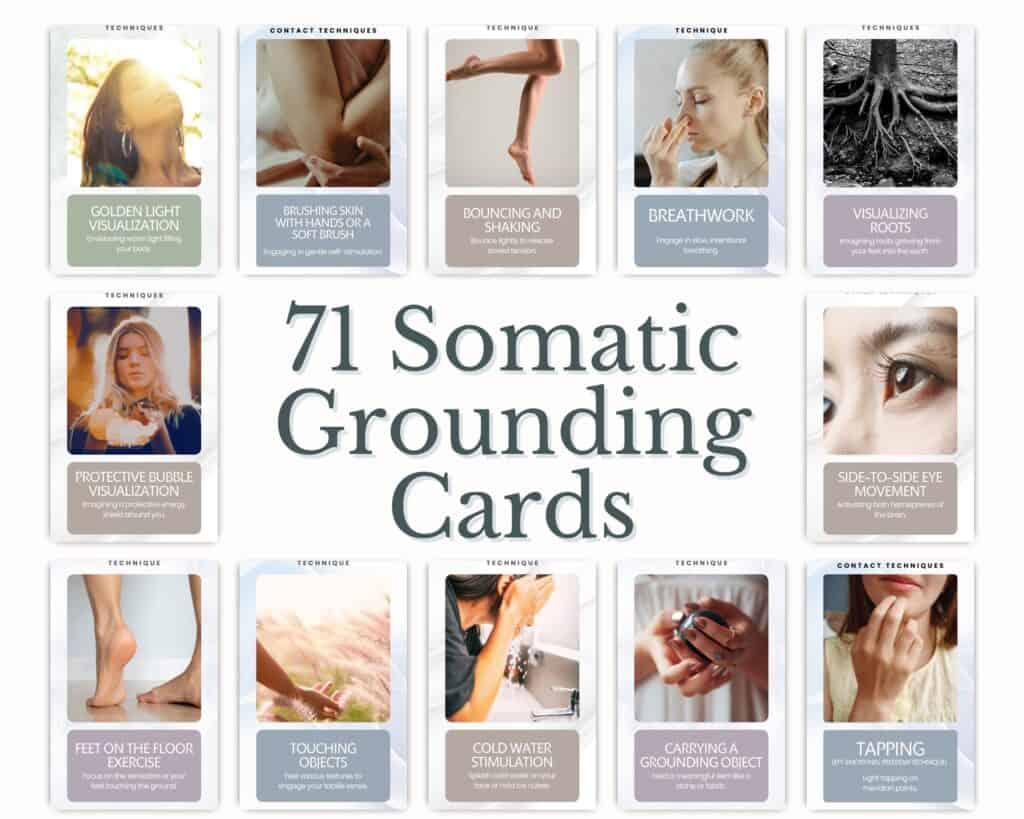
Animals do this instinctively after a stressful event. A deer that narrowly escapes a predator will stand up, shake its entire body for about 30 seconds, and walk away. That shake discharges the stress hormones so they don’t get stored.
We don’t shake. We “hold it together.” Then we wonder why our shoulders are concrete and our sleep is wrecked. Stand with soft knees, let your hands start shaking, and let it spread through your body for 2 to 3 minutes. It feels silly. It works.
4. Walking (Designed for Your Worst Day)
I run a farm, homeschool my kids, and work from home while managing autoimmune issues. I get overwhelmed often. My answer is embarrassingly simple: I go outside and walk.
When I set a goal to walk one mile a day for 100 days, I designed it for my worst day. Migraine days. Days my body is weak. On one of those days, instead of asking “how do I push through 20 minutes?” I asked “can I go outside for five?” I walked five minutes. Rested. Walked ten later. Walked five more. I didn’t override my body. I collaborated with it.
Even 10 minutes resets your entire nervous system. Not solves everything. Just resets it enough that you can think clearly again.
5. Cold Water on Your Face
This one sounds too simple to work, which is usually a sign it does. Splashing cold water on your face activates something called the mammalian dive reflex. It signals your vagus nerve to slow your heart rate and shift your nervous system out of fight-or-flight. Research shows your vagus nerve controls up to 75% of your parasympathetic nervous system, the part responsible for rest, digestion, and feeling safe.
I’ve done this in gas station bathrooms. In my kitchen at 2am when I can’t sleep. It’s not glamorous. It’s effective.
6. Naming What’s Happening (Out Loud)
When everything is spinning, I say simple things out loud: It’s Tuesday afternoon. My feet are on the floor. I’m in my kitchen. The sun is shining.
Those grounding statements bring your awareness back to the present moment. They help your prefrontal cortex come back online so you’re not reliving the past or catastrophizing about the future. I taught my kids the same thing. When my son used to have meltdowns as a toddler, I’d ask: what emotion is it that you’re feeling right now? Just naming it brings the thinking brain back.
If you want a simple place to start with body-based practices like these, I put together a free toolkit: The Somatic Starter Kit
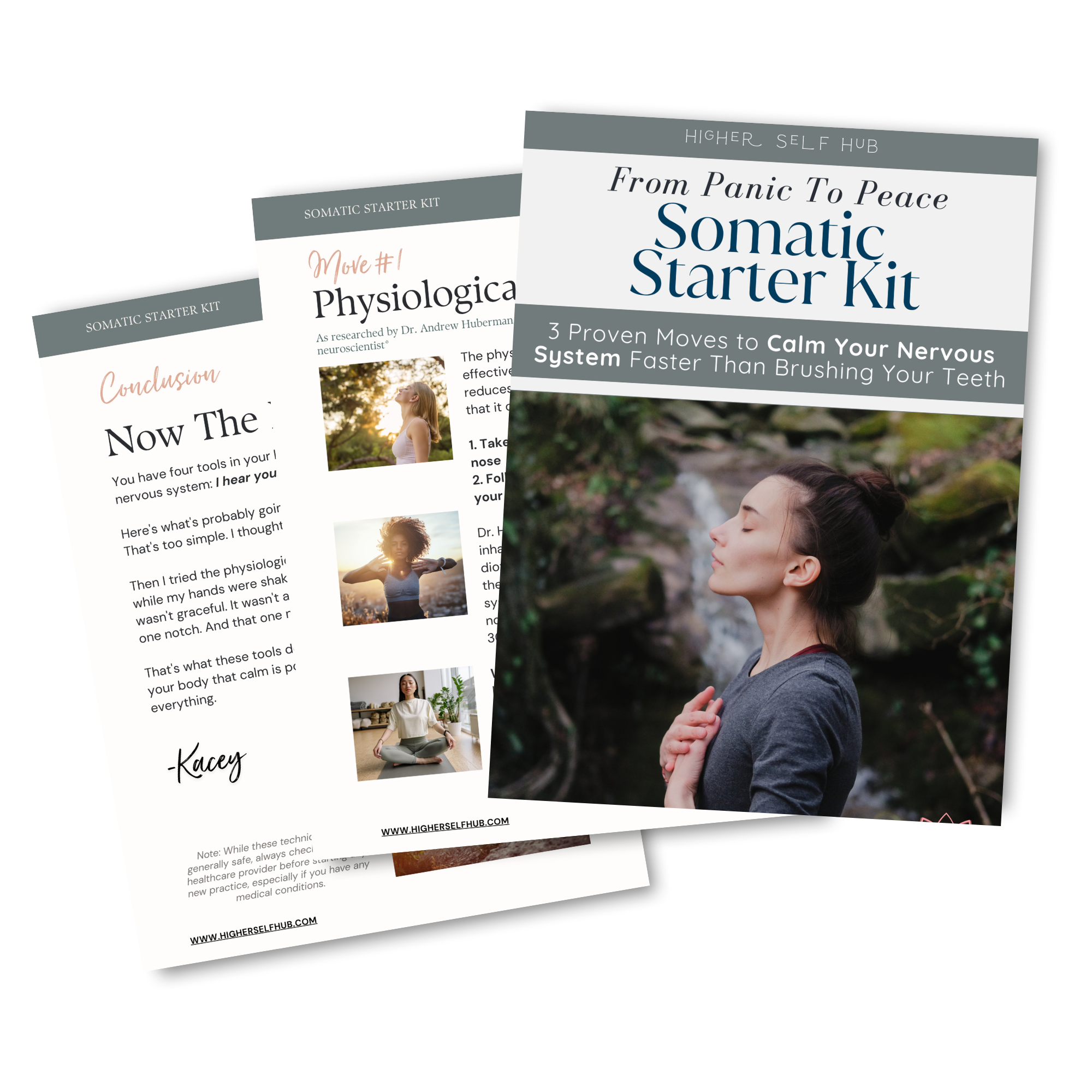
Your Free Somatic Starter Kit
3 science-backed tools to go from panic to peace in under 60 seconds.
Your inbox stays calm, too. Unsubscribe anytime. We respect your privacy.
7. Releasing Your Jaw (The Tension You Don’t Even Notice)
Your jaw is one of the first places your body holds tension. Sometimes before you even wake up. Mine was clenched so tight after my TBI that I’d get headaches before my feet hit the floor every single morning.
Place the tip of your tongue on the roof of your mouth, right behind your front teeth. Let your lips close but your teeth separate. Breathe through your nose. That’s it.
Your jaw is directly connected to your nervous system, so when you release it, you’re essentially telling your body the threat is over. I do this one in the car, at my desk, lying in bed at night. No one even knows you’re doing it.
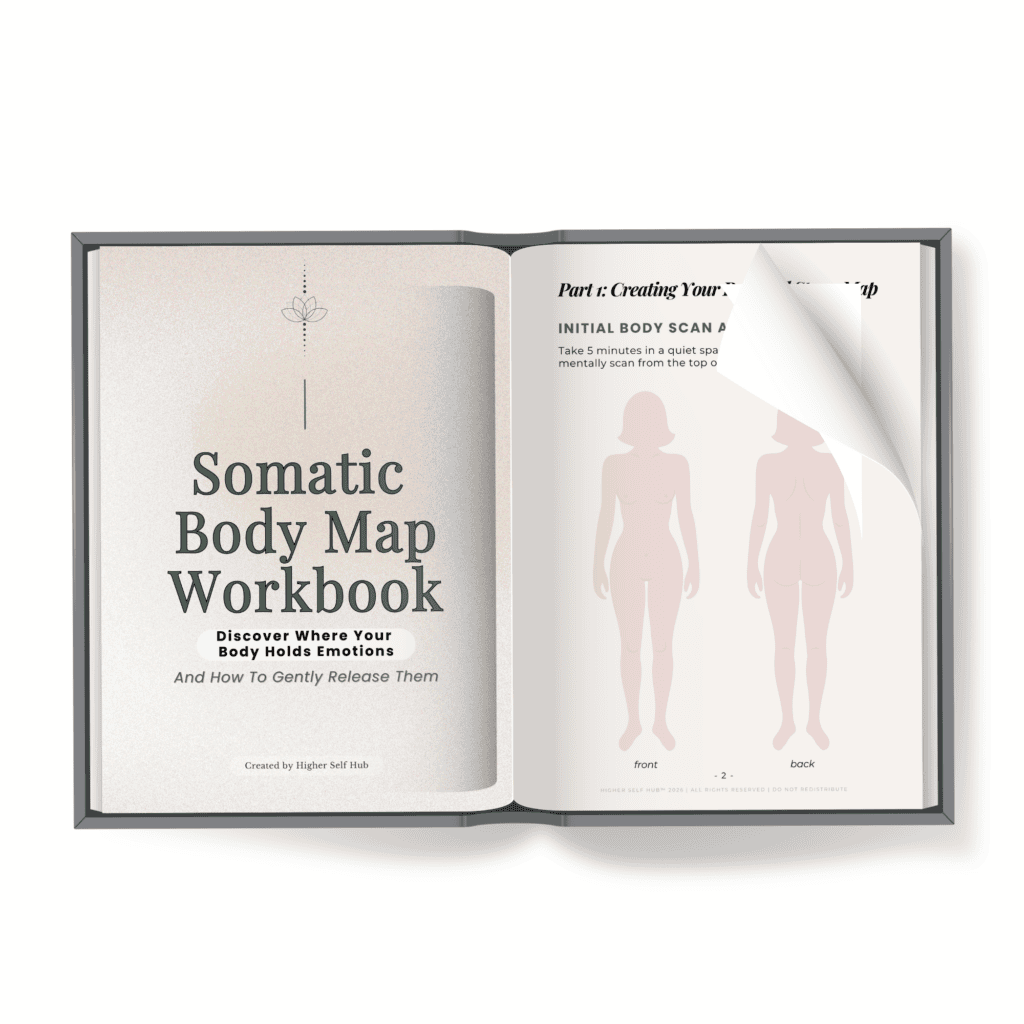
Do you know where stress lives in your body? The Somatic Body Map Workbook helps you pinpoint it.
Recommended products
Herbal Holistic Healing Practices
Before my brain injury, I didn’t think about anything holistic. Herbs weren’t on my radar. Then I spent three years being passed between specialists, collecting prescriptions, and not getting better. When a simple cup of feverfew tea outperformed a $25 migraine pill, I got really into it.
I took a homestead course on herbal healing from Rosemary Gladstar. I read books on everything from traditional Chinese methods to cottage-style blends. What I learned is that the popular recommendation isn’t always your answer. Holistic healing with herbs is personal. It takes experimentation, patience, and paying attention to how your own body responds.
8. Feverfew for Headaches
This is my everyday herb. After brain injury, I get headaches frequently. Feverfew has been used for centuries as a natural headache remedy, and for my body, it works better than anything a neurologist prescribed. It doesn’t work for everyone (herbs are personal like that), but it’s worth trying if you’re stuck in the prescription cycle.
9. Skullcap for Overthinking
Skullcap is what they call a nervine herb. It softens the overthinking and the over-sensitized state without knocking you out. When my brain won’t stop running scenarios at 10pm, skullcap quiets it down enough that I can actually rest. Not sedated. Just… quieter.
10. Nerve-Calming Teas
Valerian is one people recommend a lot for sleep. For me, it doesn’t knock me out. It makes me almost more awake but in a very chill way. That’s the thing about herbal holistic healing. What calms one person’s nervous system might energize another’s.
Chamomile and passionflower are gentler starting points if you’re new to herbs. I keep a rotation of nerve-calming teas that I reach for depending on what my body needs that day.
Lifestyle Shifts That Support Holistic Healing
The body-based practices and herbs are tools. But if the foundation is cracked, tools only get you so far. These are the lifestyle pieces that made the biggest difference for me, and none of them require a complete life overhaul.
11. Prioritizing Sleep Like Medicine
Brain injury taught me that sleep isn’t optional. It’s when your brain does its deepest repair work. Clearing out toxins, consolidating memories, processing emotions you didn’t have bandwidth for during the day.
Sleep was incredibly difficult for me after the injury. Creating a consistent sleep routine became one of the most important things I did for my health. Not because someone told me to, but because I could feel the difference in my thinking on the days I slept versus the days I didn’t.
12. Eating for Your Brain and Nervous System
After my accident, I learned that certain foods really affect brain health: fish, vitamin D, getting enough protein. Those have a measurable impact on brain wellness and nervous system function.
This isn’t about a perfect diet. It’s about noticing that when I eat well, I think more clearly. When I skip meals or live on caffeine, my nervous system pays for it by the afternoon. Holistic healing means paying attention to what your body actually needs to function, not what a diet trend tells you to eliminate.
13. Recognizing the Phone Scroll as a Pattern
When I’m at my worst, I’ll grab my phone and scroll through videos, and then 30 minutes passes and I didn’t even realize what I was doing. That’s dissociation. It’s a protective pattern, so it’s not something to blame yourself for. But it is something to notice.
If I can get myself outside and away from my phone, that’s best. If I can’t, I fall back on the grounding statements: where am I, what day is it, what can I feel right now. Simple awareness that pulls me back into my body.
14. The Family Reset
Whenever things get overwhelming in our house, we just say “reset.” That’s what we call it. If one of my kids is having a full meltdown, we offer everybody a reset. Do you want to reset? We can just start fresh and put everything behind us.
If I need it for myself, I’ll say: “Mom needs a reset. I’m going to go outside and walk.” We have a half-mile lane, so even 10 minutes outside will reset my entire energy. No expectations on it solving everything. Just enough to come back and decide what’s next with a clearer head.
What Holistic Healing Actually Looks Like (It’s Not What You Think)
Here’s what nobody tells you about holistic healing: it’s not photogenic. Not a perfectly arranged altar or a $200 supplement stack. It’s standing in your kitchen doing a breathing exercise while the pasta boils. Drinking a cup of skullcap tea instead of scrolling your phone at 10pm. Walking to the mailbox when your body wants to stay on the couch because you know that even five minutes of movement changes everything.
The medical system is built to treat symptoms one at a time. You go to a doctor for migraines and get a pill with side effects. See a different doctor for acid reflux. A different one for talk therapy. Nobody zooms out to ask what your body is actually trying to tell you.
That’s why regulation comes before discipline. Always.
Holistic healing is what happens when you stop chasing symptoms and start asking what your body actually needs. For better or worse, I have to take more care of my health than other people seem to. My nervous system was over-sensitized as a child, then compounded by brain injury. If you have to be a little more gentle with yourself, then that’s what you need to do. That’s not weakness. That’s wisdom.
“Once I started learning somatic work, I realized that those unexplained body sensations, itchy skin, rashes, hypersensitivity to light, they often tie back to unprocessed emotions. Through somatic exercise we can process all that backlog and learn how to process things as they come.”
If you want to go deeper into how your body stores and releases what it’s been carrying, these 11 things about somatic healing are worth reading.
Where to Start with Holistic Healing (If You’re Overwhelmed)
You don’t need to do all 14 of these, and you don’t need to overhaul your life. Just pick one thing that you try once, on an actual hard day, and see how it feels.
Start with whichever one sounds like the least amount of effort. The physiological sigh takes 10 seconds. A cup of chamomile tea takes 5 minutes. A walk to the end of the driveway takes 3.
Your body isn’t broken. It might be exhausted, stuck in a protective state it activated a long time ago. Or maybe it needs more support than you’ve been giving it, not because you’re doing something wrong, but because you’ve been through more than most people realize.
Holistic healing isn’t about becoming a different person. It’s about giving the person you already are what she actually needs to feel steady again. Not all at once. Not on a timeline. On your terms.
📌 Save This For Later
Your Free Somatic Starter Kit
3 science-backed tools to go from panic to peace in under 60 seconds.
Your inbox stays calm, too. Unsubscribe anytime. We respect your privacy.