

3 Easy Grounding Exercises That Anybody Can Do
You’re doing everything right. You’re getting enough sleep, eating well, checking all the boxes, but you still feel like you’re barely holding it together. Your shoulders live somewhere near your ears, your jaw is clenched by 10 AM, and there’s this constant hum of tension running through your body that you can’t seem to shake.
I get it. I’ve been that mom standing in the grocery store aisle, cart full of food I was supposed to be excited about cooking, feeling my heart race for absolutely no reason. Grounding exercises saved me on more than one occasion when I felt like I was spiraling.
The good news? You don’t need an hour-long meditation practice or a yoga retreat to feel more grounded. You need simple, practical grounding exercises that actually work when you’re living a real life with real responsibilities.
Why Grounding Techniques Work When Everything Else Fails
Your nervous system is like a smoke alarm that’s become way too sensitive. It’s designed to keep you safe, but somewhere along the way, it started treating your inbox like a house fire. Every stressor, big or small, triggers the same emergency response.
Grounding exercises work because they give your nervous system concrete proof that you’re safe right now, in this moment. They’re not about positive thinking or pushing through. They’re about speaking your body’s language through somatic exercises that signal safety.
When you’re dysregulated, you can’t think your way out of it. You have to feel your way back to center. That’s exactly what these three grounding exercises do.

Signs You Need Somatic Grounding
Your body is probably already telling you something’s off. Maybe it’s:
- That tight feeling in your chest that makes breathing feel like work
- Shoulders that won’t drop no matter how many times you roll them
- Mind racing through your to-do list even when you’re trying to relax
- Snapping at your kids or partner over small things
- Feeling disconnected, like you’re watching your life from behind glass
- Physical restlessness—can’t sit still, constantly checking your phone
These aren’t character flaws. They’re nervous system regulation issues. And the three grounding exercises I’m about to share can help.
If you’re curious why so many regulation cues don’t land, this free guide explains what’s really going on with your body.
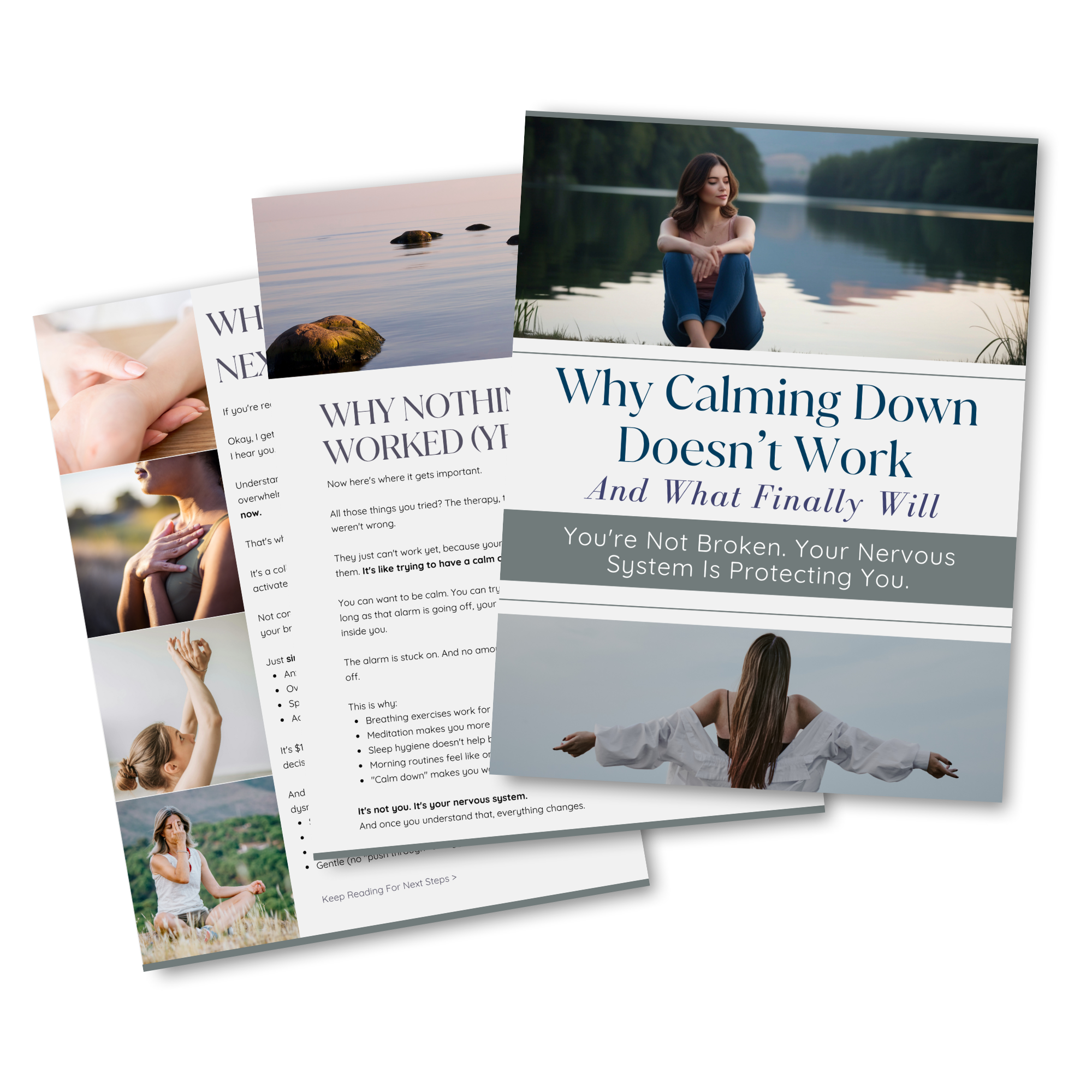
Free Guide: Why Calming Down Doesn’t Work
(And What Finally Will)
You’re Not Broken. Your Body Is Protecting You.
Your inbox stays calm, too. Unsubscribe anytime. We respect your privacy.
3 Simple Grounding Exercises You Can Do Anywhere
1. Create One Predictable Pause
One of the simplest ways to support your nervous system is to give it a small moment of predictability. This doesn’t need to be a long break or a formal practice. It can be as simple as choosing one moment in your day where you pause for a minute or two.
The science: When your nervous system is stuck in overdrive, predictability signals safety. Your body learns to anticipate this moment of calm, which helps it shift out of fight-or-flight mode. Over time, these small pauses train your nervous system to access regulation more easily throughout the day.
I started this practice after years of feeling like I was running on fumes. My days blurred together, and I couldn’t remember the last time I actually stopped. The predictable pause changed everything because it gave my nervous system something to look forward to—a built-in circuit breaker for stress.
How to do it:
For example, you might:
- Sit on the edge of your bed for 60 seconds before starting your day
- Take three deep breaths in the car before going inside
- Stand at the sink after washing your hands and notice the temperature of the water
- Pause with your hand on the doorknob before walking into work
What matters isn’t what you do, but that your body begins to recognize this moment as familiar and safe. There’s no right way to pause—just your way.
This works when:
- You’re a homeschooling mom who never gets a real break
- Your days blur together and you can’t remember the last time you stopped
- You feel like you’re running on fumes by 2pm
- You need something so simple you can’t fail at it
At first, you might forget. That’s completely normal. Over time, your body often starts to expect the pause on its own, like it’s been waiting for permission to finally exhale.

2. Walk for Just 10 Minutes
Walking isn’t just exercise—it’s one of the most powerful grounding exercises for nervous system regulation. And before you think “I don’t have time,” hear me out: We’re talking 10 minutes. Two 5-minute walks. That’s less time than you spend scrolling in bed.
The science: Walking creates bilateral stimulation, which means your left and right brain hemispheres start communicating better. This same mechanism is used in EMDR therapy to process trauma and stress. Walking also naturally reduces cortisol, increases BDNF (which supports emotional regulation), and gives you gentle cardiovascular movement without triggering a stress response.
When I was deep in my healing journey from panic disorder, walking felt almost too simple to matter. But it became the foundation everything else built on. It gave me 10 minutes of mental clarity, fresh air, and the gentle reminder that my body could move without being in crisis mode.
Explore this: The Walking Habit: Your First Step to Nervous System Regulation
How to do it:
- Start with one 10-minute walk per day, or split it into two 5-minute walks
- Focus on the sensation of your feet touching the ground with each step
- Notice your breathing naturally syncing with your movement
- Leave your phone at home if possible, or at least don’t look at it
- If your mind wanders (it will), gently bring your attention back to your feet
This works when:
- You need to reset between tasks
- Your mind won’t stop racing
- You’ve been sitting at your desk too long
- You need to process emotions without talking about them
- The weather is decent (or you have 5 minutes to walk up and down your stairs)
You don’t need special shoes, a scenic trail, or the perfect playlist. You just need to move your body intentionally for 10 minutes. The magic isn’t in the distance—it’s in the consistency.
If You Want a Little More Structure
Reading about these grounding practices is helpful, but actually trying them is best. If you want something to make the practice easier to remember and track, you can explore these tools. They support repetition and reduce overwhelm.
They’re designed for nervous-system-safe habit-building. Small enough for a few minutes, even on harder days.

3. The Physiological Sigh
This grounding exercise is your panic button—the one that works in 30 seconds when you need relief RIGHT NOW. I learned about the physiological sigh during one of my worst anxiety spirals, and it’s become my go-to when I feel overwhelm creeping in.
The science: The physiological sigh was discovered by researchers studying spontaneous sighs that happen naturally when we’re stressed. It’s the fastest way to calm your nervous system because it directly engages your vagus nerve and immediately shifts you from sympathetic (fight-or-flight) to parasympathetic (rest-and-digest) activation. One physiological sigh can lower your heart rate and reduce anxiety faster than several minutes of regular deep breathing.
This technique literally saved me in parking lots, checkout lines, and middle-of-the-night wake-ups. It’s so quick and subtle that nobody around you even notices you’re doing it.
How to do it:
- Inhale fully through your nose until your lungs feel completely full
- Take one more sharp, quick inhale through your nose to top off your lungs (yes, even though they feel full)
- Exhale slowly and completely through your mouth, like you’re sighing
That’s it. One cycle. You can do this once or repeat it 2-3 times if needed.
This works when:
- You feel a panic attack starting
- You’re about to walk into a stressful situation
- Your chest feels tight and breathing feels shallow
- You need to calm down but can’t leave where you are
- You wake up with anxiety in the middle of the night
The double inhale is the key—it fully expands your lungs in a way that signals safety to your nervous system, and the slow exhale completes the calming response. I keep this in my back pocket for moments when I don’t have time for anything else.

Making These Grounding Practices Part of Your Life
Here’s the truth: The best grounding exercise is the one you’ll actually do. All three of these work because they’re simple enough to build into days that are already full.
Start with one. Just one. Try the predictable pause for a week and see what happens. Then maybe add the 10-minute walk. The physiological sigh will be there when you need it.
Red flag moments to use these grounding exercises:
- Right when you wake up feeling off
- Before difficult conversations
- When you notice tension creeping into your shoulders
- After checking stressful emails or messages
- When you catch yourself holding your breath
These aren’t about eliminating stress completely—that’s not realistic and not even the goal. You’re teaching your nervous system that it’s safe to relax, that you have tools, that regulation is possible even in the middle of your regular, chaotic, beautiful life.
Want more ways to support your nervous system in everyday moments? I break down microhabits for nervous system health that fit into the margins of your day.
When Grounding Exercises Feel Impossible
Sometimes you try a grounding exercise and it feels wrong—maybe it makes you more anxious, or your body just won’t cooperate. This isn’t failure. This is information.
If grounding exercises feel impossible right now, your nervous system might be too activated to slow down. That’s okay. You might need to start with movement (like walking or gentle shaking) before trying stillness practices. Or you might need shorter sessions—30 seconds instead of a full minute.
Some people need to release trapped emotions or work through trauma before traditional grounding exercises feel accessible. That’s completely normal and might be a sign that working with a somatic practitioner could help.
Your nervous system has been working overtime to protect you. Give it time to learn these new patterns. Be patient with yourself.

You Deserve to Feel Grounded
That constant “off” feeling you’re carrying around? It’s not permanent. Your nervous system wants to feel calm and safe—these grounding exercises just help it remember how.
You don’t need hours of free time or perfect conditions. You need 10 minutes of walking, 60 seconds of pausing, and one deep breath when overwhelm hits. That’s enough to start.
Your body has been working so hard to keep you safe. Now it’s time to teach it how to rest.
Ready to understand why calming down hasn’t worked—and what will?
Download my free guide Why Calming Down Doesn’t Work (And What Finally Will) to discover what your nervous system really needs to feel safe.
Free Guide: Why Calming Down Doesn’t Work
(And What Finally Will)
You’re Not Broken. Your Body Is Protecting You.
Your inbox stays calm, too. Unsubscribe anytime. We respect your privacy.
Remember: These grounding exercises are tools for self-care, not replacements for professional mental health support. If you’re struggling with trauma, severe anxiety, or depression, please reach out to a qualified practitioner who can provide personalized guidance.