

Somatic Journaling Simplified: This Is How To Get Started
If thinking your way through your feelings hasn’t brought relief, your body may be asking for a different conversation. Somatic journaling helps you start that conversation.
Many women turn to journaling when they feel stressed, overwhelmed, or stuck in their head hoping clarity will come through reflection. And it does, but when your nervous system is already overloaded, more thinking can make it worse. It can actually keep you in the same loop.
Your nervous system doesn’t communicate through logic.
It speaks through the body.
Tight shoulders. Shallow breathing. A heavy chest. Restlessness you can’t explain.
These physical sensations are signals. And when they go unnoticed, your system works harder to get your attention, often by pulling you deeper into mental overdrive.
Somatic journaling offers a gentler, body-based way to check in.
Instead of analyzing your thoughts or forcing insight, this practice helps you notice what’s happening in your body right now. By tuning into sensation, breath, and tension, you give your nervous system the safety cues it needs to begin settling.
You don’t need long writing sessions or perfect prompts.
Just awareness. A few words. A moment of presence.
In this guide, you’ll learn how to start somatic journaling in a simple, supportive way, so you can feel more grounded, regulated, and connected to your body without adding another “should” to your routine.
If you’re wondering WHY your body reacts in a way that doesn’t match the situation, it’s all explained in this free guide you can download below.
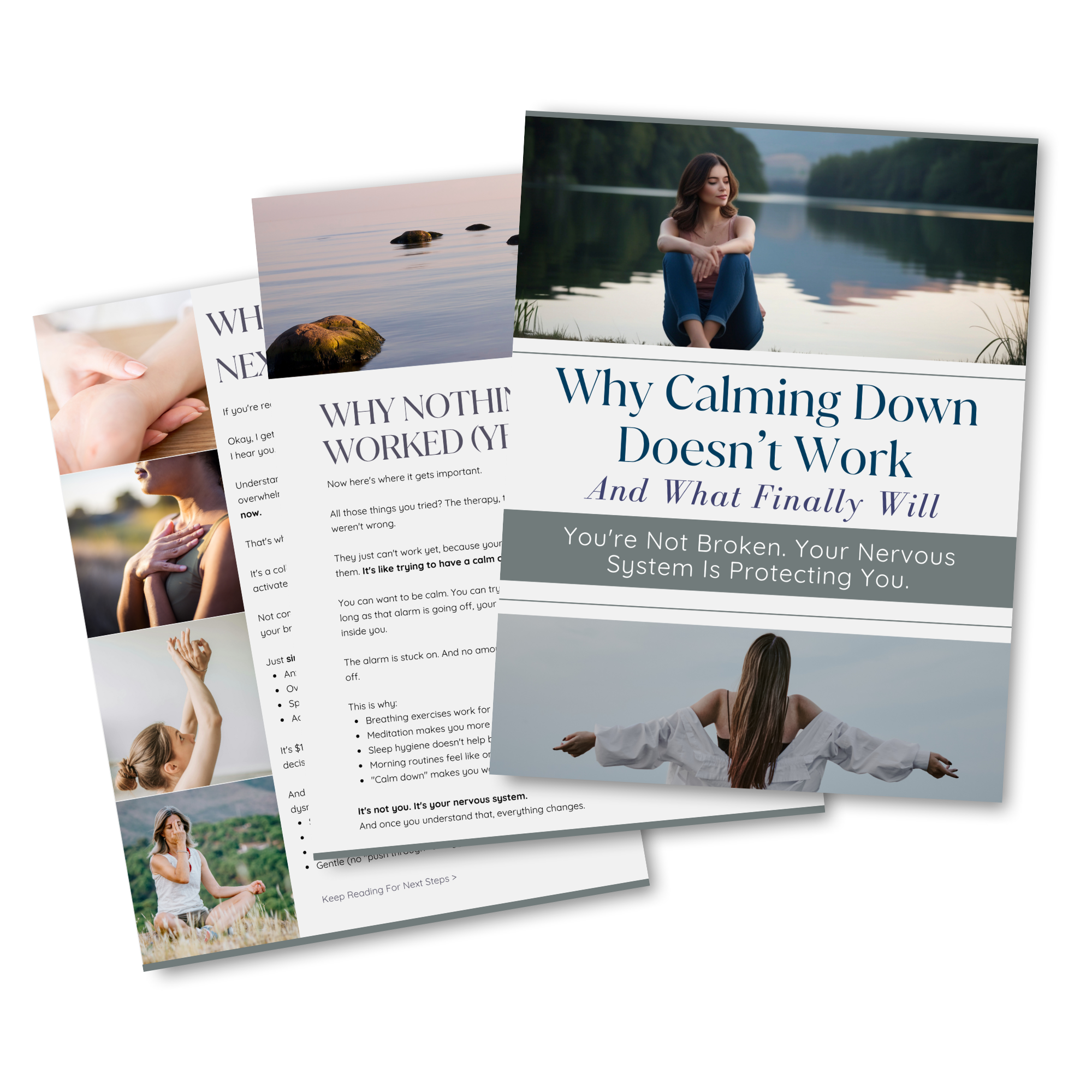
Free Guide: Why Calming Down Doesn’t Work
(And What Finally Will)
You’re Not Broken. Your Body Is Protecting You.
Your inbox stays calm, too. Unsubscribe anytime. We respect your privacy.
What Makes Somatic Journaling Different
Regular journaling is mostly about thoughts. You write what happened, what you think about it, how you feel, what it means.
Somatic journaling is about what’s happening in your body.
It’s less “why do I feel this way” and more “where do I feel this way.”

When you’re overwhelmed or anxious, your nervous system is often stuck in a protective state. It’s scanning for danger, bracing for the next thing, trying to solve problems that don’t have solutions yet. Your brain is doing what it thinks will keep you safe, but it’s exhausting.
Writing about your thoughts can sometimes keep you in that same loop. But tuning into your body — noticing tension, breath, temperature, sensation — gives your nervous system different information. It’s like saying, “Hey, we’re here. We’re present. We’re not in the middle of an emergency right now.”
It doesn’t fix everything. But it can create a little space. A little softening. And sometimes that’s enough.
How to Actually Do This (Without Overthinking It)
You don’t need a special notebook. It doesn’t have to happen every day. And it doesn’t take more than a few sentences or words that resonate.
Somatic journaling can be as simple as pausing for two minutes and writing down what you notice in your body right now.
Here are a few ways to start — pick whatever feels doable today, not what sounds like it “should” work.
1. The Body Scan Shortcut
You don’t have to do a full guided meditation. Just pause and notice:
- Where do you feel tight or tense right now?
- Where do you feel soft or relaxed?
- What’s your breath doing? (Fast, slow, shallow, held?)
Write it down. That’s it. No analysis required.

Sometimes just naming what’s there — “my shoulders are up by my ears” or “my jaw is clenched” — is enough to help your body start to release a little.
2. The Opposite of Venting
If you’ve been cycling through the same worry or frustration, try this:
Instead of writing about the thing that’s bothering you, write about what’s happening in your body while you think about it.
“When I think about that conversation, my chest gets tight and my breath gets shallow.”
“When I imagine tomorrow’s to-do list, my stomach clenches.”
You’re not solving anything. You’re just creating a little distance between the thought and the reaction. And that distance? That’s regulation starting to happen.
3. Finish This Sentence
If you’re not sure where to start, try one of these prompts:
- Right now, my body feels…
- The part of me that’s holding the most tension is…
- If my body could tell me what it needs right now, it might say…
- The sensations I’m noticing are…
You don’t have to write a whole paragraph. A few words is fine. Permission to keep it messy.
4. Track What Helps (Without Pressure)
If you’ve tried something that helped your body feel a little calmer — a walk, a stretch, a few deep breaths, lying down — jot it down.
Not because you have to do it again tomorrow. Just because it’s easy to forget what actually works when you’re in the thick of it.
Think of it as leaving breadcrumbs for your future self.
5. Name It to Tame It (Body Edition)
This one’s borrowed from neuroscience, but it works in journaling too.
When you’re feeling a big emotion, your nervous system is trying to process a lot at once. Just naming the physical sensations that go with that emotion — without trying to explain or fix them — can help your brain start to settle.
“I feel shaky and hot.”
“My throat is tight and my hands are cold.”
“There’s a heavy feeling in my chest.”
That’s enough. You don’t have to do anything with it.

You Don’t Have to Use All of This Right Now
If this feels like a lot, that’s okay. Bookmark this post. Pin it. Come back to it when you need a reminder that you have options.
The beauty of this practice is that it works as preventative care as well as emergency calm.
Somatic journaling isn’t about adding one more thing to your to-do list. It’s about giving yourself a way to check in with your body when everything else feels overwhelming. On your terms, at your pace.
If You Want a Little More Support (Without Forcing Calm)
If trying to “calm down” has ever made things feel worse, there’s nothing wrong with you. Your nervous system isn’t resisting, it’s protecting.
It’s all explained in this free guide that shows that you are not broken, your body is just protecting you. And how to help it.
You can download it here if it feels supportive right now:
👉 Why Calming Down Doesn’t Work
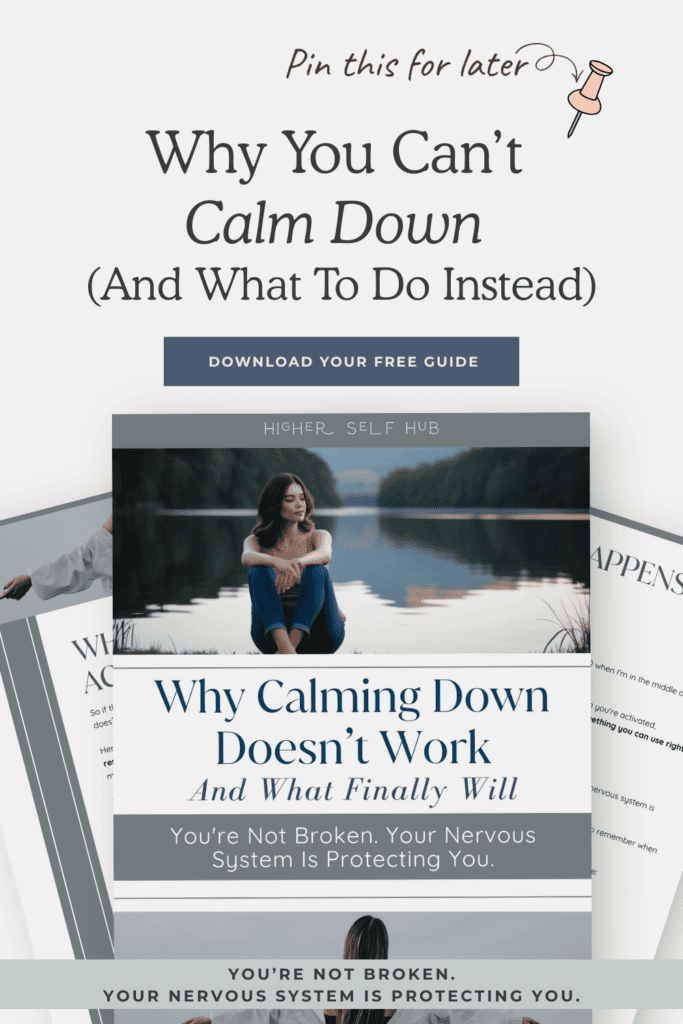
Free Guide: Why Calming Down Doesn’t Work
(And What Finally Will)
You’re Not Broken. Your Body Is Protecting You.
Your inbox stays calm, too. Unsubscribe anytime. We respect your privacy.
And if it doesn’t? That’s okay too.
You don’t need to get it right.
Your nervous system responds to moments of presence, not perfection, productivity, or control.
If you’d like more body-based tools that work with your nervous system instead of against it, you can explore the 7-Day Guide to Naturally Lower Cortisol and Boost Energy or browse the nervous system category when it feels right.
You’re allowed to take this slowly. Your body already knows the pace.