
Somatic Exercises to Reduce Cortisol: A Beginner’s Guide to Calming Your Body From the Inside Out
For me, high cortisol looked like grabbing my phone and scrolling through videos for 30 minutes without even realizing I was doing it. Not because I was lazy. Because my body had checked out to protect itself. If this sounds familiar, somatic exercises to reduce cortisol might be exactly what your body has been asking for.
The wired-but-tired state for months on end is a signal. In fact, it’s doing exactly what a stressed nervous system does. It’s flooding you with cortisol to keep you alert, keep you moving, keep you “handling it.”
Essentially, it doesn’t know how to stop.
This is the part that really hit home for me: you can’t think your way out of high cortisol. Despite what people are selling, you can’t meditate it away either.
Especially if your system is in fight-or-flight. But you can use your body to send a different signal. A signal that tells your nervous system, “It’s okay to just be in this moment.”
That’s where somatic exercises to reduce cortisol come in.

What Cortisol Actually Does (And Why It Gets Stuck)
Cortisol isn’t the enemy. It gets a bad rep, and we want to lower it. But it’s your body’s built-in alarm system, and it’s there for good reason.
Cortisol rises when you’re in danger to help your body react quickly.
The challenge is when the danger is only perceived and isn’t real. Your heart still pounds, your vision narrows and you feel like you’re ready to burst out of your skin.
That’s useful if you’re running from something. Less useful if you’re lying in bed at 2 a.m. replaying a conversation from six days ago.
When your nervous system stays in a stress response for too long, cortisol forgets to reset as a normal level. Your body keeps pumping out the stress hormone because the signal of the threat is still there. Even if the “threat” is just your inbox, your to-do list, or the weight of keeping everything together.
Ready to a gentle way to lower cortisol in 7 days? I made a free printable guide for you:
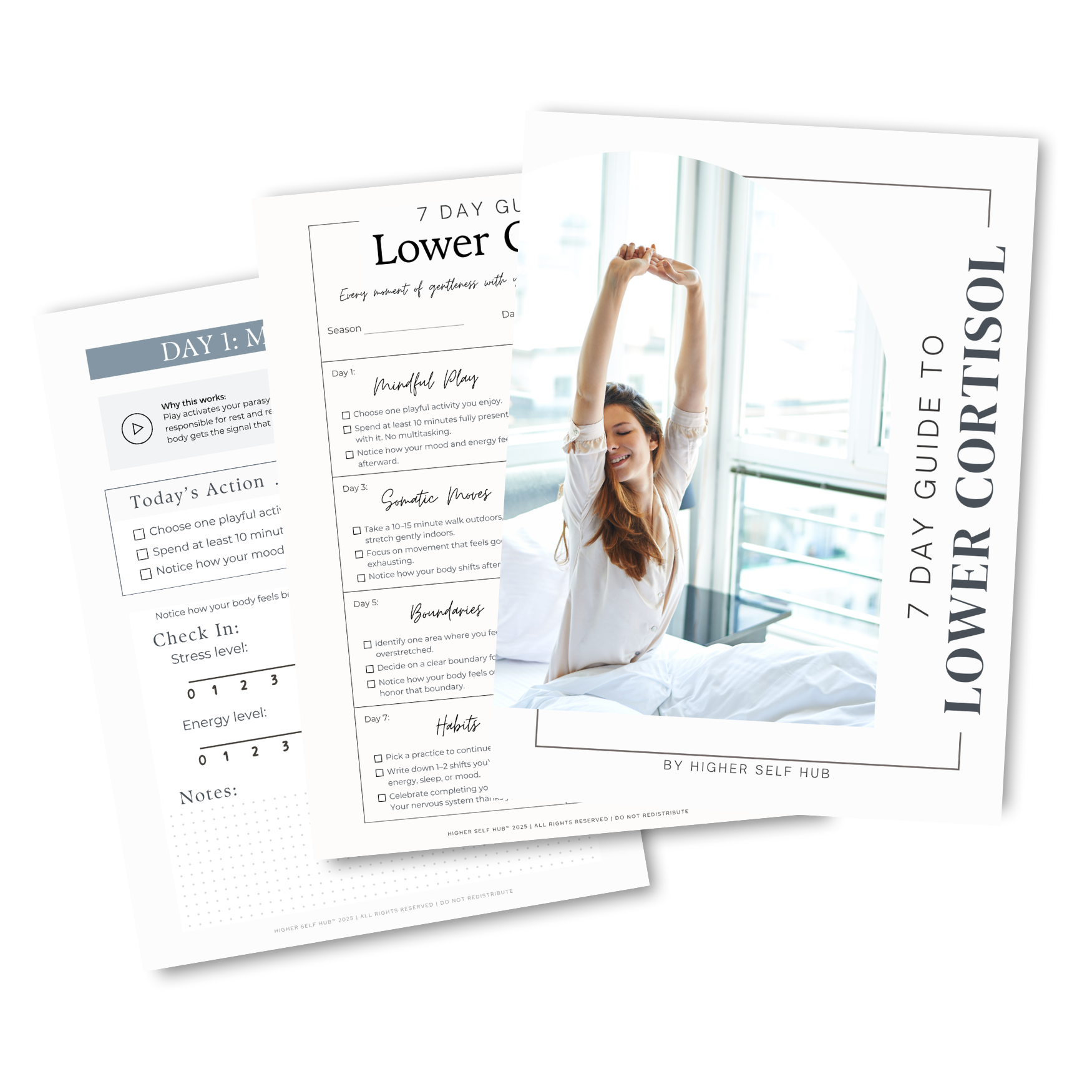
Free 7-Day Guide To Lower Your Cortisol
The Hormone Balancing Guide That Works For Women In The Thick of It.
Your inbox stays calm, too. Unsubscribe anytime. We respect your privacy.
Over time, that excess cortisol shows up as:
- That bloated, puffy feeling that doesn’t go away no matter what you eat
- Brain fog so thick you forget why you walked into a room
- Waking up at 3 a.m. wide awake for no reason
- Feeling wired all day and then crashing hard at night
- Irritability that comes out of nowhere, and then guilt for snapping
Sound familiar? That’s not a discipline problem or a diet problem. That’s a nervous system problem. And it responds better to body-based tools than to another plan or another supplement.
Why Somatic Exercises Work for Cortisol
Somatic exercises work because they speak the language your nervous system actually understands: movement, sensation, breath, and release.
Your vagus nerve, that long communication highway between your brain and your body, is constantly scanning for signals of safety or danger. When it picks up on danger signals (tension, shallow breathing, bracing), it keeps cortisol production going. When it picks up on safety signals (slow exhales, soft muscles, gentle movement), it naturally tells your brain to ease up on the cortisol.
You’re not forcing your body to relax. You’re offering it enough safety cues that it chooses to.
Ultimately, that’s the difference between “calm down” and actual regulation. And if you’ve ever been told to “just relax” and felt your whole body tighten in response, you already know that difference in your bones.
If you want to understand more about why calming down doesn’t always work (and what does), I break it all down in this free guide: Why Calming Down Doesn’t Work (And What Finally Will)
6 Somatic Exercises to Reduce Cortisol (That Actually Feel Good)
None of these somatic exercises to reduce cortisol require a yoga mat, an hour of free time, or previous experience. They work because they interrupt the stress pattern your body has been running on autopilot. So start with whichever one sounds like the least amount of effort. Seriously.
1. The Long, Slow Exhale
This is the simplest entry point. And honestly, it’s more powerful than it sounds.
Breathe in through your nose for a count of four. Then exhale through your mouth for a count of six, seven, or eight — as long as feels comfortable. The exhale is the part that matters. A long, slow exhale activates your vagus nerve and directly signals your nervous system to lower cortisol production.
You don’t have to do this for ten minutes. Three to five breaths can shift something. You might feel your shoulders drop half an inch. That’s your body starting to believe it’s safe.
2. The Shake-Off
Animals do this instinctively after a stressful event. A gazelle escapes a lion and then literally shakes its whole body before going back to grazing. We’re the only ones who skip that step and go straight to making dinner.
Stand up and gently shake your hands, then your arms, then let your whole body shake loosely for 30 to 60 seconds. Knees soft. Jaw loose. Let it be messy and uncoordinated. No one’s watching.
This helps discharge the stress energy that’s been building up in your muscles. It might feel silly. It also might feel like the first full exhale you’ve taken all day.

3. The Jaw Release
You’re probably clenching right now. Most of us are.
Open your mouth wide (like a yawn) and hold it for a few seconds. Then slowly close it and let your jaw hang slightly open, lips together but teeth apart. Move your jaw gently side to side a few times.
Your jaw holds an enormous amount of stress, and it’s directly connected to your fight-or-flight response. Releasing it is like turning down the volume on your body’s alarm system. You might feel a wave of softness move down your neck and into your shoulders. Let it.
4. The Slow Body Roll
Stand with your feet hip-width apart. Let your chin drop to your chest. Then slowly, one vertebra at a time, roll your body forward and down. Let your arms hang heavy. Don’t try to touch your toes. Just let gravity do the work.
Hang there for a few breaths. Notice where you feel pulling or tightness. You don’t have to fix it — just notice it.
Then slowly, vertebra by vertebra, roll back up. Head comes up last.
This one works because it takes your body through a slow, controlled movement that tells your nervous system there’s no rush. No urgency. Just you, moving through space at your own pace.
5. The Butterfly Hug
Cross your arms over your chest so each hand rests on the opposite shoulder, like you’re giving yourself a hug. Then gently alternate tapping. Left hand, right hand, left hand, right hand, at a slow, steady rhythm.
This bilateral stimulation helps calm the amygdala (the part of your brain that triggers the stress response) and brings your cortisol levels down. It’s originally from EMDR therapy, but you don’t need a therapist to use it. You just need two hands and a minute.
Try this one in bed. It also works in the car before school pickup, or under a blanket while your kids watch a movie. No one even has to know.
6. The Grounded Exhale
Sit or stand with your feet flat on the floor. Press your feet gently into the ground and notice the contact. Notice the weight, the temperature, the pressure.
Now take a slow breath in and imagine you’re breathing down into your feet. On the exhale, let out an audible sigh. Haaaah.
Repeat three to five times.
This combines grounding with vagus nerve activation, which makes it especially effective when you’re feeling that buzzy, can’t-sit-still energy that comes with high cortisol. It gives your nervous system two safety signals at once: you’re supported, and you can exhale.
What to Do After You Try These Somatic Exercises to Reduce Cortisol
Here’s what I’d love for you to take away from this: you don’t need to do all six. You don’t need to build a routine today. You don’t even need to remember which one is which.
Just notice what happens in your body after you try one. Does something soften? Do your shoulders drop? Does your breath slow down a little?
That noticing is the practice. That’s your body and brain starting to communicate differently.
And if you want to keep track of what’s actually working, not because you have to, but because it’s easy to forget what helped when you’re back in the thick of it, a simple tracker can go a long way.
The 28-Day Somatic Exercise Tracker & Wellness Journal was designed for exactly that. It gives you a place to log which exercises you tried, how your body felt before and after, and what’s shifting over time. Also, think of it as leaving breadcrumbs for your future self — the one who will forget what helped and could use a gentle reminder.
Grab your free guide as a reminder.
Free 7-Day Guide To Lower Your Cortisol
The Hormone Balancing Guide That Works For Women In The Thick of It.
Your inbox stays calm, too. Unsubscribe anytime. We respect your privacy.
You Don’t Need to Keep Running on Fumes. Try Somatic Exercises to Reduce Cortisol Today
If you’ve been powering through and telling yourself you’ll rest when things calm down, but things never calm down, your nervous system isn’t waiting for permission. It’s already sending you signals. The tension. The exhaustion. The inability to fully relax, even when you finally get a quiet moment.
Those aren’t flaws. They’re invitations. Your body is asking for a different kind of care. Not more willpower. Not another routine to optimize. Just a few minutes of presence and a chance to feel safe in your own skin.
You’re allowed to start small. One exhale. One shake. One moment of noticing what’s there without trying to fix it.
Your body already knows the way back. You just have to give it the space.
Save This For Later

Related posts you might find supportive: