

5 Somatic Exercises For a Vagus Nerve Reset (That Work in the Car)
You know that moment when you’re driving somewhere familiar, maybe the school pickup route or your commute, and you suddenly realize you’ve been holding your breath for the last three minutes?
Or you get to your destination and can’t quite remember the drive itself because your mind was spinning through seventeen different scenarios that may or may not ever happen?
Yeah. That’s not a focus problem.
What’s actually happening is your nervous system is trying to keep you safe by staying alert, scanning for problems, and preparing for every possible outcome. It’s doing its job. The thing is, when your system stays in that vigilant state for too long, your body starts running on fumes. That’s when the overwhelm, the irritability, and the constant mental noise get louder.
The good news? You don’t need a yoga mat, a quiet room, or an hour of free time for a vagus nerve reset. Sometimes, all you need is what you’re already doing: sitting in your car.
What’s Really Going On (The Nervous System Part)
When you’re overwhelmed, overthinking, or feeling like your brain won’t turn off, your vagus nerve, the main communication highway between your brain and body, may be stuck in a stress response.
This nerve runs from your brainstem all the way down through your chest and into your abdomen. Along the way, it touches your heart, your lungs, and your digestive system. When it’s functioning well, it helps you feel calm, connected, and capable of handling what’s in front of you.
But here’s the thing: you can reset your vagus nerve. It’s like a switch. It responds to what your body is doing, not just what your mind is thinking. That means small, physical shifts, even ones you can do while driving, can send signals of safety back up to your brain.
You’re not trying to fix anything. You’re just offering your system a different option.
Free resource: Why Calming Down Doesn’t Work (And What Finally Will)
Somatic Practices You Can Do While Driving
Think of these vagus nerve reset exercises as your release valve for the pressure that builds up in your nervous system.
1. The Audible Exhale
Sighing is underutilized. It’s your body’s built-in release valve.
Next time you’re at a red light or stuck in traffic, let yourself take a deep breath in through your nose. Then, on the exhale, let out an audible sigh. Like, actually make noise. A “haaaah” or a groan or whatever wants to come out.
That sound activates your vagus nerve and tells your system it’s okay to let go of some of that tension you’ve been carrying. One sigh won’t change your whole day, but it might soften the edges just enough.

2. Hum While You Drive
This one feels a little silly at first, but humming is one of the fastest ways to stimulate your vagus nerve.
The vibration in your throat and chest sends a signal that you’re safe enough to make sound, which is something we don’t do when we’re actually in danger. You can hum along to a song, hum a random melody, or just make a low “mmmm” sound for a few seconds.
It doesn’t have to be pretty. It just has to be yours.
For the story behind why these car resets work, my free guide breaks it down in plain language.
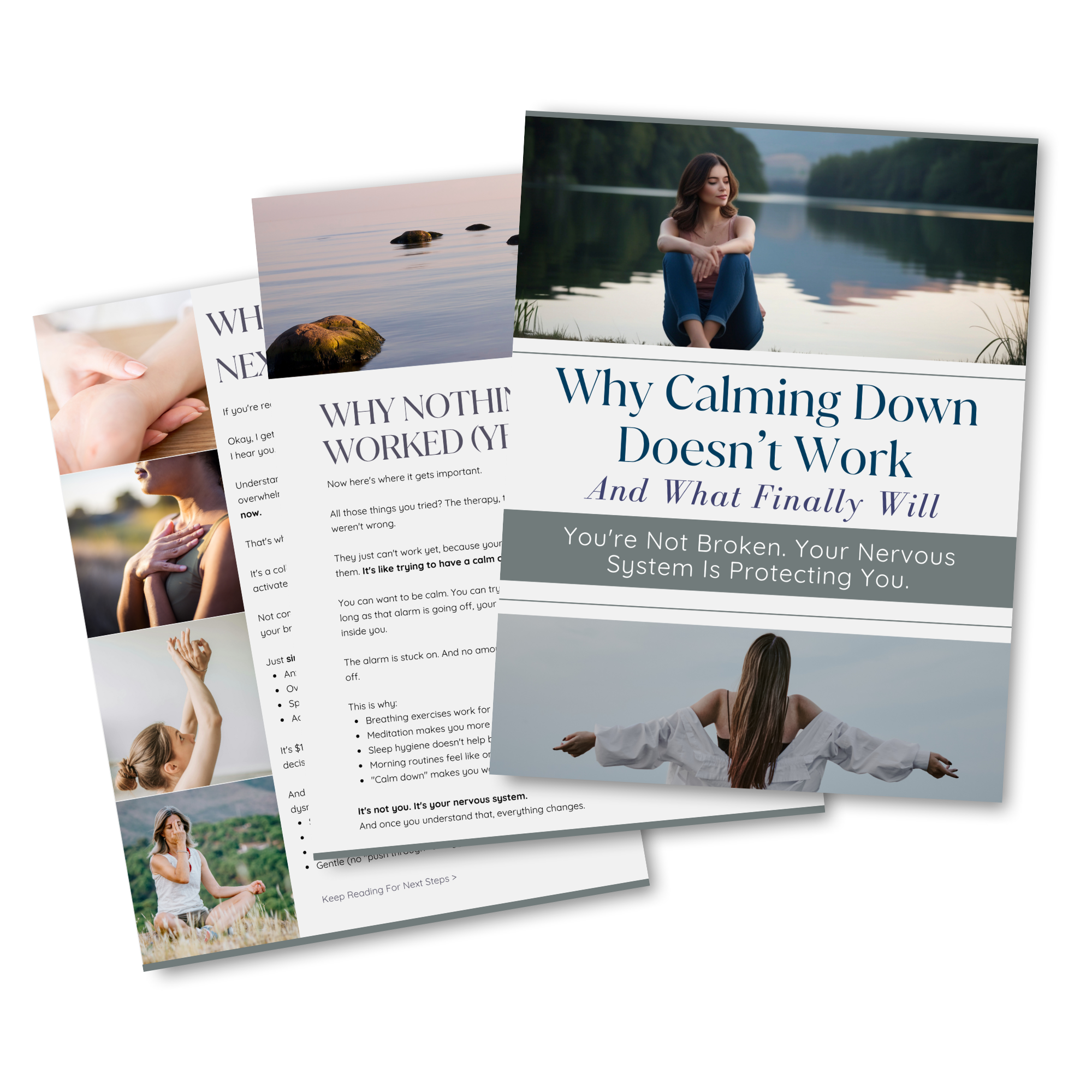
Free Guide: Why Calming Down Doesn’t Work
(And What Finally Will)
You’re Not Broken. Your Body Is Protecting You.
Your inbox stays calm, too. Unsubscribe anytime. We respect your privacy.
3. Loosen Your Jaw
Most of us drive with clenched jaws and don’t even realize it.
Try this: keep your eyes on the road, but gently open your mouth just slightly. Let your tongue relax away from the roof of your mouth. You might even move your jaw side to side a few times, like you’re chewing something slowly.
Releasing jaw tension is a signal to your nervous system that there’s no threat to brace against. It’s subtle, but it works.
4. Soften Your Gaze

When you’re in fight-or-flight mode, your vision narrows. You focus hard on what’s directly in front of you. That’s useful if you’re actually in danger, but when you’re just driving to Target, it keeps your system on high alert.
Instead, try softening your gaze. Keep your eyes on the road, but let your peripheral vision widen. Notice the trees on the side of the road, the sky, the movement around you without locking onto any one thing.
This tells your body that you’re not hunting or being hunted — you’re just here, moving through space.
5. Feel Your Body Against the Seat
Grounding doesn’t require your feet to be on the ground.
While you’re driving, bring your attention to where your body is making contact with the car. Your back against the seat. Your legs on the cushion. Your hands on the wheel.
You don’t have to do anything with this awareness. Just notice it. That simple act of feeling where you are in space can help your nervous system remember that you’re safe, supported, and not falling.
A Gentle Reminder
You don’t need to do all of these. You don’t even need to do one of them perfectly.
If you try the jaw thing and it doesn’t feel like much, that’s fine. If humming feels too weird right now, skip it. These are just options. Not assignments. Your body gets to decide what feels supportive in any given moment.
This is one of those posts that can be helpful to come back to. If you use Pinterest, saving it now can make it easier to find the next time you’re in the car and could use a vagus nerve reset.
Save This For Later

You Don’t Have to Keep White-Knuckling It
If you’ve been told to “just relax” or “try meditating” and it’s never quite worked, that’s not a you problem.
Calming down doesn’t always work because your nervous system isn’t looking for calm — it’s looking for safety. And those are two very different things.
I put together a short guide that breaks down why traditional calming techniques often miss the mark, and what actually helps when your system is stuck in overdrive. It’s called Why Calming Down Doesn’t Work (And What to Do Instead), and you can grab it for free right here.
Free Guide: Why Calming Down Doesn’t Work
(And What Finally Will)
You’re Not Broken. Your Body Is Protecting You.
Your inbox stays calm, too. Unsubscribe anytime. We respect your privacy.
It’s not a fix-all. But it might be the thing that finally makes sense of why you feel the way you do, and what to try instead.