
10 Somatic Exercises That Actually Reconnect Your Mind and Body (These Aren’t Just Stretching)
You’ve seen the somatic exercises videos. Women lying on the floor in leggings, doing slow, almost-nothing movements while soft music plays in the background.
It looks too simple. Too quiet. Maybe even a little woo.
But then you tried one. Maybe it was late at night, after the house finally went still. You laid on the carpet and did something you saw in a reel (some kind of slow twist or leg drop), and for maybe 30 seconds… something shifted. Your shoulders came down from your ears. That clenched jaw softened. Your brain got quieter, just for a second.
And then you went looking for more. But every list you found online said the same things. “Gentle stretching,” “deep breathing,” “body awareness.” Nothing told you what you were actually doing. Or why it mattered.
That’s where somatic exercises come in.
Somatic exercises are gentle, intentional movements designed to release tension your body has been holding (often without you realizing it) by working with your nervous system instead of against it. They’re not stretching. Not yoga, either. They’re your body’s own language for processing what it’s been carrying.
And they’re simpler than you think.
Why Somatic Exercises Aren’t Just Stretching
Here’s why these don’t belong in the same category as a hamstring stretch or a yoga flow.
Stretching targets your muscles. It lengthens tissue. Somatic exercises target your nervous system. They release the brain’s grip on the tension.
That’s a different mechanism. As a result, it produces a very different result.
When your nervous system gets stuck in overdrive (fight, flight, freeze), your muscles lock up as part of the protection response. You can stretch that tightness all day. However, if the nervous system is still sending the “stay tight, stay ready” signal, it comes right back. Every time.
Somatic exercises talk directly to the system that’s creating the tension. That’s why a 60-second movement can sometimes do more than an hour on a yoga mat.
A 2014 randomized controlled trial published in the Journal of Traumatic Stress found that somatic experiencing significantly reduced PTSD symptoms compared to a waitlist control group. The body remembers what the mind tries to forget. And the body can also release it.
If you’re brand new to this, Somatic Exercises for Beginners: A Gentle Start walks through the basics of how and why these work.
10 Somatic Exercises That Work in Real Life
These aren’t theoretical. Every exercise here comes with a real-life moment where it fits. Because the best somatic practice isn’t the most advanced one. It’s the one you’ll actually do on a Tuesday when you’re running on four hours of sleep.
1. The Physiological Sigh
What it does: Activates your parasympathetic nervous system (the “calm down” branch) in under 90 seconds.
How: Inhale through your nose. Then, before exhaling, take one more small sip of air through your nose. Now exhale slowly through your mouth. One long, audible sigh.
When to use it: Before getting out of bed. In the car at pickup. In the bathroom at work when you need 30 seconds alone.
Extended exhale breathing activates the parasympathetic nervous system within 90 seconds (Stanford Medicine). That’s not a metaphor. It’s measurable.
“It’s the most effective physical shift that you can feel in your body. Not a magic pill, because none of these are. But it creates a pattern I can feel of going from highly sensitized to feeling more calm.”
2. Crossbody Arm Swing
What it does: Re-engages both hemispheres of your brain, bringing your prefrontal cortex back online after a stress response.
How: Stand with your feet hip-width apart. Let your arms hang loose. Gently twist your torso left and right, letting your arms swing naturally across your body. Not forced. Just gentle momentum. In yoga, this is called “knocking on heaven’s door.”
When to use it: When your mind is spiraling. When you can’t think straight. When you’ve been scrolling for 20 minutes and didn’t realize it.
Once we get agitated or over-sensitized, our prefrontal cortex is designed to turn off. The amygdala takes over so we can make quick actions without having to process them. Great if you’re actually in danger. Not helpful when you’re standing in your kitchen trying to figure out what’s for dinner.
Crossbody stimulation helps re-engage the left and right parts of your brain so that the thinking part can come back online. Then you can respond, not just react.
3. Toe Relaxation
What it does: Gives your brain one tiny focal point when everything else feels like too much.
How: Without moving anything else, focus all your attention on your toes. Try to relax just your toes. Not your whole body. Not your shoulders. Just your toes.
When to use it: Stuck in a drive-through line. Waiting at the doctor’s office. In any moment where your body wants to run and you can’t leave.
“If I can’t relax my entire body or my entire nervous system, can I relax just my toes?”
Sometimes the smallest thing is the only thing that gets you through. You don’t have to calm your entire body at once. Start with the smallest piece of yourself you can access.
If you want these exercises in a form you can actually follow this week, my free Somatic Starter Kit lays out the simplest ones step by step.
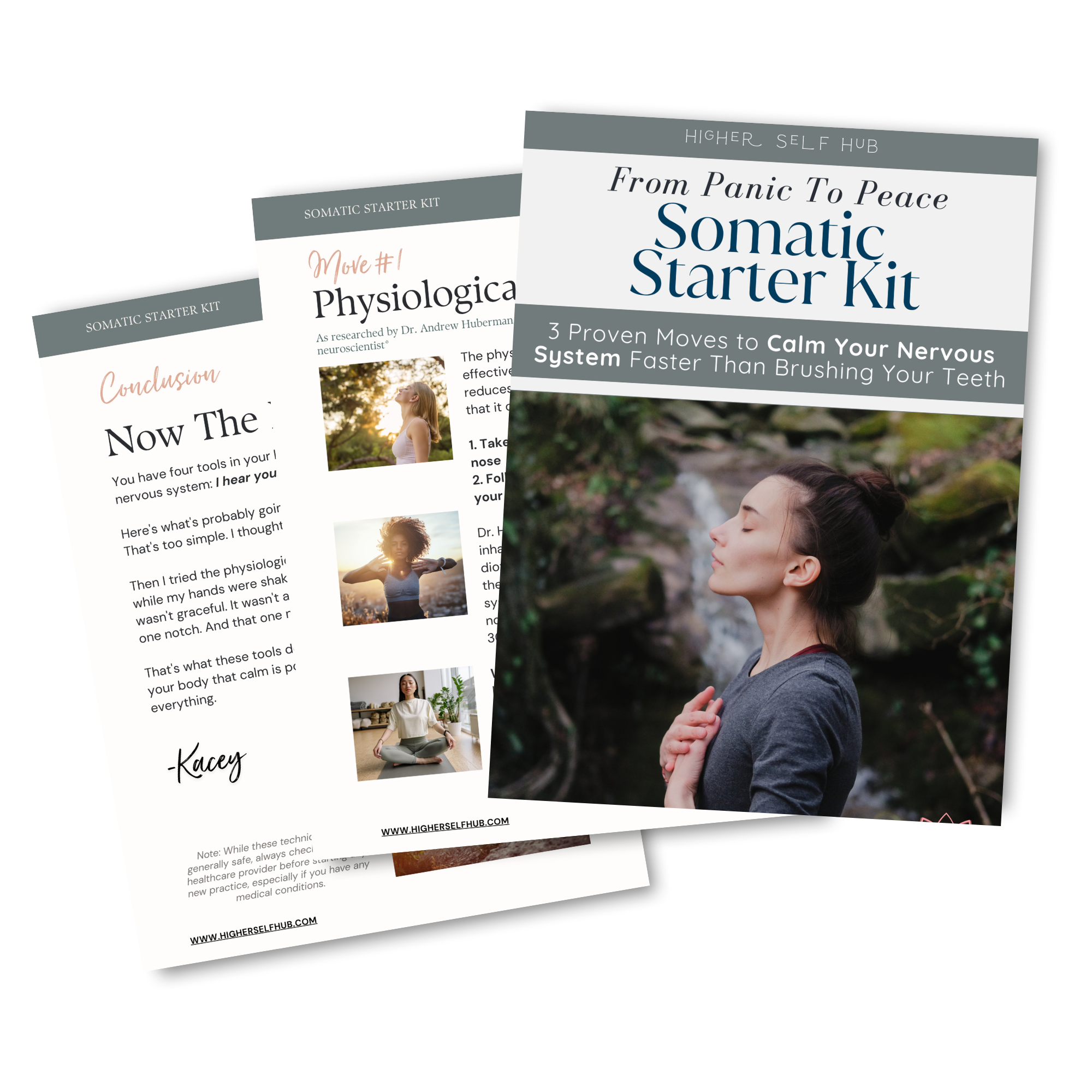
Your Free Somatic Starter Kit
3 science-backed tools to go from panic to peace in under 60 seconds.
Your inbox stays calm, too. Unsubscribe anytime. We respect your privacy.
4. The Jaw Release
What it does: Releases stored tension from the jaw, which is directly connected to your vagus nerve and your stress response.
How: Place the tip of your tongue on the roof of your mouth, just behind your front teeth. Let your mouth fall gently open. Feel your jaw muscles soften. Hold for 10 to 15 seconds, breathing naturally.
When to use it: After clenching all day. Before bed. When you notice your teeth are pressed together (which, if you check right now, they probably are).
Your jaw is one of the first places your body stores protective tension. Still, it’s also one of the easiest places to release it. Most people don’t realize they’ve been holding their jaw tight until someone tells them to let it go.
5. Shaking and Tremoring (The Somatic Exercise Animals Do Naturally)
What it does: Completes the stress cycle your body started but never finished. Animals do this naturally after a threat passes. Humans tend to suppress it.
How: Stand up. Bounce lightly on the balls of your feet. Let the movement travel up through your knees, hips, and torso. Shake your hands and arms. It might feel silly. That’s fine. Do it for 60 seconds.
When to use it: After a stressful phone call. After a hard parenting moment. Any time your body is buzzing with energy that has nowhere to go.
Your nervous system processes stress signals in as little as 80 milliseconds, far faster than conscious thought (Stephen Porges, Polyvagal Theory). That means your body reacted to the stressor before you even had time to think about it. Shaking is how it finishes what it started.
6. The Wall Push
What it does: Gives your fight response somewhere safe to go. Instead of suppressing the impulse to push back, you let it complete through your body.
How: Face a wall. Place both hands flat against it at shoulder height. Push into the wall with steady pressure for 10 to 15 seconds, like you’re trying to move it. Then release. Notice what you feel.
When to use it: When frustration is building in your chest. When you need to do something with the energy but can’t yell or leave.
“This is a protective response. A protective response is normal. How can I bring more connection to this moment?”
7. The Self-Hug (Butterfly Tap)
What it does: Bilateral stimulation that calms the nervous system through rhythmic, alternating touch. Similar to what therapists use in EMDR, but gentler and self-directed.
How: Cross your arms over your chest so each hand rests on the opposite shoulder. Gently tap, alternating left and right, at a slow, steady rhythm. Like rocking yourself. Because that’s essentially what you’re doing.
When to use it: At your desk. In bed before sleep. Anywhere you can sit quietly for a minute and no one needs to know what you’re doing.
8. The 2-Minute Body Scan
What it does: Brings your awareness back into your body when you’ve been dissociated, stuck in your head, or scrolling without realizing it.
How: Close your eyes (or soften your gaze). Start at the top of your head and slowly move your attention down. Forehead. Jaw. Neck. Shoulders. Chest. Belly. Hips. Legs. Feet. You’re not trying to fix anything. Instead, just notice what’s there.
When to use it: Standing at the kitchen counter. In the car before going inside. Any time you realize you’ve been “somewhere else” mentally.
You don’t need a meditation app. You don’t need a quiet room. A body scan takes less than 2 minutes, and all it does is pull your attention out of the spiral and back into the body you’re actually standing in.
9. The Grounding Walk
What it does: Combines gentle movement with sensory awareness to reset your nervous system through bilateral stimulation (left foot, right foot, left, right) and environmental connection.
How: Walk slowly. Notice each foot touching the ground. Feel the air on your skin. Name 3 things you can see. That’s it. No pace. No particular destination. Not even a podcast.
When to use it: When you need a reset but lying on the floor isn’t an option. When the house is too much. In fact, even 5 minutes will change the channel.
If you want to explore this more, 5 Somatic Exercises For a Vagus Nerve Reset includes techniques that work even when you’re stuck in the car.
10. Full-Body Yawn and Stretch (Somatic Exercises You Already Do)
What it does: Triggers your parasympathetic system through deep diaphragmatic expansion. For example, yawning is actually a nervous system regulation tool, not just a sign of boredom.
How: Fake a yawn if you need to. (Your body usually catches on.) Stretch your arms overhead. Open your mouth wide. Let the sound out. Stretch until your body feels done.
When to use it: First thing in the morning. After sitting too long. Whenever your body is asking for it and you’ve been saying “not now.”
How to Start Somatic Exercises (Even on Your Hardest Day)
Pick the one that sounds like the least amount of effort. Do it for 60 seconds. See what you notice.
You don’t have to do all ten. You don’t have to do them in order. Some will resonate immediately. Others might feel strange at first. That’s normal.
The goal isn’t to master a routine. It’s to give your body one small way to process what it’s been carrying. On your terms. In your own time. The 60-Second Reset isn’t a program. It’s a permission slip. Any of these somatic exercises, adapted to fit 60 seconds of your real life, counts.
If you want to understand how these somatic exercises specifically affect cortisol (the stress hormone your body floods you with when it thinks you’re in danger), this post breaks it all down.
Your Body Already Knows These Somatic Exercises
Your body has been holding onto things for you. Tension, stress, moments it never got to finish processing. These somatic exercises aren’t asking you to override any of that. They’re asking you to meet it.
You already felt it once. That thing that shifted when you tried the movement from the reel. It wasn’t a fluke. That was your body responding to something it’s been waiting for.
If you want to understand more about why calming down doesn’t always work (and what does), I break it all down in this free guide: Why Calming Down Doesn’t Work (And What Finally Will)
This is one of those posts worth saving for later. If you use Pinterest, pinning it makes it easy to find when you need it.
Start with one exercise, tonight, from the free Somatic Starter Kit below. Your body will take it from there.
Your Free Somatic Starter Kit
3 science-backed tools to go from panic to peace in under 60 seconds.
Your inbox stays calm, too. Unsubscribe anytime. We respect your privacy.