

6 Surprising Places Your Body Stores Hidden Emotions (And How to Finally Release Them)
You notice it at the strangest times. Standing in line at the grocery store, your chest tightens for no reason. Sitting in a meeting, your stomach drops the second someone raises their voice. Driving home after a perfectly fine day, you notice you have a death grip on the steering wheel.
Nothing happened. Not really. But your body is responding to something.
And if you’ve ever wondered why certain feelings seem to live in specific places (the knot in your throat, the ache behind your eyes, the weight on your chest), you’re already noticing emotions stored in your body.
There’s a reason your body holds onto emotions the way it does. The good news is that once you understand where emotions are stored in the body, you can start to work with those signals instead of against them.
Why Emotions Get Stored in the Body in the First Place
Your nervous system is always running in the background, scanning for safety. When something feels threatening (even emotionally, like conflict, rejection, or being overwhelmed), your body responds before your brain catches up. Muscles tighten. Breathing shifts. Your posture changes.
Often, these responses don’t fully complete. Instead of shaking it off the way animals do after a chase, we push through. We keep working. We smile and say “I’m fine.”
The activation stays in the body, tucked into muscles and tissues, sometimes for years.
This is how emotions get stored in the body. Not because something is wrong with you, but because your nervous system is doing exactly what it was designed to do: protecting you by holding what you weren’t able to process in the moment.
If you want to understand what’s happening beneath read ‘Why Calming Down Doesn’t Work (And What Finally Will)‘ It helps you understand the nervous system patterns behind stress responses, so you can work with your body instead of fighting it.
According to Harvard Health, chronic activation of this survival response can affect everything from digestion to sleep to immune function. So when your body holds tension, it’s not just a feeling. It’s a whole-system pattern.

Common Places Where Your Body Stores Emotions
Everyone’s body tells a slightly different story. However, there are patterns that show up again and again. Research from the University of Aalto (published in PNAS) mapped where people consistently feel specific emotions in the body. The results were remarkably consistent across cultures.
Here are some of the most common places where emotions are stored in the body, and what they might be connected to.
Jaw and Throat
Tightness here often connects to things left unsaid. If you clench your jaw at night or feel a lump in your throat before hard conversations, your body may be holding words it never got to speak. Frustration and grief tend to settle here, especially for people who learned early on to keep quiet.
Shoulders and Neck
This is where responsibility likes to camp out. The weight of carrying too much (for too long, for too many people) often shows up as chronic tension across the upper back. If your shoulders hike up the moment you open your email, that’s your nervous system bracing for the next thing on your list.
Chest and Heart Space
Heaviness or tightness in the chest is often linked to sadness, longing, or heartbreak. Sometimes it shows up as a feeling of pressure, like something is sitting on your sternum. For many women, this area also holds the ache of feeling unseen or emotionally depleted.
Stomach and Gut
Your gut has its own nervous system (it’s called the enteric nervous system, and it contains more neurons than your spinal cord). So when people say they have a “gut feeling,” it’s not just a metaphor. Fear, anxiety, and dread often live right here. Butterflies, nausea, tightness below the ribs. These are all ways your body processes uncertainty.
Hips and Pelvic Floor
The hips are sometimes called the body’s emotional storage unit. Old survival patterns, particularly around safety, control, and vulnerability, tend to settle deep in the hip flexors and pelvic floor. If you’ve ever done a hip-opening stretch and felt unexpected emotion rise, that’s your body releasing something it’s been holding.
Hands and Feet
Cold hands, restless legs, tingling feet. These can all be signs of a nervous system that’s stuck between “go” and “freeze.” When your body doesn’t know whether to run or shut down, the extremities often bear the confusion. Numbness or restlessness in the hands and feet can point to unresolved activation.
What to Do When You Notice Emotions Stored in Your Body
Noticing is the first step. Not fixing, not analyzing, not pushing through. Just noticing. The goal isn’t to force your body to let go. Instead, it’s about building a relationship with what’s already there.

Here are a few small, nervous-system-safe ways to start working with emotions stored in the body.
1. Do a Simple Body Scan
Close your eyes or soften your gaze. Start at the top of your head and slowly move your attention downward. Don’t try to change anything. Just notice where you feel tension, heaviness, heat, buzzing, or nothing at all. All of it counts. Even numbness is information.
2. Name the Sensation (Not the Story)
Instead of asking “why do I feel this way,” try asking “what does this feel like?” Tight. Heavy. Warm. Buzzy. Hollow. Keeping it physical helps your nervous system stay regulated instead of spiraling into the narrative. Often, just naming the sensation takes some of its intensity away.
3. Place a Hand Where You Feel It
This sounds almost too simple. But placing a warm hand on the area where you feel tension sends a direct signal of safety to your nervous system. One hand on your chest. Both hands on your belly. A palm resting on the side of your neck. Gentle pressure tells your body: I’m here. I notice you.
4. Breathe Into (Not Away From) the Sensation
When something feels uncomfortable in the body, the instinct is to tighten around it or distract yourself. Instead, try directing a slow exhale toward it. Imagine your breath reaching the tightness in your shoulders, or softening the knot in your stomach. You’re not trying to make it disappear. You’re just giving it a little more room.
5. Track It Over Time
One body scan is a snapshot. Several body scans, tracked over days or weeks, become a mirror. Patterns start to emerge. Maybe your chest always tightens on Sunday nights. Perhaps your jaw locks during family phone calls. Tracking helps you connect the dots between what’s happening in your life and what’s happening in your body.
If you want a structured way to do this, the Somatic Body Map & Nervous System Regulation Workbook walks you through the process with guided body outlines and reflection prompts. Not homework. Just a quiet place to put what you notice, so the patterns become clearer over time.
Why Understanding Where Emotions Are Stored in the Body Matters
When you can recognize the connection between what you feel emotionally and where you feel it physically, something shifts. You stop blaming yourself for being “too sensitive” or “too stressed.” You start seeing your body’s signals as information, not inconvenience.
This is the foundation of somatic awareness. Rather than trying to think your way out of a feeling, you learn to meet it where it actually lives. In your body. In the tightness, the heaviness, the holding. According to research on the vagus nerve, this kind of body-based awareness can directly support nervous system regulation.
If you want to understand more about why calming down doesn’t always work (and what does), I break it all down in this free guide: Why Calming Down Doesn’t Work (And What Finally Will).
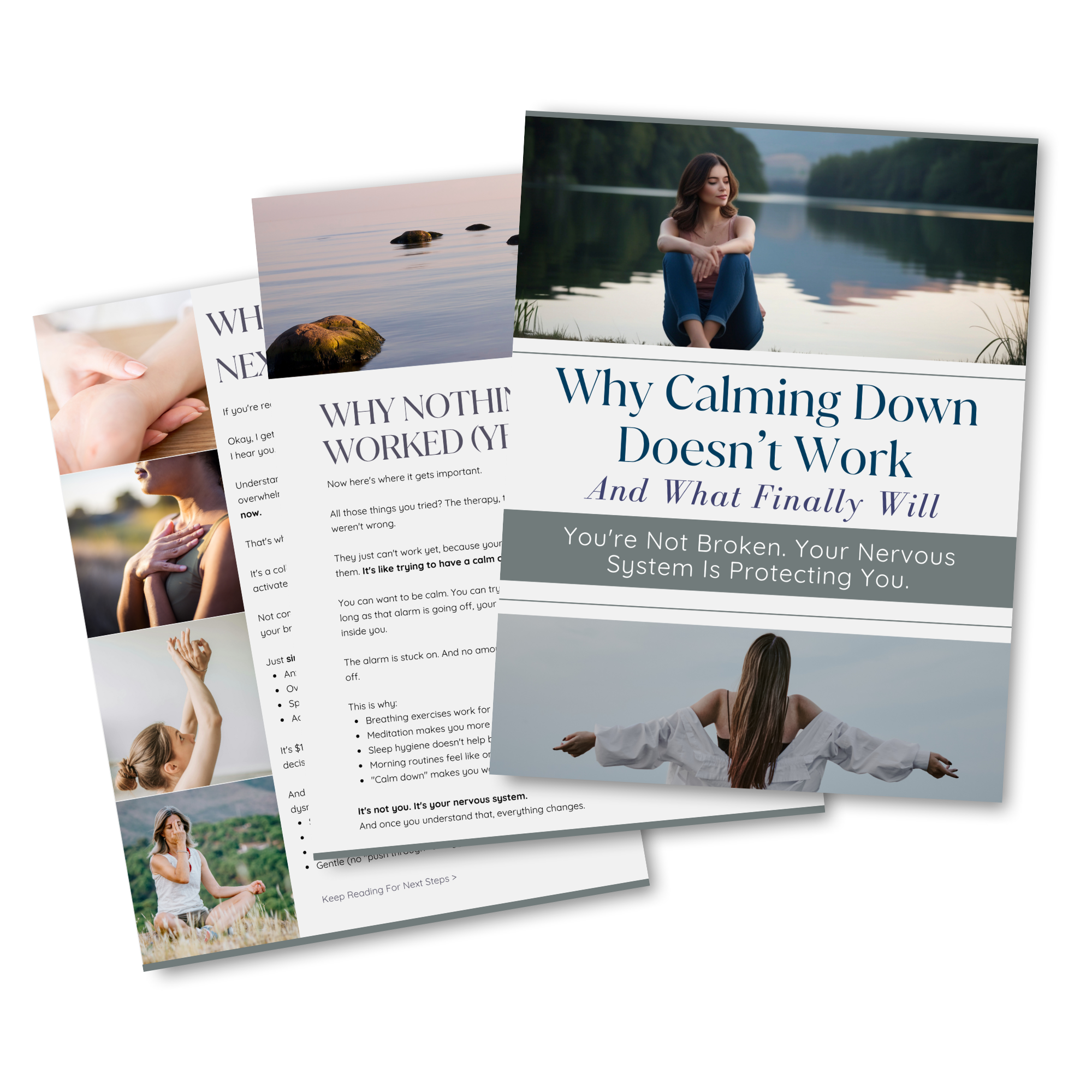
Free Guide: Why Calming Down Doesn’t Work
(And What Finally Will)
You’re Not Broken. Your Body Is Protecting You.
Your inbox stays calm, too. Unsubscribe anytime. We respect your privacy.
You don’t have to decode every signal today. Understanding where emotions are stored in the body is something that deepens slowly, one quiet observation at a time. The fact that you’re reading this means you’re already paying attention. That’s more than enough for right now.
Your Body Has Been Keeping Score. Now You Can Listen.
Every tight muscle, every clenched jaw, every unexplained heaviness in your chest has been trying to tell you something. Not to alarm you. Not because anything is wrong. Because your body has been carrying what your mind wasn’t ready to hold.
Now you have a starting point. A way to notice, name, and gently begin to understand the emotions stored in your body. That understanding doesn’t happen all at once, and it doesn’t need to.
📌 Save This For Later

Related posts you might find helpful: