

9 Calming Activities That Actually Work When You’re Overwhelmed
It’s 2 PM on a Tuesday and you’re locked in the bathroom at a family lunch, palms flat on the counter, trying to remember how to breathe like a normal person. Your chest is tight. Your jaw is clenched. And the only thought on repeat is I just need this to stop.
What you’re looking for in that moment, whether you have the words for it or not, are calming activities that actually work when your body is already past the point of “just relax.”
Calming activities are body-based practices designed to interrupt your nervous system’s stress response and help you shift from overwhelm back to a felt sense of safety.
Here’s the thing: most calming advice is written for people who are a little bit tense. A little wound up. Maybe slightly annoyed. It’s not written for the version of you who feels like your skin is on inside out and someone just asked you to pass the salt.
When your nervous system is already activated, telling yourself to calm down is like trying to reason with a smoke alarm. The alarm doesn’t care about logic. It only cares about the signal it’s receiving. So deep breathing, positive affirmations, and “just letting it go” often feel impossible in those moments. Not because you’re doing it wrong. Because your body needs something different first.
Why Most Calming Activities Don’t Work When You Need Them Most

When you’re overwhelmed, your nervous system shifts into a protective state. It’s doing its job. The problem is, once that switch flips, the thinking part of your brain (the part that knows you’re safe, that this isn’t actually an emergency) goes offline. Essentially, your body takes over.
That’s why calming activities that rely on willpower, logic, or focus tend to fall flat in the middle of a spiral.
They’re asking your brain to do something it physically can’t do right now. It’s not a mindset problem. It’s a nervous system response.
What does work? Things that talk to the body first. Sensory input, physical pressure, vibration, temperature shifts. These are the kinds of signals that can interrupt the loop your nervous system is stuck in, without needing you to think your way out of it. In fact, the less thinking involved, the better.
9 Calming Activities That Actually Work When You’re Overwhelmed
Each of these is designed for real life. Not a meditation retreat. Not a quiet room with candles. These are for the bathroom, the car, the 2 AM spiral, the school pickup line. Pick the one that sounds easiest and start there.
1. The Physiological Sigh
Take a quick inhale through your nose, then immediately take a second, shorter inhale on top of it (like a double sniff). Then let out one long, slow exhale through your mouth. That’s it. One round is often enough to feel a shift.
When to use it: In the car before you walk into work. At your desk when a message makes your stomach drop. At 2 AM when your thoughts start looping.
Why it works: Research shows this breathing pattern is the fastest known way to activate the parasympathetic nervous system, because the double inhale reinflates the tiny sacs in your lungs and the long exhale slows your heart rate.
Want a quick reference guide? The Somatic Starter Kit has the best somatic exercises to calm your nerves in less time than it takes to brush your teeth.
2. Run Cold Water Over Your Wrists
Turn on the cold tap and hold the insides of your wrists under the water for 30 to 60 seconds. Focus on the sensation. Let the temperature do the work.
When to use it: In the bathroom at a dinner party. At the office when you need a reset between meetings. Any time you have access to a sink and 60 seconds of privacy.
Why it works: Cold on the wrists activates the dive reflex, a built-in mammalian response that slows your heart rate and pulls your nervous system toward calm. No one even has to know you’re doing it.
3. 5-4-3-2-1 Sensory Grounding
Silently name 5 things you can see, 4 you can touch, 3 you can hear, 2 you can smell, and 1 you can taste. You don’t have to close your eyes. You don’t have to say it out loud. Just notice.
When to use it: In a crowded room when everything feels too loud. In the grocery store when overwhelm hits out of nowhere. During a conversation you’re trying to stay present for.
Why it works: Sensory input anchors your brain in the present moment, which interrupts the future-focused thought spiral that keeps your nervous system activated.
If you want a head start on the body-based options below, my free Somatic Starter Kit walks you through the basics.
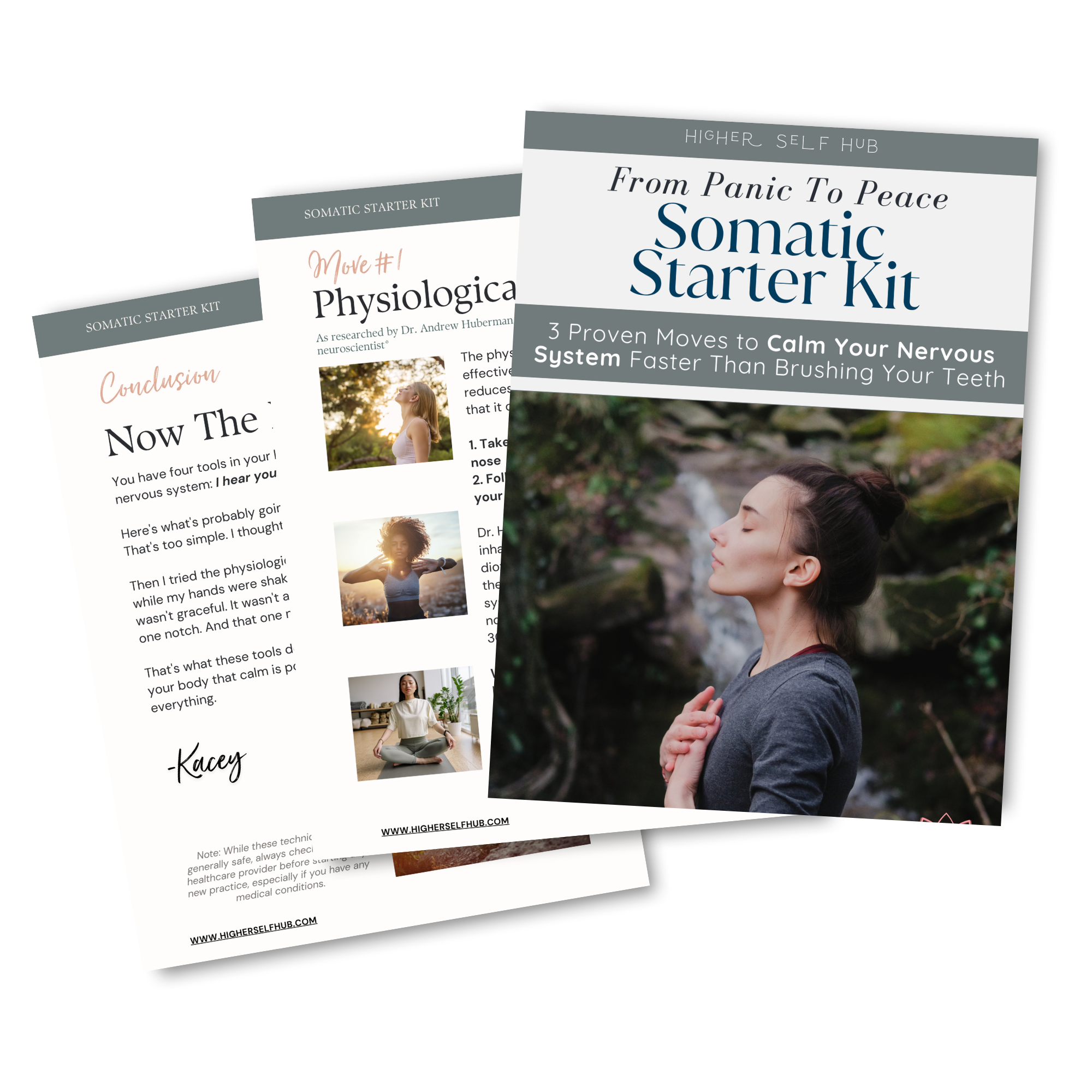
Your Free Somatic Starter Kit
3 science-backed tools to go from panic to peace in under 60 seconds.
Your inbox stays calm, too. Unsubscribe anytime. We respect your privacy.
4. Hum or Voo Breathe
Take a breath in, then hum as you exhale. Low and slow, like you’re humming a lullaby to yourself. If you want to go deeper, try the “voo” sound instead (rhymes with “who”). Let the vibration fill your chest.
When to use it: In the car with the windows up. In the shower. In bed at night when your body won’t settle.
Why it works: The vibration from humming stimulates the vagus nerve, which runs through your throat and chest, and sends a direct safety signal to your nervous system.

5. The Sour Candy Reset
Pop something intensely sour in your mouth. A Warhead, a sour gummy, even a squeeze of lemon if that’s what you have. Let the flavor jolt you. Don’t think about it. Just taste it.
When to use it: When your brain is stuck in a loop and nothing else is cutting through. Keep a few sour candies in your bag or desk drawer for these moments.
Why it works: A strong taste sensation forces your brain to process something new, which interrupts the repetitive thought cycle and redirects your attention to your body.
6. Intentional Yawning
Fake a yawn. Open your mouth wide, stretch your jaw, and pretend. After one or two fake ones, a real yawn will usually follow. Let it happen. Let your eyes water. Let the stretch move through your face and neck.
When to use it: At your desk. On the couch. Sitting in the school pickup line. This one is so subtle that no one will even notice.
Why it works: Yawning triggers the parasympathetic nervous system (the “rest and digest” side), signaling your body that the threat has passed, even if your mind hasn’t caught up yet.
If you want calming activities like these in a format you can pull up on your phone the moment you need them, I put together a free guide that breaks down why calming down doesn’t always work and what to do instead.
7. Smell Something Strong
Hold a peppermint roller under your nose. Smell your coffee. Open a jar of something sharp, like eucalyptus salve or a citrus peel. Inhale slowly and deliberately, focusing on what you’re smelling rather than what you’re feeling.
When to use it: At home when overwhelm creeps in during a quiet evening. At work between back-to-back calls. While cooking, when the day finally catches up with you.
Why it works: Scent is processed through the olfactory system, which has a direct line to the amygdala (your brain’s alarm center). A strong, familiar smell can shift you out of fight-or-flight faster than almost anything else.
8. Press Your Back Against a Wall
Stand with your entire back flat against a wall. Shoulder blades, low back, head. Press into it. Feel the solid surface behind you. Stay for 30 seconds or as long as you need.
When to use it: In a hallway. In the bathroom. In your bedroom when your body feels buzzy and ungrounded. This is also a good one for the middle of the night when you can’t sleep.
Why it works: The firm pressure on your back provides proprioceptive input, which tells your nervous system that you are physically supported. That signal alone can shift you from activated to settled.
9. Squeeze and Release Your Fists
Make tight fists with both hands. Squeeze hard for 5 seconds, like you’re wringing out a washcloth. Then release all at once. Let your hands fall open in your lap. Notice the contrast between tension and release. Repeat two or three times.
When to use it: Under the table at dinner. In a meeting. In bed. Anywhere, truly, because no one can see your hands. This is one of the most discreet calming activities on the list.
Why it works: Progressive muscle release works by giving your body a controlled version of the tension it’s already holding, then letting it go. That release tells your nervous system the danger has passed.
Start With the One That Sounds Easiest
You don’t have to try all nine. That’s not the point.
The point is having one thing you can reach for when your body is louder than your brain.
So pick the calming activity that sounds like the least amount of effort. Maybe that’s the cold water. Maybe it’s the fist squeeze. Maybe it’s just yawning on purpose. Whatever it is, practice it once when you’re not overwhelmed so your body remembers it when you are.
It also helps to keep your go-to technique somewhere easy to find. A note on your phone. A screenshot on your lock screen. Something you can pull up without having to search for it in the middle of a spiral, because that’s the moment when your brain will tell you nothing works and it’s not worth trying. Having it already there, already chosen, already familiar, takes one decision off your plate when decisions feel impossible.
If you want to read more about how somatic exercises help your nervous system release stored tension, that post walks through the body-first approach in more detail. And if you’ve ever tried simple techniques that work in the moment, you’ll recognize some of the same nervous system principles at play here.
Your Body Isn’t Broken
If you’ve been feeling like you should be able to handle things better, or like other people don’t seem to fall apart this easily, that’s not a character flaw. That’s your nervous system doing its job. It’s trying to protect you. It’s just using the only tools it has.
These calming activities aren’t about fixing yourself. They’re about giving your body a different signal. One that it can actually hear.
If you want all of these calming activities in one printable guide with phone wallpapers for quick access, The Undercover Calm Guide was built for exactly that. Twelve somatic grounding and calming techniques, designed to fit in your pocket and your real life. On your terms.
If This Post Landed For You, Save it For Later

Somatics, Simplified
If you tend to do what I do, and read something great, then forget it, you’ll appreciate this: The Somatic Starter Kit has the best body-based moves to calm your nervous system fast. And it’s free here:
Your Free Somatic Starter Kit
3 science-backed tools to go from panic to peace in under 60 seconds.
Your inbox stays calm, too. Unsubscribe anytime. We respect your privacy.