
7 Body-Based Resets You Can Do at Your Desk When Burnout Hits
You’re staring at your inbox. Fourteen unread. Three marked urgent. Your cursor is blinking in a reply you started twenty minutes ago and still haven’t finished.
Your hands are tight on the keyboard. Your jaw has been clenched since the morning meeting. You haven’t taken a real lunch break in… actually, you can’t remember the last time you did.
Somewhere underneath the to-do list, your body is screaming. But there’s no time to deal with that right now. There’s never time.
Work burnout isn’t just mental exhaustion. It’s your nervous system stuck in fight-or-flight mode during the hours you’re supposed to be productive, processing threat signals from emails, deadlines, and meetings the same way it would process actual danger. And you can’t exactly lie on the floor of your office and do breathwork.
But you can reset your nervous system in 10 to 60 seconds, at your desk, without anyone noticing. That’s what these seven tools are for.
Why Your Body Needs a Different Kind of Break From Work Burnout
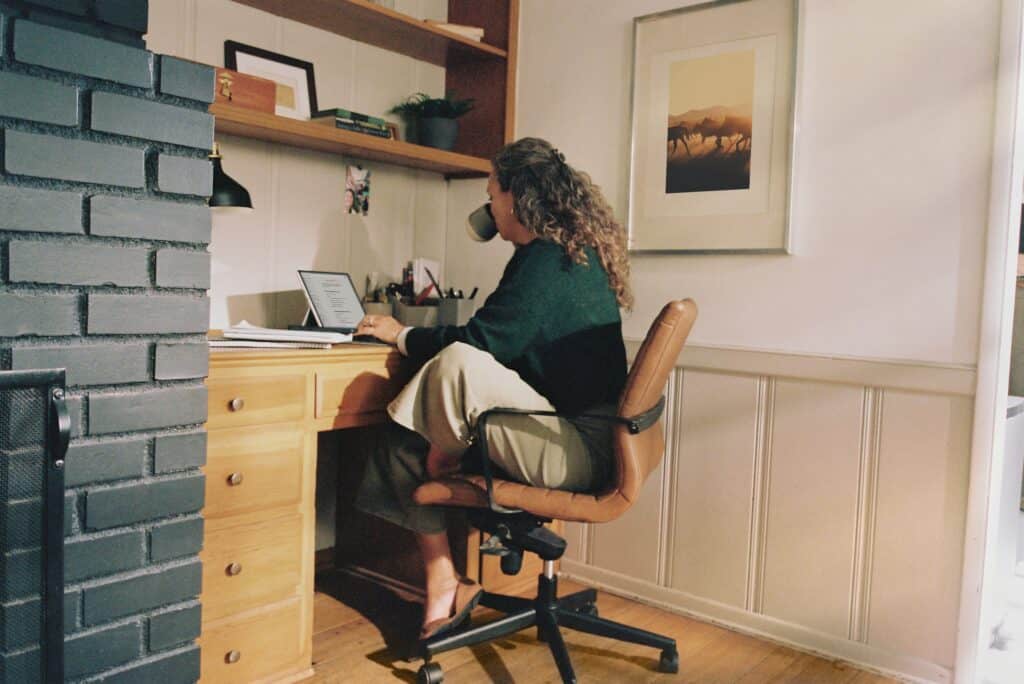
Here’s what happens in your nervous system during a typical workday:
Your autonomic nervous system processes threat signals in as little as 80 milliseconds (Porges, Polyvagal Theory). Every email notification, every unexpected Slack ping, every meeting that should have been an email. Your body reads each one as a low-grade threat. Not life-threatening. But enough to keep cortisol elevated and your nervous system on alert.
By 2pm, your body has processed hundreds of these micro-signals. Your prefrontal cortex is exhausted. Your shoulders are concrete. And the “break” you’re told to take (go for a walk, step away from the screen) feels impossible because there’s too much to do.
These resets don’t require stepping away. They work where you are.
The 7 Body-Based Resets for Work Burnout
1. The Physiological Sigh (60 Seconds)

One inhale through your nose. A second small sip of air through your nose. Then a long, slow exhale through your mouth.
Research from Stanford Medicine shows that extended exhale breathing activates the parasympathetic nervous system within 90 seconds. One or two rounds of this can shift you from “I want to scream at this email” to “okay, I can deal with this.”
You can do this on a Zoom call with your camera off. In a bathroom stall. Between emails. Nobody sees it. Nobody hears it. Your nervous system feels it.
2. Toe Relaxation (10 Seconds)

When everything is clenched and you can’t figure out where to start, relax just your toes.
This sounds absurd. But when your whole body is bracing against the workday, picking the smallest, most invisible body part and deliberately releasing it sends a signal to your nervous system: you can let go of something. Not everything. Just this.
Under the desk. In the meeting. During the call. Ten seconds. Done.
3. The Peripheral Vision Shift (30 Seconds)

When you’re in fight-or-flight, your vision narrows. Literally. Your eyes focus on the perceived threat (the screen, the inbox, the deadline) and your peripheral awareness shrinks.
To reverse this: without moving your head, expand your awareness to the edges of your vision. Notice what’s to the far left. The far right. Above you. Below you.
This sends a safety signal to your nervous system. If you can see the whole room, there’s no immediate threat. Your body starts to stand down.
This is one of the most effective nervous system regulation techniques that exists, and it looks like you’re staring at your screen thinking.
Free Guide: Why Calming Down Doesn’t Work
(And What Finally Will)
You’re Not Broken. Your Body Is Protecting You.
Your inbox stays calm, too. Unsubscribe anytime. We respect your privacy.
4. The Seated Crossbody Tap (60 Seconds)

Cross your arms and tap alternating hands on your upper arms or shoulders. Left, right, left, right. Slow and steady.
This bilateral stimulation re-engages both hemispheres of your brain. When you’re in work burnout mode, your prefrontal cortex goes offline and your amygdala takes over. That’s why you can’t think clearly, can’t prioritize, can’t figure out which email to answer first.
The tapping brings the thinking brain back. You can do this while reading an email. While waiting for a page to load. While listening to someone on speakerphone.
5. The Grounding Statement (10 Seconds)

When the mental spiral starts (the project is behind, you forgot to follow up, you should be further along by now), interrupt it with what’s actually true:
It’s 2pm on Tuesday. I’m at my desk. My feet are on the floor. The next thing I need to do is answer this email.
Not positive thinking. Not affirmations. Just present-tense facts. This pulls your brain out of the future (where all the catastrophizing lives) and back to right now (where you can actually do something).
6. The Exhale Before Sending (5 Seconds)

Before you hit send on the email. Before you respond to the message. Before you walk into the meeting.
One slow exhale. That’s it.
This is the tiniest reset on the list, and it might be the most powerful. It creates a micro-pause between stimulus and response. Instead of firing off a reply from your amygdala, you give your prefrontal cortex just enough time to come back online.
Five seconds. The email will still be there.
7. The 60-Second Reset

Stand up. Shake your hands. Roll your shoulders back three times. Take one physiological sigh. Sit back down.
Total time: 60 seconds. You could do this while your computer restarts. While you wait for someone to join a meeting. While the Keurig brews.
The 60-Second Reset isn’t about relaxation. It’s about completing the stress cycle your body started when that first email hit your inbox this morning. Movement, even tiny movement, helps your nervous system process the cortisol that’s been building all day instead of storing it.
How to Actually Use These Resets for Work Burnout

You don’t need all seven. Pick two or three that felt realistic for your setup. That’s your Undercover Calm Method: tools that work in public spaces, in professional settings, without anyone knowing what you’re doing.
A few ways to build them in:
- Before every meeting: One physiological sigh while you wait for people to join
- At the top of every hour: 10-second toe relaxation (set a quiet alarm if it helps)
- Before sending any email you feel tension about: One exhale
- At 2pm (the crash hour): The 60-Second Reset
The goal isn’t to prevent work burnout entirely. The goal is to stop accumulating it. Each reset is a small withdrawal from the stress account your body has been depositing into all day.
If you want to understand why calming down at work feels so hard (and what actually works), I put everything into this free guide. It was originally designed for exactly this situation: when you need to regulate your nervous system and nobody can know.
Free Guide: Why Calming Down Doesn’t Work
(And What Finally Will)
You’re Not Broken. Your Body Is Protecting You.
Your inbox stays calm, too. Unsubscribe anytime. We respect your privacy.
The Real Cost of Not Resetting

Work burnout doesn’t stay at work. It follows you home. It’s the reason you snap at your kids ten minutes after walking through the door. The reason you can’t be present at dinner. The reason you fall asleep on the couch but can’t sleep in bed.
Your body doesn’t have a separate account for work cortisol and home cortisol. It’s all the same system. And the calming techniques that help you at your desk are the same ones that help you in the car at pickup.
That’s not checking out. That’s checking in.
If this post felt useful, save it for one of those afternoons when your jaw is clenched, and you can’t remember why. You’ll be glad it’s there.
Related posts:
- Your Burnout Recovery Plan: A Somatic Approach That Actually Works (the bigger picture)
- 7 Grounding Techniques You Can Do at Your Desk (more discreet tools)
- 60-Sec Calming Techniques: A Nervous System Reset (quick resets for anywhere)