
Evening Rituals That Actually Calm Your Nervous System (Not Just Your To-Do List)
It’s 10:47 PM. You’re in bed, phone in hand, eyes burning. Your body is exhausted but your brain is running a highlight reel of every unfinished task, awkward conversation, and tomorrow’s schedule. You tell yourself to put the phone down. You scroll for another 20 minutes instead.
You’ve probably tried evening rituals before. The candles. Chamomile tea. A “no screens after 9” rule that lasted two nights. They didn’t stick, and it wasn’t because you lacked discipline. It was because those rituals were treating the surface while your nervous system was still running in overdrive underneath.
Evening rituals are the consistent, intentional actions you take at the end of each day to help your body transition from a state of activation to rest.
The ones that actually work aren’t about aesthetics or willpower. They’re about giving your nervous system specific signals that it’s safe to wind down.
Why Your Body Can’t Wind Down at Night
Here’s what’s happening: your autonomic nervous system has two main modes. Sympathetic (alert, activated, ready for action) and parasympathetic (calm, restorative, safe). During the day, sympathetic mode keeps you going. That’s its job. But at night, your body needs to shift gears, and for a lot of us, that shift doesn’t happen automatically.
If you’ve been running on stress, managing a household, working, caring for kids, or just holding it all together, your nervous system stays in that activated state even when you lie down. Research on sleep and arousal confirms that sympathetic activation at bedtime is one of the primary drivers of difficulty falling asleep. In other words, it’s not that you can’t relax. It’s that your body hasn’t received the signal that it’s safe to.
That’s why the most effective evening rituals aren’t about forcing calm. They’re about creating the conditions for your body to choose calm. If you want to understand more about how nervous system regulation works in everyday life, that’s a good place to start.

21 Evening Rituals Your Nervous System Will Actually Respond To
These aren’t the “light a candle and journal your feelings” tips you’ve seen a thousand times. Instead, these evening rituals are designed to work with your biology, not against it. Pick one or two that feel doable. That’s enough.
1. The 5-Minute Phone Transition
This isn’t a screen ban. It’s a transition. Specifically, five minutes before you want to wind down, put your phone in a specific spot (not your bed, not your nightstand). Somewhere you have to get up to reach it.
Here’s why this matters: scrolling at night isn’t a character flaw. It’s a protective pattern. Your brain is using the stimulation to avoid sitting with whatever your body is holding. Once you understand that, you can redirect without shame. You don’t need to fight the urge. You just need to make the transition physical, not mental.
2. Legs Up the Wall
Lie on your back and swing your legs up against a wall (or the headboard, or a stack of pillows). Stay there for 5 to 10 minutes. That’s it.
This position activates your parasympathetic nervous system by changing blood flow and reducing the demand on your heart. In fact, it’s one of the simplest evening rituals because it requires zero effort. Your body does the work. You just lie there.
3. A Body-Based Check-In
Before bed, take 60 seconds to scan your body. Not to fix anything. Just to notice. In particular, where are you holding tension? Jaw? Shoulders? Stomach? Hands?
For instance, you might realize your jaw has been clenched since dinner. Or that your shoulders are up by your ears. You don’t need to do anything with that information. Just noticing tells your nervous system: someone is paying attention. And that awareness alone starts the shift toward rest.
4. A Temperature Shift
A warm shower or bath 30 to 60 minutes before bed triggers a natural cooling response when you get out. As a result, your body temperature drops, which signals your brain that it’s time for sleep. This isn’t a spa ritual. It’s thermodynamics.
If you don’t have time for a full shower, even running warm water over your hands and wrists for a minute creates a smaller version of the same effect.

5. Slow Breathing Before Bed
One breathing pattern outperforms every other for calming the nervous system: the physiological sigh. Two short inhales through your nose, followed by one long exhale through your mouth. It’s the most effective physical shift you can feel.
Do three to five rounds. You don’t need an app. You don’t need a timer. However, you do need to make the exhale longer than the inhale. That’s what activates the vagal brake and tells your body the danger has passed. For more techniques like this, see these calming techniques for a nervous system reset.
6. A Grounding Object
Pick one object that you associate with calm. A specific blanket. Your favorite mug, the one you only use at night. A spot on the couch that’s yours. This becomes your safety signal.
Safety signals work because your nervous system responds to repetition and familiarity. When you pair your evening rituals with the same sensory cue every night, your body starts to relax before you even do anything. As a result, the mug becomes the cue. The calm follows.
7. Read Something Physical
Not on a screen. A physical book, magazine, or even a printed recipe. The act of holding something, turning pages, focusing your eyes at a fixed distance, all of it tells your brain: this is different from the day.
I used to think I was “too tired to read.” In reality, I was too wired. Once I started building this into my evening rituals, I realized how far away from that kind of quiet I’d been for so many years. Even five pages counts. Even one.
8. The “Already Done” Acknowledgment
Before you close your eyes, say one sentence to yourself: I did enough today. Not a gratitude list. Not a plan for tomorrow. Just a quiet acknowledgment that the day is finished and you don’t owe it anything else.
This matters because most of us go to bed still mentally running. Still solving. Still preparing. As a result, that single sentence is a boundary between today and tonight. Your body hears it, even when your brain argues.
9. Dim the Lights
Low lighting signals your nervous system that the day is ending. Not pitch black, just softer. Swap overhead lights for a lamp or candles about an hour before bed. In fact, bright overhead lighting tells your brain it’s still go-time. Essentially, dimming is one of the simplest evening rituals because it requires zero effort and your body responds to it immediately.
10. Gentle Stretching
Neck rolls, hip openers, anything that releases where you hold tension. This isn’t a workout, though. It’s slow, intentional movement your body can follow without effort. Even two minutes of gentle stretching before bed helps your muscles let go of what they’ve been gripping all day. Try it on the floor next to your bed.
11. One-Sentence Journal
Not a full journal entry. One sentence about how today felt in your body. For example, “My shoulders were tight all day.” Or, “I felt lighter after my walk.” That’s it. Over time, these single sentences show you patterns your thinking brain misses entirely. Similarly, a body scan practice can help you notice what you’d write about.
If you want to understand more about why calming down doesn’t always work (and what does), I break it all down in this free guide: Why Calming Down Doesn’t Work (And What Finally Will).
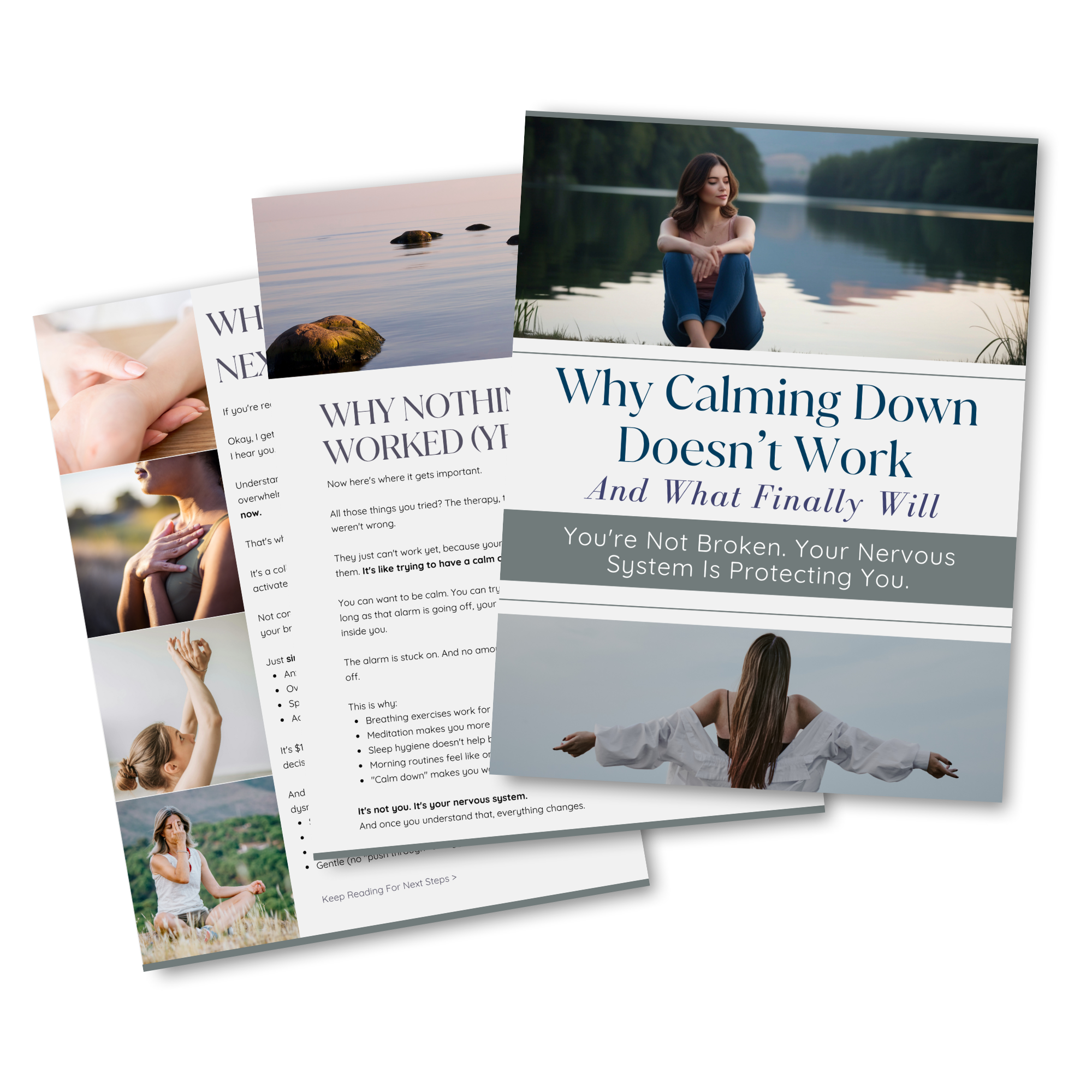
Free Guide: Why Calming Down Doesn’t Work
(And What Finally Will)
You’re Not Broken. Your Body Is Protecting You.
Your inbox stays calm, too. Unsubscribe anytime. We respect your privacy.
12. A Warm Drink Ritual
The act of making it is the point. Boiling water, choosing a mug, holding the warmth in both hands. Because the preparation is the ritual, not just the drinking. It slows you down without requiring you to “try” to slow down. Chamomile, herbal tea, warm water with lemon. In other words, whatever you reach for, let the making of it be the transition.
13. The Butterfly Hug
Cross your arms over your chest with your hands resting on opposite shoulders. Then alternate gentle taps, left and right. This bilateral stimulation is used in trauma therapy because it calms the nervous system quickly. You can do it in bed, on the couch, or standing in the kitchen. In fact, it looks like you’re hugging yourself because, essentially, you are.
14. Close Your Open Loops
Write tomorrow’s to-do list before bed so your brain can release it. Not to plan perfectly, but to get it out of your head and onto paper. As a result, your mind stops cycling through “don’t forget” reminders at 2 AM. Because unfinished tasks create mental tension, your brain keeps replaying them. Writing them down tells your brain: it’s handled.
15. Gentle Self-Massage
Your hands, your feet, your jaw (where most people hold tension without realizing it). Two minutes is enough. In particular, no technique is needed. Just pressure and attention. Specifically, rubbing your own feet before bed is one of the most underrated evening rituals. It’s grounding, it’s calming, and it brings your awareness down and away from your spinning head.
16. Change into Sleep Clothes
Specific clothes you only wear to sleep. Not the leggings you also wore to the grocery store. Your body learns through association. So when you put them on, it’s a signal: the doing part of the day is over. Of course, this works best when you make it a deliberate shift, not something that happens mid-scroll on the couch.
17. Humming
Humming activates your vagus nerve through vibration in your chest and throat. Hum anything. A song you love, a single note, whatever comes naturally. Because the vibration is what matters, not the melody. Even 30 seconds of humming shifts your nervous system toward rest. It’s one of those evening rituals that feels strange until you try it and realize how immediately calming it is.
18. Open a Window
Even for two minutes. Fresh air creates a sensory shift your body notices. The temperature change, the sounds, the smell of outside, for instance. It interrupts the loop your brain has been running all day. In addition, the brief exposure to cooler air primes your body for the natural temperature drop that happens during sleep.
19. A “Goodnight” to the Room
Name five things you can see from where you’re standing. Not a gratitude list. A grounding exercise. “The lamp. The blanket. The window. The stack of books. The water glass.” It brings you back to right here, right now. Instead of living in tomorrow’s worries, you’re standing in tonight’s reality. And tonight’s reality is usually pretty quiet.

20. Shake It Out
Stand up and shake your whole body for 30 seconds. Hands, arms, legs, shoulders. It looks silly and it works. Animals do this instinctively after a threat passes. It discharges stored nervous system energy because it completes the stress cycle. However, most humans skip this step entirely, which is why we carry the day’s tension straight into our pillows.
21. A Fixed Bedtime Anchor
One small action you do at the same time every night. Locking the front door. Turning off the kitchen light. Filling your water glass. It doesn’t matter what it is. What matters is the consistency. Consequently, your body learns through repetition, not willpower. Eventually, this tiny anchor becomes the cue that tells your nervous system: we’re done. In other words, it’s safe to rest now.
What to Do When You Skip Your Evening Rituals
Of course you will skip nights. You’ll fall asleep on the couch watching something. You’ll scroll until midnight despite knowing better. That’s not failure. That’s just being human.
The goal isn’t a perfect streak. Instead, the goal is a pattern your body starts to recognize. Even if you only do one of these evening rituals three nights a week, your nervous system is learning something new. It’s learning that nighttime can feel different. And that information adds up.
If you want a simple way to notice what’s working (without turning it into another obligation), a body-based tracker can help. Not a gold star system. Just a quiet place to note: this helped tonight. Something like the 28-Day Somatic Exercise Habit Tracker was designed for exactly that.
Your Evening, On Your Terms
You don’t need a 90-minute nighttime routine. No essential oils or meditation cushion or social media detox required. You need one or two things that tell your body: we’re done for the day. We’re safe here.
Start tonight. Pick one ritual from this list. Do it imperfectly. See what your body does.
If this post helped, save it for later. Pinterest is a great place to keep things like this close when you need them.
Take your evenings further with this holistic bedtime kit for restful sleep.

And if evenings are the only time you get to yourself, make them count. Grab Why You Can’t Calm Down below.
Free Guide: Why Calming Down Doesn’t Work
(And What Finally Will)
You’re Not Broken. Your Body Is Protecting You.
Your inbox stays calm, too. Unsubscribe anytime. We respect your privacy.