

The Self-Care Morning Routine That Starts With Your Body (Not Your To-Do List)
You know that version of a self-care morning routine that lives on Pinterest? The one with the matcha latte, the gratitude journal, the skincare routine with seven steps, the perfectly made bed, the sunlight pouring through the window onto a woman who clearly slept eight uninterrupted hours?
It’s beautiful. It’s aspirational. And for most people, it creates more guilt than calm.
Because if that’s what a self-care morning routine is supposed to look like, and yours looks like hitting snooze, scrolling your phone for 12 minutes, and then rushing through everything while your body hums with a low-grade tension you can’t quite name, then it feels like you’re failing at the one thing that’s supposed to make you feel better.
But here’s what nobody tells you about those aspirational routines: a real self-care morning routine doesn’t start with rituals. It starts with your body. Specifically, it starts with checking in on your nervous system before you ask it to perform for the day.
Because all the journaling and jade rolling in the world won’t make your morning feel steady if your nervous system is already activated before you’ve left the bedroom.
The Problem With “Self-Care” Morning Routines
Most self-care morning routine advice treats the morning like a performance. A set of beautiful activities stacked on top of each other in a specific order, photographed well, and shared with a caption about “pouring into yourself first.”
And look, there’s nothing wrong with matcha or skincare or gratitude journals. Those things can genuinely feel good. However, they address the surface. If your body wakes up tight, bracing, already running through a mental to-do list, adding a skincare ritual on top of that is like painting over a crack in the wall. It looks better. Nothing underneath has changed.
Your nervous system doesn’t care about your aesthetic. It cares about whether it feels safe. When it does, your morning naturally slows down. When it doesn’t, even the most carefully curated routine feels rushed and hollow.
So what does a self-care morning routine look like when you start with the body instead of the to-do list?
A Body-First Self-Care Morning Routine (That Doesn’t Add More to Your Plate)
The beauty of this approach is that it’s not another list of things to do. It’s a shift in where you start. Instead of beginning your morning with output (journaling, exercising, planning), you begin with input: what does my body need right now?
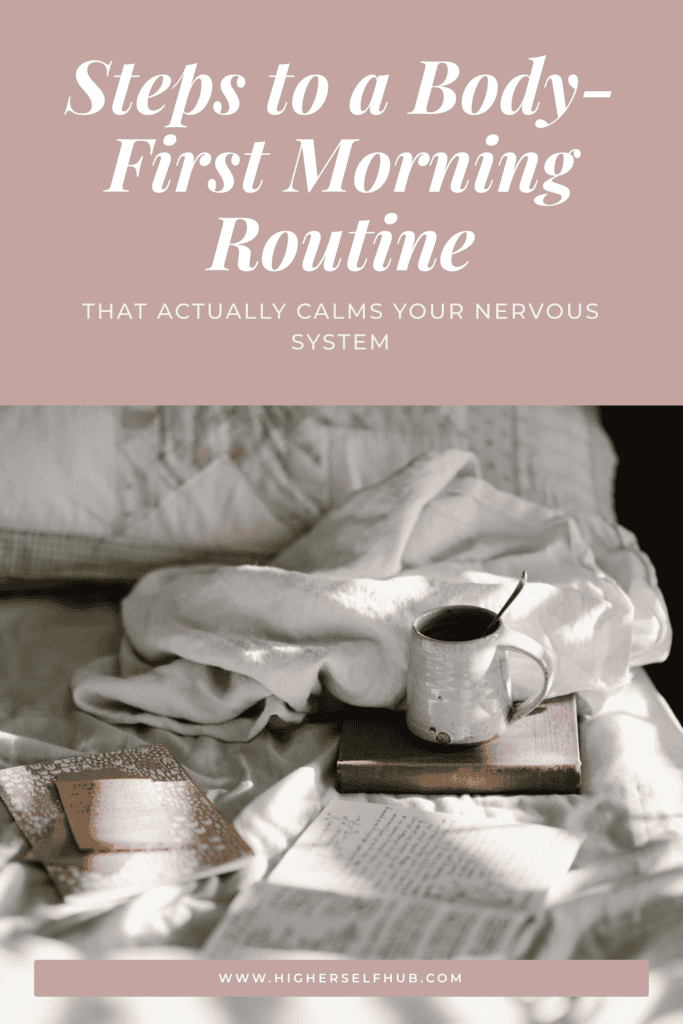
Some mornings, your body needs stillness. Other mornings, it needs gentle movement. Some mornings, it just needs you to notice it’s there before you hand it over to the day.
Step 1: Notice Before You Fix
Before you reach for your phone, before you get up, spend 30 seconds noticing.
Where is there tension? Is your jaw clenched? Are your fists closed? Is your stomach tight?
You don’t have to do anything about what you find. Just notice. That’s it. This simple act of body awareness is a somatic practice that interrupts the autopilot pattern of waking up and immediately doing. Instead of launching into the day from wherever your nervous system left off, you create a small gap between sleep and action. Often, that gap is enough.
Step 2: One Breath That Changes the Tone
The physiological sigh. Two quick inhales through your nose, then one long exhale through your mouth. Research from Stanford has shown this single breathing pattern can lower heart rate and cortisol levels more effectively than several minutes of mindfulness meditation.
One breath. That’s the foundation of a self-care morning routine that actually works. Not 20 minutes of breathwork. Not a guided meditation. One intentional breath that tells your parasympathetic nervous system: we’re safe. We can slow down.
If you only do this one thing, you’ve already given yourself more than scrolling your phone for 12 minutes would have.
Step 3: Move Your Body Before You Move Through Your Day
This doesn’t mean a workout. It means 2 to 3 minutes of gentle, intentional movement that helps your nervous system shift from sleep mode to present mode.
A few options:
- Crossbody arm swings (stand and gently swing your arms across your torso, left to right). This re-engages both hemispheres of your brain, helping your prefrontal cortex come back online after sleep.
- Slow neck rolls. Your vagus nerve runs through your neck, and gentle movement in this area can stimulate a calming response.
- A full-body stretch in bed. Arms overhead, legs long, gentle twist to each side. Nothing fancy. Just waking up your body before asking it to carry you through the day.
The self-care part isn’t the movement itself. It’s the intention behind it: I’m going to check in with my body before I hand it a to-do list.
If your mornings start with dread before they start with coffee, my free guide explains what your body is trying to tell you.
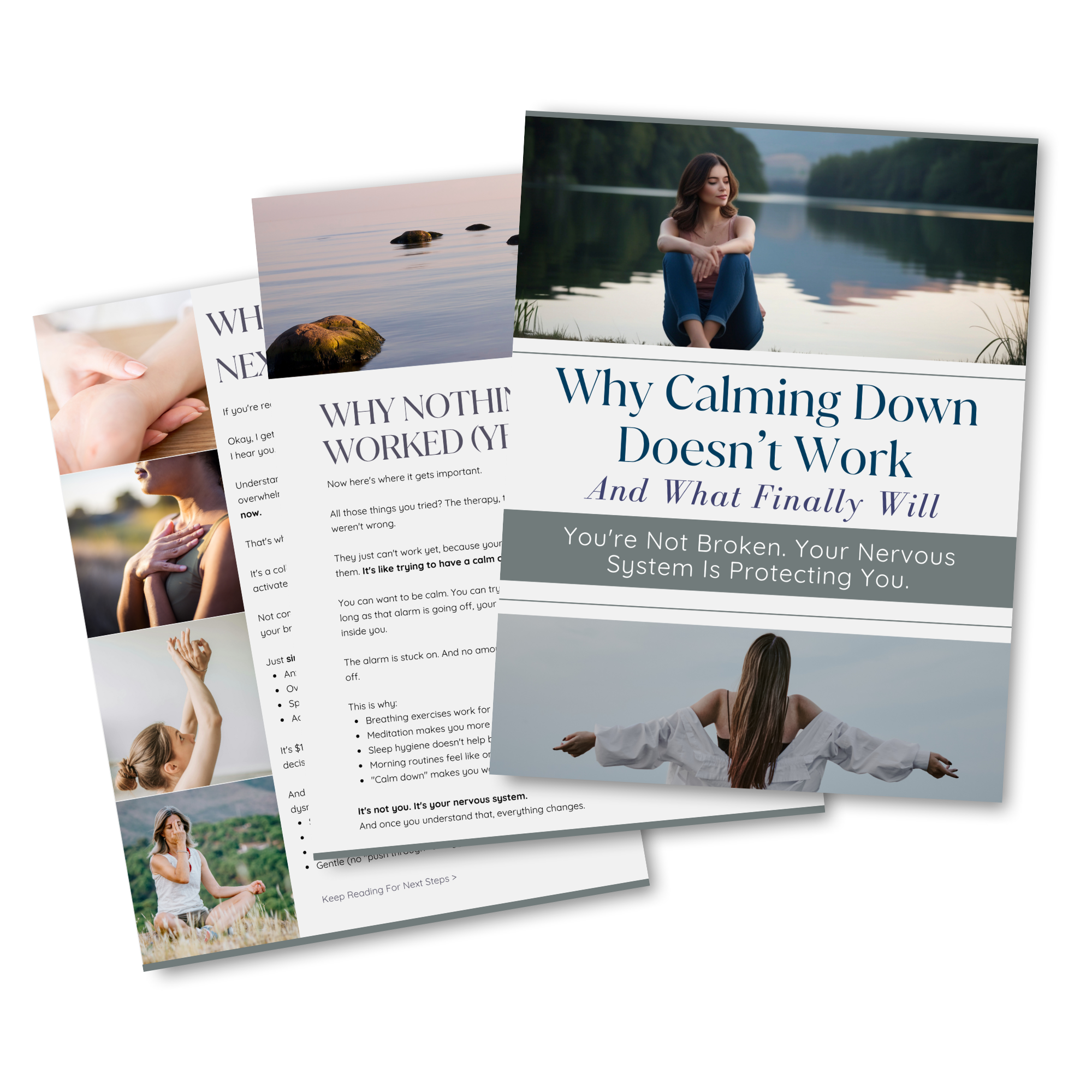
Free Guide: Why Calming Down Doesn’t Work
(And What Finally Will)
You’re Not Broken. Your Body Is Protecting You.
Your inbox stays calm, too. Unsubscribe anytime. We respect your privacy.
Step 4: Protect the Transition Window
The first 10 to 15 minutes after waking are a transition window. Your brain is moving from sleep architecture to waking consciousness, and your nervous system is calibrating for the day ahead.
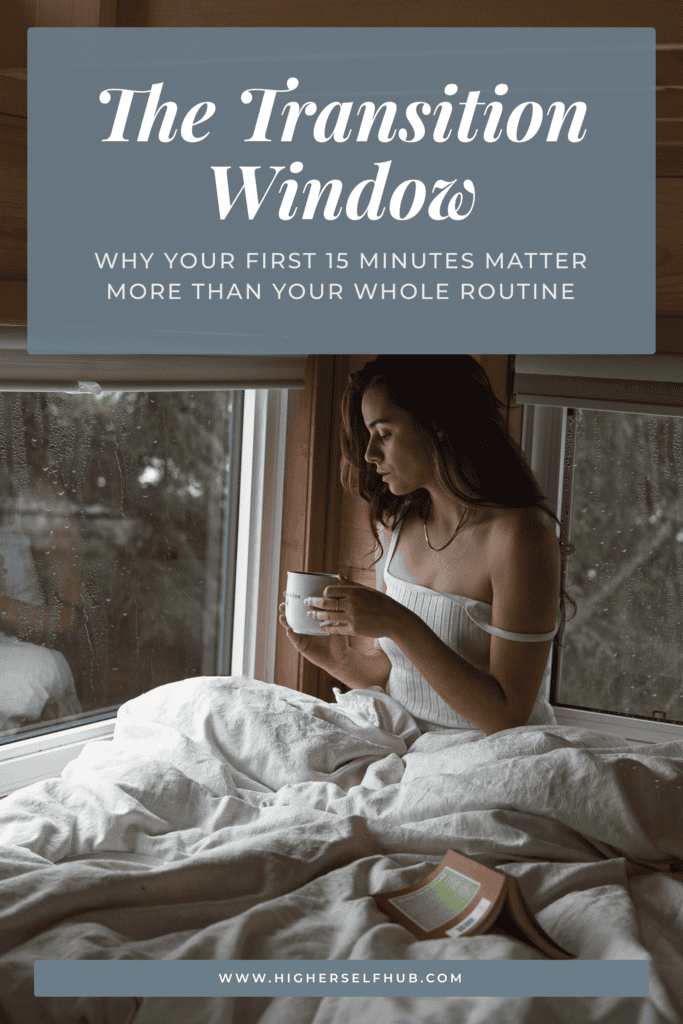
What you expose yourself to during this window matters more than what you do during the next three hours.
If the first thing you do is check email, scroll social media, or read the news, you’re flooding a still-waking nervous system with external stimulation. That’s like opening a fire hydrant into a garden hose. Everything downstream gets overwhelmed.
Instead, keep those first minutes sensory and slow. Feel the warmth of your mug. Hear the sounds of your home. Let your eyes adjust to light naturally. This isn’t about avoiding technology forever. It’s about giving your nervous system time to finish waking up before you ask it to process the world.
Step 5: Choose One Grounding Anchor
Pick one small thing that anchors you in the present moment each morning. Not five things. Not a rotating system. One thing that becomes your body’s cue for the morning is beginning and I’m here for it.
Some ideas:
- Both hands around a warm mug (feel the heat, the weight, the texture)
- Bare feet on the floor for 30 seconds (notice the temperature, the surface)
- The 5-4-3-2-1 grounding practice (5 things you see, 4 you feel, 3 you hear, 2 you smell, 1 you taste)
- Stepping outside for 60 seconds of natural light (sunlight in the first 30 minutes helps regulate your circadian rhythm and cortisol response)
Over time, this anchor becomes automatic. Your nervous system starts to associate it with the beginning of a steady day. That’s how a self-care morning routine builds: not through discipline, but through repetition that feels safe enough to repeat.
If you want to understand more about why calming down doesn’t always work (and what does), I break it all down in this free guide: Why Calming Down Doesn’t Work (And What Finally Will)
What This Routine Actually Looks Like (Honestly)
Monday: You do the sigh, notice your jaw is clenched, put your feet on the floor, hold your coffee for a minute before checking your phone. Total time: 4 minutes.
Wednesday: You wake up late, skip everything except the one sigh before your feet hit the ground. Total time: 10 seconds.
Saturday: You have a slow morning. You do the sigh, the body scan, gentle crossbody swings, drink your coffee on the porch without your phone. Total time: 15 minutes.
All three of those are a self-care morning routine. The Wednesday version isn’t a failure. It’s the proof that the routine is sustainable, because it still worked on a hard day. That’s the test most morning routines fail: they only work when everything else does.
If tracking which mornings feel steadier sounds useful, a simple routine tracker can help you start to see the pattern. Not a scorecard. Just a quiet way to notice what your body responds to so you can lean into what works.
This Is Self-Care That Actually Cares
The self-care morning routine that actually changes how your day feels isn’t the one that looks the most impressive. It’s the one that starts with your nervous system instead of your to-do list. The one that asks what does my body need? before what do I need to get done?
And some mornings the answer is a 10-second breath. Some mornings it’s a slow cup of coffee without your phone. Some mornings it’s just noticing that your shoulders are up by your ears and letting them drop an inch.
That’s not laziness. That’s not giving up on having a good morning. That’s your body asking for something real before you give it a checklist. And listening to that? That’s the most honest form of self-care there is.
Want to Go Deeper?
If you want to understand more about why calming down doesn’t always work (and what does), I put together a free guide that breaks it all down: Why Calming Down Doesn’t Work (And What Finally Will)
Free Guide: Why Calming Down Doesn’t Work
(And What Finally Will)
You’re Not Broken. Your Body Is Protecting You.
Your inbox stays calm, too. Unsubscribe anytime. We respect your privacy.