
What Is Functional Freeze? (7 Signs You’re In It Right Now)
You’re sitting on the couch. The dishes are in the sink. The laundry is in the dryer. The kids need something, and the dog needs to go out, and there are seventeen things on the list you wrote this morning.
You know all of this. And still, you can’t move.
Not in a dramatic, something-is-medically-wrong kind of way. More like your body just… won’t.
Your legs feel like concrete. Your brain sees the list, understands the list, and then goes completely blank. So you pick up your phone. You scroll. And thirty minutes later you look up and realize you have no idea what you just read, what you just watched, or where the time went.
That’s not laziness. That’s not a lack of discipline. And for many, it’s not even ADHD, even though it looks a lot like it.
That’s functional freeze.
Functional freeze is when your nervous system gets stuck in shutdown mode, even when you’re safe. You look fine on the outside. But inside, everything has gone quiet, heavy, and still.
What Is Functional Freeze?
Functional freeze is a nervous system state where your body gets stuck in a protective shutdown response, even though there’s no immediate danger. You can still “function” on the surface (you get the kids to school, you show up to work, you answer texts) but internally, you feel stuck, numb, or completely disconnected from your own life.
It’s one of those things that’s hard to explain to someone who hasn’t felt it. Because from the outside, you look fine. You might even look like you have it all together. But inside, there’s this heavy, foggy stillness. Like your body decided to hit pause and forgot to tell you.
Functional freeze is part of your body’s survival system. You’ve probably heard of fight or flight, the two responses your nervous system uses when it detects danger. But there’s a third one that doesn’t get nearly enough attention: freeze.
Freeze is what happens when your nervous system decides that fighting won’t work and running isn’t an option. So it shuts down instead. It conserves energy. It goes still and quiet. In the animal world, this is playing dead. In the human world, this is sitting on your kitchen floor scrolling Pinterest while dinner burns.
Why You Should Understand Functional Freeze
Because most women I know who are living in functional freeze don’t know that’s what’s happening.
They think they’re lazy or they’ve just lost motivation. They think something is wrong with them because everyone else seems to be handling life just fine and they can’t even get in the car to drive to the store.
I know this because I lived it.
I’m a mom and a homesteader. I homeschool my kids. I run a household, a small business, and a life that requires showing up in a hundred small ways every single day. And one day, everything just… stalled. My entire history of trauma hit me all at once. Not in a dramatic breakdown. Just in this quiet, heavy way where suddenly the things that used to feel simple felt impossible.
I couldn’t get in the car and drive. I started asking my husband to do things I knew I was physically capable of, but my body wouldn’t cooperate. My legs felt like concrete. My brain would see the task, understand the task, and then just… check out.
It devolved into missing out on a lot of life. And I think that’s the part people can really relate to. That feeling of I want to, but I just cannot get my body to take the steps and move.
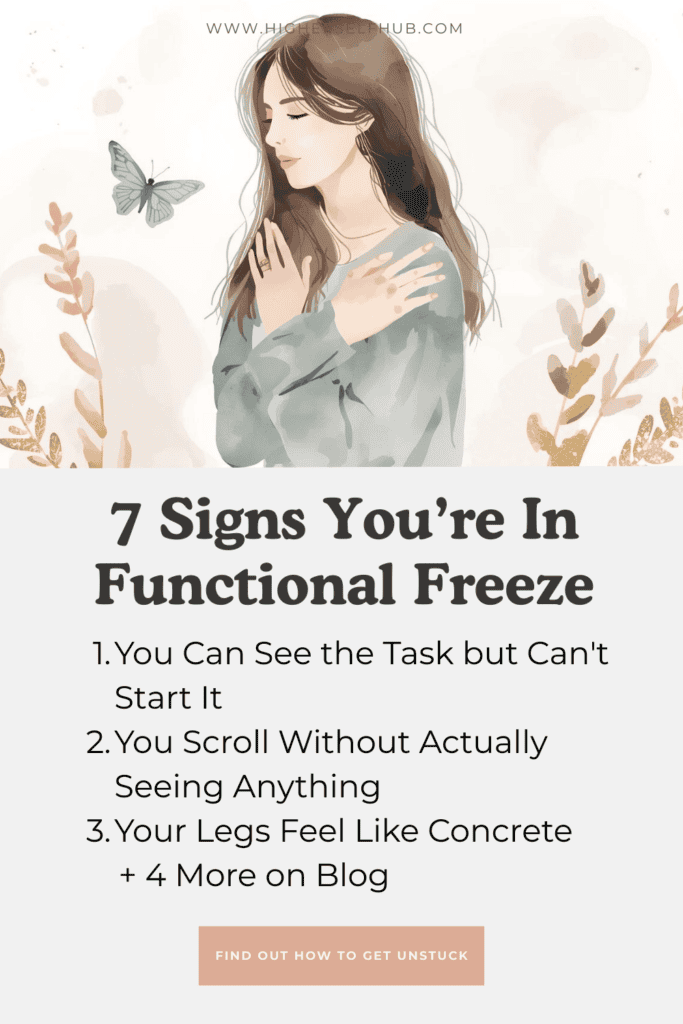
7 Signs You Might Be in Functional Freeze
Not sure if this is what you’re experiencing? Here are seven common functional freeze symptoms that often fly under the radar.
1. You Can See the Task but Can’t Start It
The dishes are right there. You know it would take ten minutes. You’ve been staring at them for an hour. This isn’t about the dishes. It’s about being stuck in a freeze response where initiating feels impossible.
2. You Scroll Without Actually Seeing Anything
You pick up your phone as if on autopilot. Thirty minutes disappear. You couldn’t tell someone what you looked at. This is dissociation, and it’s a protective pattern. Your body is pulling you away from the overwhelm, not toward entertainment.
3. Your Legs Feel Like Concrete
Not tired legs. Not sore legs. Heavy legs. Like your body has physically rooted you to wherever you’re sitting. This is your freeze response showing up in your muscles.
4. You Rely on Someone Else for Things You Could Do
Asking your partner to make the call, run the errand, handle the thing. Not because you’re incapable, but because the gap between knowing you can and actually doing it feels enormous.
5. You Feel Emotionally Numb More Than Sad
Functional freeze doesn’t always look like crying or falling apart. Often it looks like… nothing. Flat. Feeling disconnected from everything around you. Going through the motions without being present in any of them.
6. You Get Overwhelmed and Then Shut Down
There are a hundred things to do. Instead of starting one, you sit down. Your brain goes quiet. This isn’t a productivity issue. This is your nervous system deciding that the safest response to overwhelm is to stop.
7. People Keep Asking If You Have ADHD
Here’s the part nobody talks about. A lot of what gets labeled as ADHD, the inability to start tasks, the zoning out, the executive function struggles, can actually be a freeze response. They look almost identical from the outside. But the root is different.
ADHD is a neurodevelopmental condition. Functional freeze is a nervous system state, often rooted in trauma or chronic stress.
The distinction matters because the support that helps is different. And a lot of women are walking around with a label that doesn’t quite fit, wondering why the strategies built for ADHD aren’t working for them.
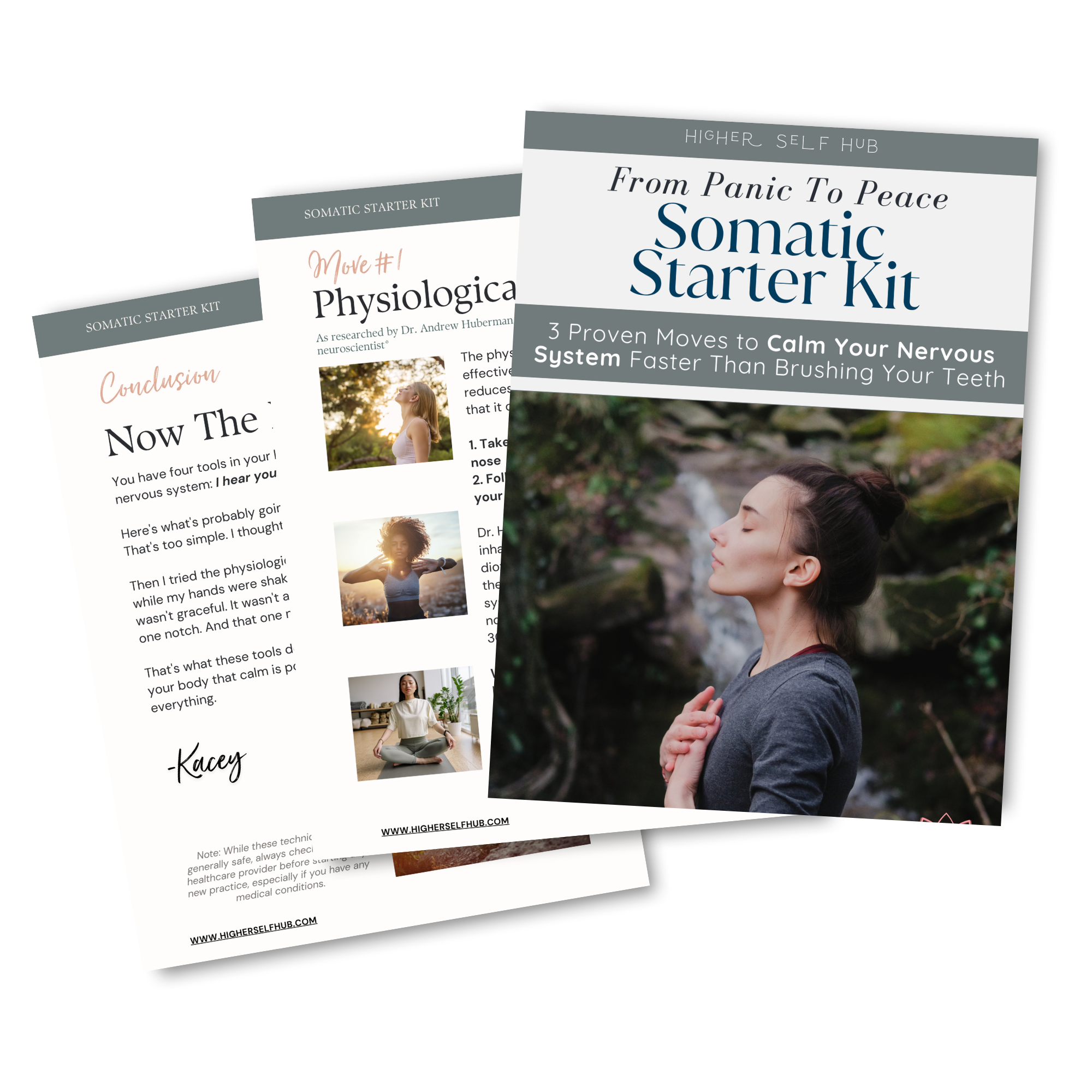
If you’re starting to recognize yourself in this, you’re not alone. And you’re not broken. I created a free Somatic Starter Kit with simple, body-based tools you can use right now (even from the couch). Grab it here.
Your Free Somatic Starter Kit
3 science-backed tools to go from panic to peace in under 60 seconds.
Your inbox stays calm, too. Unsubscribe anytime. We respect your privacy.
What Causes Functional Freeze?
Functional freeze isn’t a character flaw. It’s a biological response. Your nervous system developed it to protect you. The problem is that for many of us, it got stuck there.
Here’s what commonly puts a body into functional freeze:
Childhood trauma or chronic stress. If you grew up in a home where it wasn’t safe to fight back or run away, freeze was the only option your nervous system had. It learned that pattern. And it kept using it, even after you grew up and moved out and built a life that looks nothing like where you started.
Being “the strong one” for too long. If you’re the person everyone leans on, the fixer, the one who holds it all together, your nervous system has been running on high alert for years. Functional freeze is what happens when it finally says enough. Not dramatically. Just quietly.
Cumulative overwhelm. It doesn’t have to be one big event. Sometimes it’s the motherhood, the homesteading, the homeschooling, the work, the healing, the bills, the appointments, all of it stacking up until your body decides the only safe response is to shut down.
Medical trauma. Being dismissed by doctors. Being medicated without being heard. Spending years in a system that treats your symptoms in isolation without ever seeing the whole picture of who you are. That wears on a nervous system too.

How Your Nervous System Gets Stuck in Functional Freeze
Your autonomic nervous system has three main modes. Think of them like gears in a car. In fact, your nervous system processes threat signals in as little as 80 milliseconds (Porges, Polyvagal Theory). That’s faster than you can form a conscious thought. So by the time your brain catches up, your body has already shifted gears.
Ventral vagal (safe and connected). This is where you want to be. You’re present, you can think clearly, you feel connected to the people around you. You can handle the dishes and the dog and the laundry without your brain short-circuiting.
Sympathetic (fight or flight). Something feels threatening. Your heart rate goes up, your muscles tense, your body prepares to move. This is the gear that makes you snap at your kids when you’re overwhelmed or feel your heart racing in a parking lot for no reason.
Dorsal vagal (freeze/shutdown). Your body decided that fighting and fleeing aren’t going to work. So it pulls the emergency brake. Everything goes still, foggy, heavy. This is the functional freeze state, and when your nervous system gets stuck here, it becomes your default mode.
The word “functional” is key here. You haven’t collapsed completely. You’re still technically operating. But you’re doing it from the shutdown gear instead of the connected one. It takes enormous energy to function from this state. Which is why you’re exhausted all the time, even when you “haven’t done anything.”
That exhaustion isn’t laziness. It’s your body working overtime to do basic tasks from a gear that was never designed for daily life.
Your body isn’t broken. It learned to freeze to protect you. Now it just needs help remembering it’s safe to come back online.
How to Get Out of Functional Freeze (Gently)
If you’ve read this far and thought that’s me, I want you to hear something directly.
Don’t expect this to get solved instantly now that you know about it. It’s an unraveling process, but it starts today.
Understanding comes first, then repetition to relearn the pattern. Through the body, not the mind. You can’t think your way out of a freeze state. But you can move your way out, one tiny shift at a time. Here are five small things that can help.
1. Name It Without Judging It
When you notice yourself in freeze mode, try this: I’m in a freeze response right now. This is my nervous system protecting me. A protective response is normal.
That’s it. No fixing. No pushing through. Just naming. This alone can start to shift the pattern because it brings your thinking brain (your prefrontal cortex) back online.
2. Start With Your Toes
If you can’t relax your whole body, can you relax just your toes? Wiggle them. Press them into the floor. Notice what they feel like. This is the tiniest possible re-entry point to your body, and sometimes tiny is all you need.
3. Try the Physiological Sigh
One inhale through your nose. A second small sip of air through your nose. Then a long, slow exhale out through your mouth. This is the fastest way to signal your nervous system that it’s safe to shift gears. Research from Stanford Medicine found that this specific breathing pattern activates your parasympathetic nervous system within 90 seconds. It won’t fix everything. But it creates a felt shift from stuck to slightly less stuck. And that matters.
4. Get Your Body Across the Midline
Swing your arms gently across your body, like you’re giving yourself a lazy hug from side to side. This is called crossbody stimulation, and it helps re-engage both hemispheres of your brain. When you’re in freeze, your prefrontal cortex has essentially gone offline. This movement helps bring it back so you can start thinking clearly again instead of reactively.
5. Go Outside for Five Minutes (Not Twenty)
If you can get outside, even for five minutes, do it. Don’t set a timer for a “real” walk. Don’t turn it into exercise. Just go stand in the air. Feel the ground. Notice one thing you can see and one thing you can hear. That’s a nervous system regulation practice, and it works even when nothing else does.
None of these require you to feel ready. None of them require motivation. They work because they bypass the part of your brain that’s stuck. Getting out of freeze mode isn’t about willpower. It’s about giving your body one small signal that it’s safe to move again.
You’re Not Broken. Your Body Is Doing Its Job.
Functional freeze isn’t a sign that something is wrong with you. It’s a sign that your nervous system has been working incredibly hard for a very long time, and this is the only way it knows how to rest.
That’s not a flaw. That’s biology.
Functional freeze recovery doesn’t look like a dramatic before-and-after. One random Tuesday you’ll notice you’re frozen and you wiggle your toes instead of scrolling. It looks like saying “I’m in freeze mode right now” out loud in your kitchen and feeling something soften. It looks like overcoming a freeze response, not by fighting it, but by finally understanding it.
I know this because I’ve lived it. I still live it some days. But the difference between now and before is that I understand what’s happening. I have somatic tools that actually work, even from the couch, even on the concrete-leg days. And I stopped blaming myself for a response my body chose to protect me.
That’s not weakness. That’s discernment.
📌 Save This Functional Freeze Guide for Later
If this post felt like a mirror, save it. Pin it. Come back to it on the days your body won’t cooperate and you need someone to remind you that you’re not broken.

Your Next Step
If functional freeze resonated with you, I put together a free Somatic Starter Kit with simple, body-based tools you can try today. No programs to sign up for. No appointments to make. Just quiet, practical practices that meet you exactly where you are.
Your Free Somatic Starter Kit
3 science-backed tools to go from panic to peace in under 60 seconds.
Your inbox stays calm, too. Unsubscribe anytime. We respect your privacy.
Because sometimes the most powerful thing you can do is something small enough that your body actually believes it can repeat it tomorrow.
Get the free Somatic Starter Kit here >>