

What Brain Injury Taught Me About My Nervous System & Brain Health
You’re standing in the kitchen and you walked in there for something. You know you walked in there for something. But now you’re just… standing there. Staring at the counter. Trying to retrace your steps like you’re solving a puzzle that shouldn’t be this hard.
It’s the third time today.
Some mornings the fog is so thick you can barely finish a thought before the next one dissolves. You read the same paragraph four times. The milk is in the pantry. You forget the word for the thing you use every single day, and for a split second, it scares you.
You’re not old. You’re not sick (at least, nobody can find anything). You’re just… not sharp anymore. And you don’t know why.
Brain health is the ability of your brain to think clearly, regulate emotions, process information, and recover from what life throws at it. It’s not just about memory or IQ. It’s about whether your brain can actually keep up with the life you’re living, or whether it feels like it’s running three steps behind.
Most brain health advice will point you toward supplements, crossword puzzles, and salmon. Those things aren’t bad. But they miss the bigger picture.
Because brain health isn’t just a brain problem. It’s a nervous system problem.
I know this because I had to rebuild mine.
What a Brain Injury Taught Me About the Brain
In 2005, I was living in California, walking to my restaurant job on Ocean Boulevard. It was dark and rainy. I was crossing Wilshire with the crosswalk sign.
The next thing I remember is waking up in the street with a group of strangers standing over me. From their faces, they looked concerned. Frightened. I had no idea what had happened.
I’d been hit by a car.
They took me to UCLA, where they found a brain bleed. I was on anti-seizure medications, doing scan after scan, mostly alone in the hospital for three days because it took a full day for my mom to get there from another state.
Mine was technically classified as a “minor” traumatic brain injury because I wasn’t unconscious for more than thirty minutes.
But there was nothing minor about it.
Becoming a Different Person Overnight
Before the injury, I was a straight-A student. I juggled a full school schedule, a varied work schedule as a server, activities, assignments. Things just came naturally easy to me.
And then afterwards, they didn’t.
The biggest shift wasn’t physical. It was cognitive. The amount of information I could hold in my head dropped dramatically. To this day, if I don’t write things down, I will forget them. I need systems and plans. I need to break things into incredibly small steps, or my brain feels overwhelmed and just… stalls.
The specialists told me brain injury acts like permanent sleep deprivation. If you’ve ever gone more than 36 or 48 hours without sleep, that heavy, foggy, everything-takes-twice-as-long feeling? That was my baseline. Every single day.
Their prognosis was dire. They said I would never be able to operate the same again.
I decided I wasn’t going to accept that.
Why Brain Health Is Really Nervous System Health
Here’s what none of those specialists explained to me at the time: my brain wasn’t just injured. My entire nervous system had been knocked offline.
Your brain and nervous system aren’t separate systems that happen to share some wiring. They’re the same system. Your brain is the command center of your nervous system, and when one is compromised, the other follows.
That brain fog you can’t explain? It might not be a brain problem at all.
It might be your nervous system stuck in a protective state, diverting energy away from clear thinking and toward survival. When your body is running on cortisol and adrenaline all day, your brain doesn’t get the resources it needs for memory, focus, or emotional regulation.
If that sounds like something you’re carrying, this post on nervous system dysregulation symptoms breaks down exactly what that looks like in daily life.
What Actually Helped Me Rebuild My Brain Health
The turning point wasn’t a supplement. It wasn’t a brain training app.
It was learning about neuroplasticity.
Your brain can change. The pathways that feel stuck can be rewired through repetition and practice. This isn’t wishful thinking. It’s how the brain actually works. Neurons that fire together, wire together. The ones you stop using? They fade.
That science became my lifeline. Here’s what I built my recovery on:
1. Movement That Crosses the Midline
Not just exercise for the sake of exercise. Somatic movement, specifically. Crossing the midline (think: touching your left knee with your right hand) re-engages your prefrontal cortex, the part of the brain responsible for focus, decision-making, and emotional regulation.
Sometimes that means an hour of yoga. Sometimes it means tossing a ball back and forth while I’m stressed in a waiting room. The simplicity is the point. Your brain doesn’t need complexity right now. It needs repetition.
2. Writing Everything Down
This one isn’t glamorous, but it changed my life. I have to have a system or my brain loses control of what to do next. That stagnation people describe with ADHD, where you’re staring at a list of ten things and can’t start any of them? That’s what I live with.
So I write it all down. I break tasks into absurdly small steps. I track what my body needs. Not because I’m rigid, but because my brain genuinely works better with external support.
If you feel like you need more systems, more lists, more structure than other people seem to need, that’s not weakness. It might just mean your brain requires more intentional care.
3. Prioritizing Sleep Like Medicine
Brain injury taught me that sleep isn’t optional. It’s when your brain does its deepest repair work. Clearing out toxins, consolidating memories, processing emotions you didn’t have bandwidth for during the day.
Sleep was incredibly difficult for me after the injury. Creating a consistent sleep routine became one of the most important things I did for my brain health. Not because someone told me to, but because I could feel the difference in my thinking on the days I slept versus the days I didn’t.
4. Managing My Nervous System First
This is the piece most brain health advice skips entirely. If your nervous system is dysregulated, no amount of omega-3s or puzzles will clear the fog.
I have to put extra effort into managing my emotions and processing them in healthy ways.
Some days that looks like an hour of walking outside. Other days it’s breathwork in the car before I go into the grocery store. I see other people who seem to stay pretty even-keeled without much effort. I have to be more intentional about it. I’m not upset about it, but I recognize that when I skip it, everything unravels fast.
If you’re curious about how cortisol specifically affects your brain and energy, this post on high cortisol and a stuck nervous system explains the connection in a way that might click.
What Brain Health Looks Like Now
I’m not going to pretend I’m back to where I was before 2005. That person doesn’t exist anymore.
But the person I am now has something she didn’t have then: an understanding of what her brain actually needs to function well. Not the generalized advice from a magazine. The real, lived knowledge of what happens when I skip movement, lose sleep, ignore my nervous system, or try to push through without the systems my brain depends on.
Brain health isn’t about optimizing yourself into some sharper, faster version of who you used to be. It’s about knowing what your brain needs today and actually giving it that.
Some days that’s fresh air and a walk. Others it’s going to bed early. Some days it’s literally just writing down the three things you need to do so your brain can stop spinning.
If you want to understand more about why calming down doesn’t always work (and what does), I break it all down in this free guide: Why Calming Down Doesn’t Work (And What Finally Will)
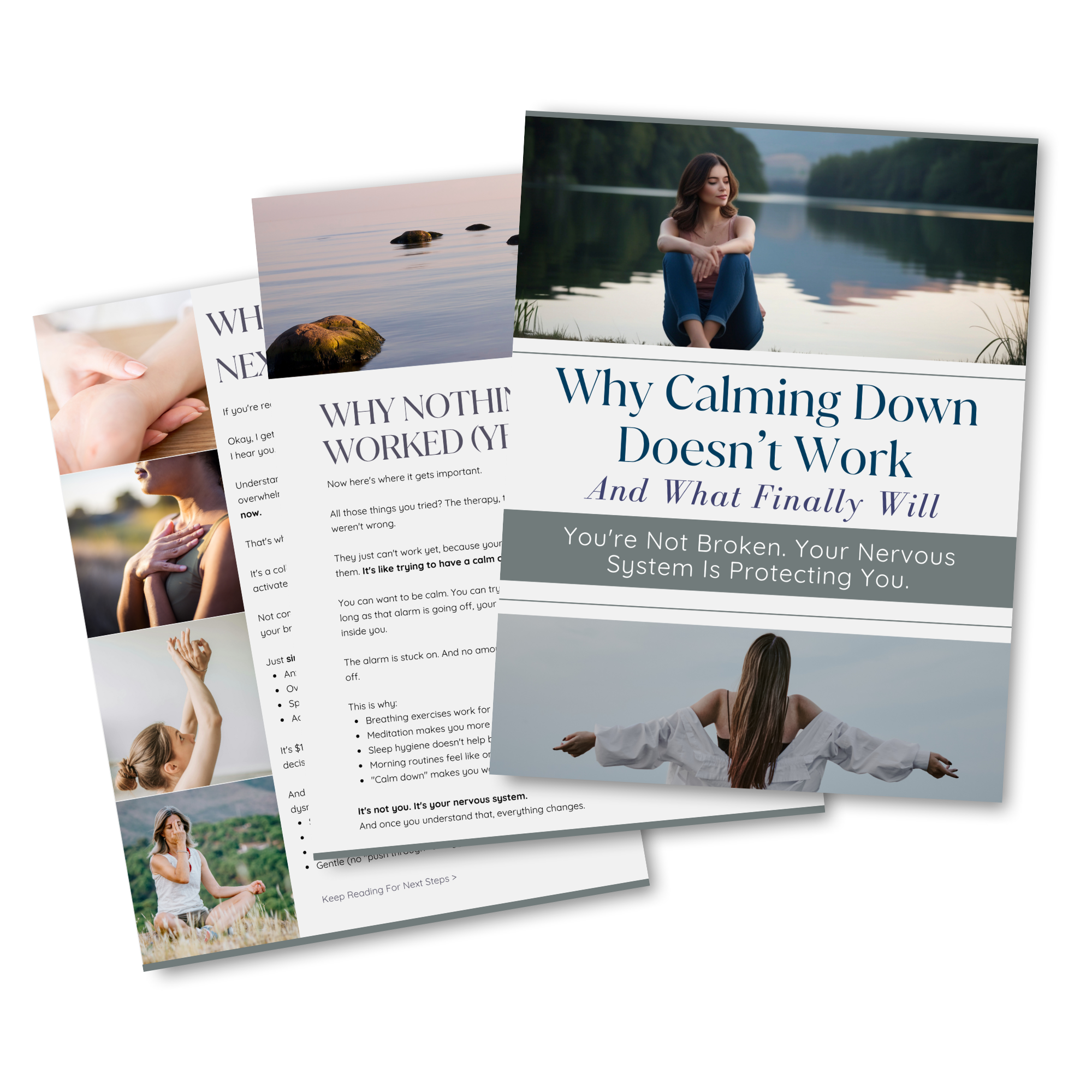
Free Guide: Why Calming Down Doesn’t Work
(And What Finally Will)
You’re Not Broken. Your Body Is Protecting You.
Your inbox stays calm, too. Unsubscribe anytime. We respect your privacy.
If Your Brain Feels Like It’s Failing You
Here’s what I want you to hear, because it’s something I wish someone had told me in that hospital in 2005.
Your brain isn’t broken. It might be exhausted. It might be stuck in a protective state your nervous system activated a long time ago. Or maybe more support than you’ve been giving it, not because you’re doing something wrong, but because you’ve been through more than most people realize.
And it can change. Not overnight. Not with a miracle supplement. Through small, repeated, body-first practices that give your nervous system the signal that it’s safe to let your brain come back online.
That’s not wishful thinking. That’s neuroplasticity. And I’m living proof it works.
That fog you keep apologizing for? That’s not a character flaw.
It’s your brain asking for something different. Something simpler. Something your body has been trying to tell you for a while now.
The fact that you’re still here, still searching for answers? That’s not desperation.
That’s your brain doing exactly what it’s designed to do: finding the path forward.
It already started.
📌 Save This For Later
If you want to understand more about why calming down doesn’t always work (and what does), I break it all down in this free guide: Why Calming Down Doesn’t Work (And What Finally Will)
Free Guide: Why Calming Down Doesn’t Work
(And What Finally Will)
You’re Not Broken. Your Body Is Protecting You.
Your inbox stays calm, too. Unsubscribe anytime. We respect your privacy.