

How To Lower Cortisol In Public, Without Anyone Noticing
Three years ago, I didn’t know what was happening inside me. I just knew I felt overwhelmed, on edge, and like I had to hide it. I thought the answer was to pull myself together. To push through, stay quiet, and deal with it later.
What I didn’t know then was that what I really needed was to understand how to lower cortisol in a way that actually worked with my body, not against it.
Because stress, anxiety, and cortisol aren’t malfunctions. They’re messages.
Cortisol is your body’s primary stress hormone, and elevated levels are your nervous system’s way of saying, “pay attention.”
And the real problem isn’t that we feel too much. It’s that we’ve forgotten how to listen to the very signals that once guided us home to ourselves.
The Nervous System Doesn’t Need Privacy to Feel Safe

We’re taught that regulation requires stillness. That healing happens in quiet rooms with salt lamps and time set aside.
But what if it could happen here? On the train. In the store. At the meeting.
And it turns out, the nervous system doesn’t need privacy to feel safe.
It just needs consistency. It needs cues it can trust. It needs you to start listening.
Because what your body is doing? It’s not random. Cortisol doesn’t rise out of nowhere. Anxiety isn’t an overreaction. It’s a whisper from within saying:
“Something feels unresolved. Please notice me.”
Anxiety Is Not the Enemy—It’s an Invitation
What if we stopped seeing anxiety as something to fight or fix? What if, instead, we welcomed it as a call-in—not a call-out?
Modern life conditions us to suppress, override, numb, or escape. Smile through it. Push through it. Save the breakdown for later.
The voice that says “just push through it” isn’t your adult wisdom—it’s the conditioning that made you forget your body is wise. Every time you pause to listen instead of override, you’re remembering how to trust yourself again.
But when you pause, even for just a moment, and acknowledge what your body is saying, something incredible happens:
The message gets delivered. The loop completes. And the signal no longer has to keep pinging you for attention.
This is the work of somatic healing. Not dramatic releases or massive breakdowns. But small, quiet returns to your body’s wisdom throughout the day. Gentle remembrances of what you’ve always known.
The Science of Feeling Safe
When you acknowledge stress instead of fighting it, you’re literally rewiring your nervous system. These natural ways to lower cortisol work because you’re working with your body’s wisdom, not against it.

Understanding Neuroception
This is called “neuroception.” It’s your body’s ability to detect safety without conscious thought. Your nervous system is constantly scanning: Am I safe? Can I trust this person? This environment? This feeling?
Each time you respond to stress with presence instead of panic, you’re awakening neural pathways that remember safety. You’re returning to your body’s innate ability to detect what serves you and what doesn’t.
Your Original Blueprint
Your nervous system learned its patterns before you could even speak. But underneath all that conditioning lives your original blueprint—the part of you that knew how to feel safely, how to trust your instincts, how to return to calm.
You don’t need to be taught how to regulate. You need to remember.
The 7-Day Guide to Lower Cortisol is built around that idea. One small practice per day to help your body remember what it already knows.
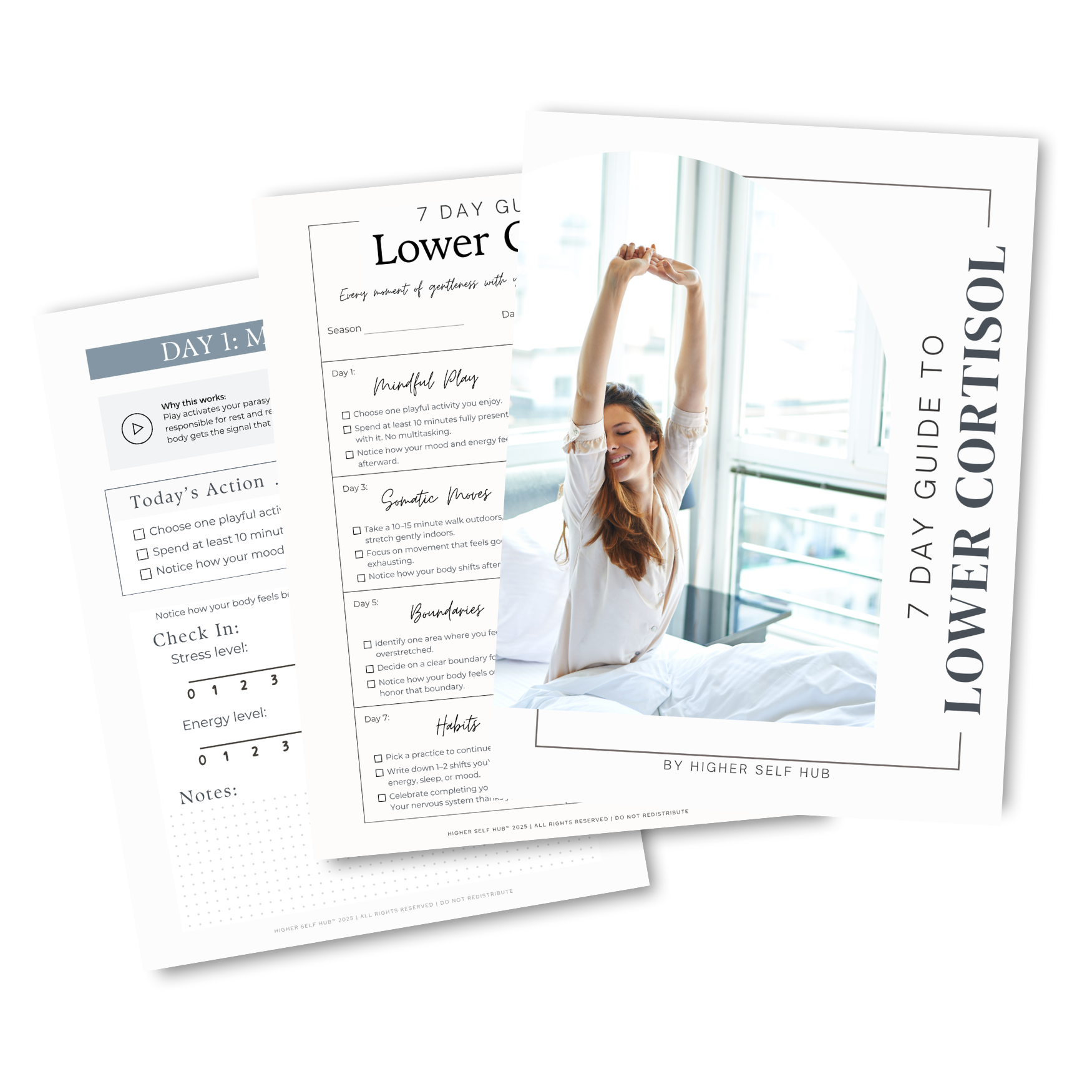
Free 7-Day Guide To Lower Your Cortisol
The Hormone Balancing Guide That Works For Women In The Thick of It.
Your inbox stays calm, too. Unsubscribe anytime. We respect your privacy.
You Don’t Need a Grand Exit. You Just Need a Way In
In public, you often can’t “get away.” But you can come back to yourself.
This isn’t about forcing calm or following breathing protocols. It’s about remembering your body’s own rhythm. This is different from traditional “just breathe” or mindfulness advice—you’re not performing techniques, you’re returning to relationship.
This is how your body remembers its way home:
Notice where you feel the tension in your body. Your belly, your shoulders, lower back. Place a hand there if you’re able. This isn’t something you need to fix—it’s the physical manifestation of a cortisol spike, which is just a message asking you to pay attention.
If you can, speak to yourself in your head as if you were that little child: “I hear you. I feel you. And what you’re feeling is important.”
Your nervous system isn’t asking you to make the feeling go away. It’s asking you to witness it. To acknowledge that something inside needs tending.
Maybe you slow your breathing—not because you should, but because your body remembers this rhythm of safety. Maybe you soften your jaw because you notice you’ve been clenching it. Maybe you simply say “yes, this is hard” instead of “I should be handling this better.”
You’re not performing regulation. You’re returning to relationship—with your body, with your feelings, with the part of you that never forgot how to feel safely.
This is what real safety feels like, not pretending everything’s fine, but remembering how to be with yourself in the moments that aren’t.
When It Feels Too Hard: The Inner Child Connection

“What if acknowledging the feeling makes it worse?”
This fear often comes from a very young part of you that learned: “If I show I’m upset, something bad will happen.” That little one inside is still protecting you the only way they knew how—by staying quiet, staying small, staying invisible.
But here’s what that little one is forgetting: You came into this world knowing how to feel everything fully and still be okay. Try whispering to that part of you: “We remember now. We can feel this and still be safe. This is how we were meant to be.”
“What if people notice I’m doing something?”
Your nervous system learned to scan for danger in other people’s faces before you could even walk. That hypervigilant part is still trying to keep you safe by making sure you don’t “cause problems” or “make scenes.”
But here’s what that little one is remembering: You were born with the wisdom to care for yourself. Taking care of your nervous system isn’t selfish—it’s returning to your natural state of self-compassion.
“What if it doesn’t work immediately?”
If you grew up in chaos, your nervous system learned to expect instant relief or complete shutdown, there was no middle ground. That impatient part of you is actually trying to protect you from disappointment.
But healing happens in tiny increments. Learning how to heal yourself means remembering that your higher self has always known how to feel safely. Be patient with the part of you that’s been holding it all together for so long.
Regulation Is Your Birthright, Not Something You Need to Learn
You Were Born Knowing
You were born knowing how to do this. You came into this world with an innate ability to feel, to regulate, to trust your body’s wisdom.
Watch a baby. They feel fully, express completely, then return to peace. They don’t overthink their emotions or judge their needs. They simply are.
Remembering vs. Learning
But modern life, well-meaning caregivers, and societal conditioning slowly taught you to override that inner knowing. To ignore your intuition. To distrust the very signals designed to guide you home to yourself.
The work isn’t learning something new. It’s remembering what you’ve always known. It’s reconnecting with that higher self, that part of you that’s still connected to source, to your deepest wisdom.

Your Body Isn’t the Problem. It’s the Path.
Your body isn’t weak. It’s wise. And every spike in cortisol, every anxious breath, every surge of stress, it’s not a failure.
It’s an invitation to come closer.
Your body remembers every time you were told to “stop being so sensitive” or “you’re overreacting.” But it also remembers what it felt like before those messages took root. When you approach your stress with curiosity instead of judgment, you’re returning to your original blueprint—the one that knew sensitivity was a gift, not a flaw.
Coming closer means asking: “What do you need right now?” Sometimes it’s slower movement. Sometimes it’s permission to feel annoyed. Sometimes it’s simply: “This is hard, and that’s okay.”
Because when you learn how to speak the language of your body, you don’t need to escape anymore.
You can stay.
When You’re Ready to Bring This Into Real Life
You don’t have to wait for the perfect moment or the perfect conditions.
You can start now, quietly, gently, without anyone even knowing.
If you loved the “without anyone noticing” angle, our full guide on nervous system regulation in real life goes deeper into why discreet body-based tools work better than anything you can think your way through.
Because the goal isn’t to “fix” your anxiety.
It’s to build a relationship with your body that makes anxiety less necessary.
The 7-Day Guide to Lower Cortisol is a quiet place to start. One practice per day, a place to notice what shifts, and nothing you need to force.
Free 7-Day Guide To Lower Your Cortisol
The Hormone Balancing Guide That Works For Women In The Thick of It.
Your inbox stays calm, too. Unsubscribe anytime. We respect your privacy.