

11 Nervous System Dysregulation Symptoms That Explain Why You Can’t “Just Relax”
Some mornings your body is already running before your feet hit the floor. Jaw tight. Shoulders pulled up toward your ears. Heart beating like something is wrong, except nothing is wrong. The house is quiet. The kids are still sleeping. And your body is acting like it missed the memo.
So you push through. Coffee. Deep breath. Move faster. And by 10 AM, you’re exhausted in a way that sleep never seems to fix.
If that sounds familiar, what you’re experiencing might not be a mindset problem or a motivation problem. It might be nervous system dysregulation symptoms, and they look nothing like what most people expect.
Nervous system dysregulation is what happens when your body gets stuck in a protective state, cycling between fight, flight, or freeze responses even when there’s no actual threat. It’s not a diagnosis. It’s a pattern. And once you know what to look for, a lot of things suddenly make sense.
What Does Nervous System Dysregulation Actually Mean?
Your autonomic nervous system runs two main modes. One speeds everything up (sympathetic, the gas pedal). One slows everything down (parasympathetic, the brake). In a regulated system, they take turns. You respond to something stressful, and then your body comes back down.
In a dysregulated system, the dial gets stuck.
Sometimes it’s stuck on high. Racing thoughts, tight muscles, a startle response that fires at every small sound. Sometimes it’s stuck on low. Brain fog, emotional flatness, the feeling of watching your own life from behind glass.
Your body processes stress signals in as little as 80 milliseconds (Porges, Polyvagal Theory). That’s faster than you can form a conscious thought. Which is exactly why you can’t think your way out of it, and why telling yourself to “just calm down” has never once worked.
11 Nervous System Dysregulation Symptoms You Might Not Recognize
These aren’t the obvious ones. These are the symptoms that get blamed on personality, laziness, hormones, or “just being a mom.”
1. You’re Exhausted But Can’t Sleep
Your body is tired. Your brain won’t stop. You lie in bed running through tomorrow’s to-do list, replaying a conversation from 6 hours ago, or just feeling wired for no reason. This is your sympathetic nervous system refusing to hand the keys over. The gas pedal is still pressed even though you pulled into the driveway hours ago.
2. Small Things Make You Snap
The cereal spills. The shoe can’t be found. Someone asks you a question while you’re in the middle of something. And your reaction is wildly out of proportion to what actually happened. That’s not a character flaw. It’s a nervous system already running at capacity. There’s no bandwidth left for one more thing.
3. Your Digestion Is Unpredictable
Bloating, nausea, acid reflux, or cycles of constipation and urgency that no elimination diet has fully fixed. Your gut has more nerve endings than your spinal cord. When your nervous system is dysregulated, digestion is one of the first things it deprioritizes. Your body is too busy scanning for danger to break down lunch.
4. You Startle Easily
A door closes. A text notification buzzes. Someone walks into the room and you jump. A heightened startle response is one of the clearest nervous system dysregulation symptoms, because it shows your threat-detection system is running on high sensitivity. It’s scanning for danger constantly, even in safe environments.
5. You Dissociate Without Realizing It
You drove the entire way home and don’t remember any of it. Your kids are talking and you realize you haven’t heard a single word. You feel like you’re watching yourself from outside your body. Dissociation is your nervous system’s freeze response. When the system gets overwhelmed, it checks out to protect you. It’s not laziness. It’s the brake pedal slamming down.
6. Your Jaw, Neck, or Shoulders Are Always Tight
You notice your teeth are clenched. Again. Your shoulders are up by your ears. Again. No amount of stretching holds for more than an hour. Chronic tension is your body bracing for something it never fully processes. It’s not about posture. It’s stored activation that never got a signal to stand down.
7. You Cycle Between Doing Everything and Doing Nothing
Monday you’re unstoppable. Cleaning, organizing, planning, producing. By Wednesday you’re on the couch unable to respond to a text. This isn’t inconsistency. It’s your nervous system oscillating between sympathetic overdrive and parasympathetic shutdown. The swing itself is the symptom.
8. Caffeine Hits Different Now
Coffee used to give you energy. Now it gives you a racing heart, shaky hands, or a spike of panic you can’t explain. When your nervous system is already activated, caffeine pours fuel on a fire that’s already burning. Your tolerance didn’t change. Your baseline did.
9. You Feel Guilty for Resting
You sit down for five minutes and feel like you should be doing something. Rest doesn’t feel like relief. It feels like falling behind. That’s not ambition. That’s a nervous system that has linked stillness with danger. For some bodies (especially ones that learned early that staying busy meant staying safe), rest triggers the same alarm bells as threat.
If you recognized yourself in more than one of these symptoms, my free guide explains what’s happening in your body (and what finally helps).
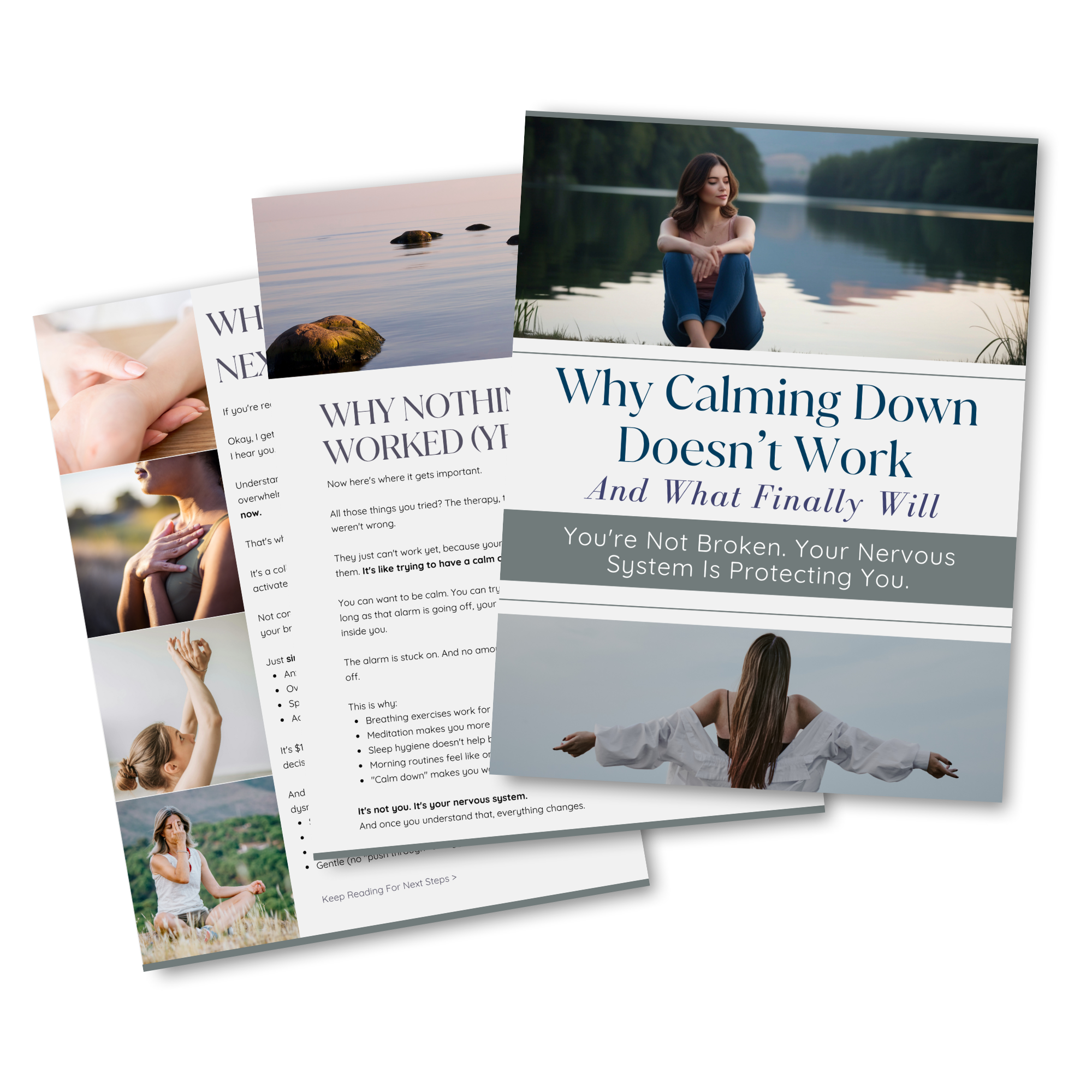
Free Guide: Why Calming Down Doesn’t Work
(And What Finally Will)
You’re Not Broken. Your Body Is Protecting You.
Your inbox stays calm, too. Unsubscribe anytime. We respect your privacy.
10. Certain Sounds or Textures Bother You More Than They Should
The neighbor’s dog. The texture of certain fabrics. Chewing sounds. Background noise that used to be invisible now feels unbearable. Sensory sensitivity spikes when the nervous system is in a heightened state. It’s not that you’re being difficult. Your filter is overwhelmed, so everything gets through.
11. You Feel Like Something Is Wrong, But You Can’t Name It
Nothing specific happened. No crisis. No bad news. Just a persistent, low-grade sense that something is off. A hum underneath everything. This is one of the hardest nervous system dysregulation symptoms to explain to someone who hasn’t felt it, because there’s nothing to point to. It’s your body carrying an unresolved stress response that never fully completed.
Not all of these will be true for you. Some might land immediately. Others might not fit at all. That’s normal. Nervous system dysregulation symptoms show up differently in every body.
Why These Symptoms Keep Coming Back
Here’s what most wellness content won’t tell you: you can’t supplement your way out of a dysregulated nervous system. You can’t journal it away, meditate it into submission, or organize your life well enough that your body finally feels safe.
Those things aren’t useless. Journaling and breathwork are genuinely helpful tools. But if your nervous system is stuck in a protective pattern, adding more things to do often just adds more pressure to a system that’s already overloaded.
A 2017 randomized controlled trial found that somatic experiencing (body-based therapeutic work) significantly reduced PTSD symptoms compared to standard care (Brom et al., Journal of Traumatic Stress). Not because it was more intense, but because it worked with the body instead of asking the mind to override it.
Your body isn’t broken. It’s protecting you. It just needs a different kind of signal than “try harder.”
The key is working with your nervous system instead of around it. Small, body-based practices that give your system real-time evidence that the threat has passed.
If you want to understand more about why calming down doesn’t always work (and what does), I break it all down in this free guide: Why Calming Down Doesn’t Work (And What Finally Will)
What Actually Helps (When “Just Relax” Doesn’t)
You don’t need a 90-minute yoga class or a weekend retreat. You need something small enough to do in the middle of a hard day. Here are a few starting points.
Orienting
Look up from your screen right now. Find three things in the room that are the same color. Just look at them. Let your eyes land softly. That’s called somatic orienting, and it works because your nervous system gets real sensory data about where you actually are. Not where your thoughts are. Here. This room.
Extended Exhale
Breathe in for 4 counts. Out for 6 to 8. That longer exhale activates your parasympathetic nervous system. Stanford Medicine research shows extended exhale breathing can activate the parasympathetic response within 90 seconds. You can do this in a parking lot, at your desk, or standing at the kitchen counter while dinner is burning.
Bilateral Movement
Cross-body movement (touching your right hand to your left knee, tapping alternating shoulders, tossing a ball back and forth) engages both hemispheres of your brain. It gives your nervous system something concrete to organize around instead of an abstract worry loop.
Temperature Change
Cold water on your wrists or the back of your neck. Holding an ice cube. Stepping outside barefoot for 30 seconds. Temperature is one of the fastest ways to interrupt a sympathetic activation because it forces your body to respond to something immediate and real.
Start with whichever one sounds like the least amount of effort. That’s the right one for today.
These aren’t fixes. They’re signals. Small pieces of evidence your body can use to update its threat assessment. Done consistently (even imperfectly), they start to shift the baseline.
If you find yourself wanting a simple way to build these into a daily rhythm, a somatic exercise habit tracker can help. Not as a gold star system. Just a quiet way to notice you’re showing up for yourself, even on the hard days.
The Symptoms Are Real. So Is What Helps.
Nervous system dysregulation symptoms are not in your head. They’re in your jaw, your gut, your startle response, your 2 AM ceiling stare. They’re your body doing exactly what it was designed to do in the face of ongoing, unresolved activation.
Let these insights settle in your body tonight. Just knowing that there’s a reason your body does what it does (and that it’s not because you’re broken) can be the first shift.
Pick one practice from the list above. Try it tonight before bed. And if you feel like sharing, tell me in the comments which symptom hit you the hardest. I read every single one.
📌 Save This For Later
If this post landed for you, save it for later.
If you want to understand more about why calming down doesn’t always work (and what does), I break it all down in this free guide: Why Calming Down Doesn’t Work (And What Finally Will)
Related Posts
- Somatic Exercises to Reduce Cortisol (Simple Practices That Actually Help)
- Nervous System Regulation in Real Life: How to Calm Down Without Anyone Noticing
- 6 Surprising Places Your Body Stores Hidden Emotions
You’re not broken, and you’re not imagining it. Grab Why You Can’t Calm Down below for the plain-language explanation your symptoms deserve.
Free Guide: Why Calming Down Doesn’t Work
(And What Finally Will)
You’re Not Broken. Your Body Is Protecting You.
Your inbox stays calm, too. Unsubscribe anytime. We respect your privacy.