

What’s Your Self-Regulation Style? (And Why It Matters for Your Nervous System)
You click end after a stressful phone call and your body does something before your brain catches up.
Maybe you let out a long breath you didn’t realize you were holding. Maybe you toss your phone on the counter a little harder than necessary. Maybe you immediately start wiping down the kitchen, scrubbing something that doesn’t need scrubbing, because your hands need to move.
Or maybe you go completely still. Pick up your phone again and scroll without seeing anything. Thirty minutes pass and you’re not even sure what just happened.
None of those responses are random. They’re your nervous system’s way of regulating after a threat, real or perceived. And the way you do it? That’s your self-regulation style.
Your self-regulation style is the pattern your body defaults to when it’s trying to manage emotional and physical overwhelm. It’s not a personality trait. It’s the way your nervous system learned to keep you safe, often long before you had any say in the matter.
Understanding your self-regulation style isn’t about putting yourself in a box. It’s about finally seeing the pattern clearly enough to work with it instead of constantly fighting against it.
How I Discovered Mine
For years, I thought I was just a planner. I ran a 24-hour cafe for a decade, homeschooled my kids, managed a farm. I could juggle anything as long as I could see it coming.
Then the panic attacks started. And suddenly all my planning, all my preparation, all my “stay three steps ahead” strategies couldn’t touch what was happening inside my body.
That’s when I realized something. My need to plan wasn’t just a personality quirk. It was my nervous system’s way of creating safety. Predictability was my regulation tool. And when life became unpredictable, my body had no backup plan.
I didn’t need a better calendar. I needed to understand my self-regulation style and learn what to do when it stops working.
The 4 Self-Regulation Styles
See which one feels most like you. Most people lean heavily into one, with a secondary style that shows up under different conditions.
1. The Strategic Planner
Your body feels safest when it can see what’s coming.
You’re the one with the meal plan, the backup plan, and the plan for when the backup plan falls apart. Prevention is your superpower. You’re excellent at setting up environments that protect your nervous system before it gets activated.
Where this gets tricky: when life throws something you didn’t plan for (a sick kid, a surprise bill, a conversation that comes out of nowhere), your body can shift from calm to hypervigilant fast. Because your regulation strategy depends on predictability, and the world isn’t always predictable.
The growth edge is learning to regulate in the moment, not just in advance. Quick nervous system resets that work without preparation give your body a second option when the plan falls apart.
2. The Mindful Monitor
Your body is always reading the room.
You notice everything. The shift in someone’s tone. The tension in your own shoulders before you consciously register that something feels off. Your emotional intelligence is high, and your somatic awareness runs deep.
Where this gets tricky: that same sensitivity can tip into overwhelm. You absorb so much information from your environment that your nervous system can get flooded, and instead of acting on what you notice, you get stuck analyzing it. Insight without action becomes its own kind of stuckness.
The growth edge is grounding. Simple everyday regulation practices that help your body process what it’s picking up, so awareness becomes a tool instead of a trap.
3. The Adaptive Reactor
Your body rolls with whatever comes.
You’re flexible. Resilient. The person who can handle a crisis and somehow come out the other side still functioning. You bounce back from hard things relatively quickly, and you trust your ability to figure it out in the moment.
Where this gets tricky: because you recover fast, you might not build consistent regulation habits. You wait until you’re overwhelmed to do something about it, then bounce back, then repeat the cycle. Over time, that pattern wears on your nervous system even if it looks like you’re handling everything fine.
The growth edge is gentle consistency. Not rigid routines (those won’t stick for you), but small practices woven into your day that keep your baseline steady instead of waiting for the crash and recovery loop.
Whatever your regulation style, the next step is the same: understanding what your nervous system is actually asking for. My free guide explains it.
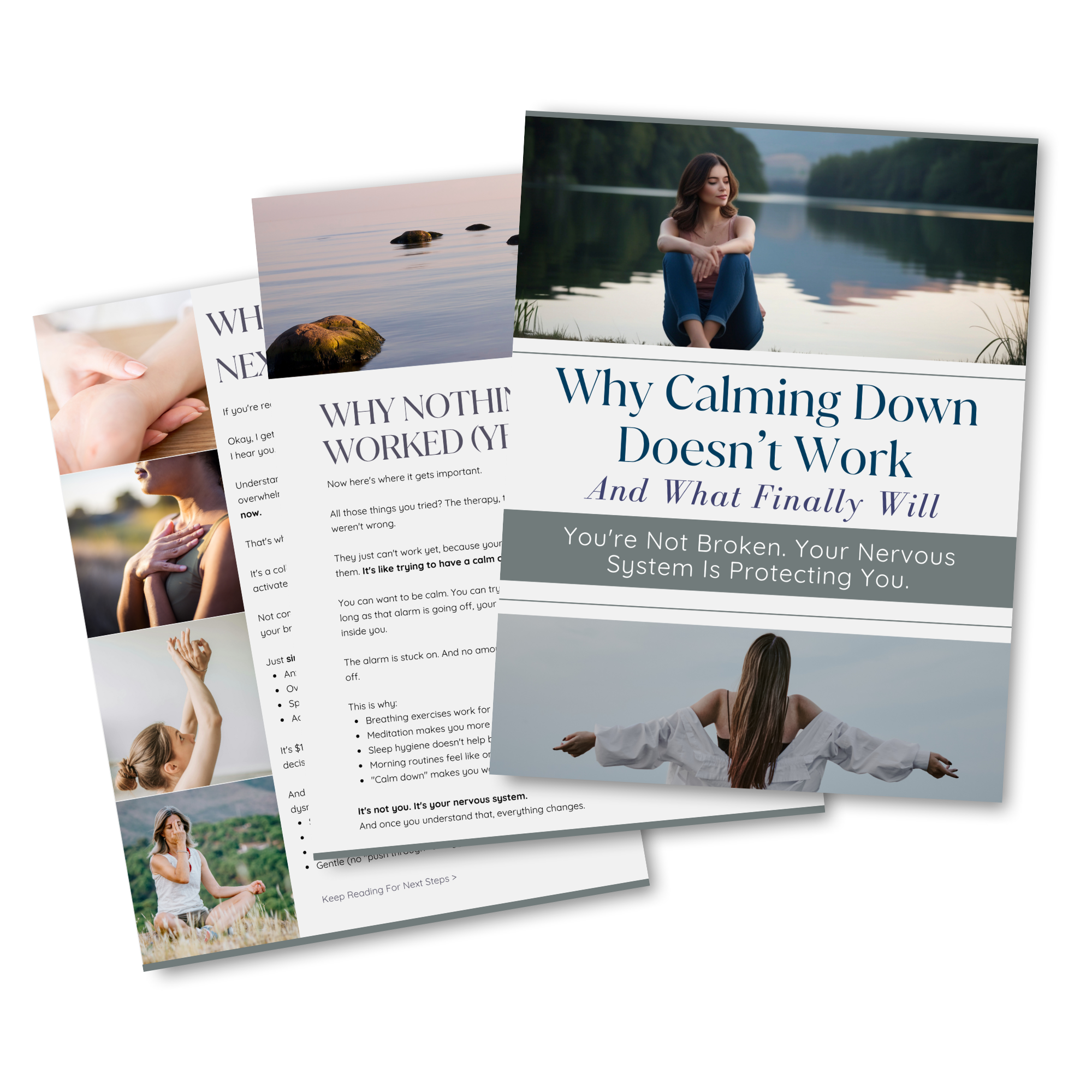
Free Guide: Why Calming Down Doesn’t Work
(And What Finally Will)
You’re Not Broken. Your Body Is Protecting You.
Your inbox stays calm, too. Unsubscribe anytime. We respect your privacy.
4. The Systematic Controller
Your body thrives on structure and routine.
You’re the person with the morning routine, the evening routine, and the journal that actually gets used. Consistency is your superpower. When your systems are in place, you feel grounded, steady, and capable.
Where this gets tricky: when your usual structure isn’t available (travel, a sick week, a season of chaos), the ground disappears. Without your systems, your nervous system can feel completely unanchored. The very thing that keeps you regulated becomes a vulnerability when it’s taken away.
The growth edge is flexible regulation. Tools that work with nothing but your own body, in any room, at any time. No journal required. No morning routine needed. Just your breath, your hands, and 60 seconds.
If you’re curious about a different lens on this, I wrote about nervous system archetypes and how to reclaim the one that fits you.
Why Your Self-Regulation Style Alone Isn’t Enough
Here’s the thing most people miss: knowing your self-regulation style is genuinely useful. But it’s only half the picture.
Because no matter which style you lean into, all of them eventually hit a wall when your nervous system is truly dysregulated.
I know this personally. I spent years perfecting my planning strategy, building every system I could think of, and my body still ended up in full-blown panic in a drive-through coffee line. My hands went sweaty. My vision narrowed. My whole body wanted to run.
All the planning in the world couldn’t touch that. Because my nervous system wasn’t in a state where any strategy could land.
That’s true for every self-regulation style. The Mindful Monitor can’t think her way through a freeze response. The Adaptive Reactor can’t bounce back from something her body hasn’t released. The Systematic Controller’s journal can’t regulate a nervous system that’s stuck in survival mode.
The foundation underneath every style is the same: your nervous system needs to feel safe enough for your natural approach to actually work.
What Actually Helps (Regardless of Your Self-Regulation Style)
The tools that make the biggest difference aren’t complicated. They’re body-based. They work with your nervous system’s language instead of trying to override it with logic.
A double inhale through the nose and a long sigh out through the mouth. Crossbody movements that re-engage your prefrontal cortex. A 10-minute walk when everything feels like too much.
I learned the physiological sigh from Andrew Huberman’s research, and it’s the most effective physical shift I’ve felt in my own body. Not a magic solution. But a pattern I can feel of going from highly sensitized to something calmer. And that proof changes everything.
These work for Strategic Planners who need a tool that doesn’t require advance setup. For Mindful Monitors who need to move from awareness into their body. For Adaptive Reactors who need something before the crash. For Systematic Controllers who need a reset that works without their usual structure.
I put together a free guide with the body-based tools that work across every self-regulation style. It’s called the Somatic Starter Kit, and it’s a good place to start if you’re not sure what to try first.
Your Style Is the Map. Your Nervous System Is the Territory.
Knowing your self-regulation style isn’t a personality quiz result you screenshot and forget about. It’s the first honest look at how your body has been trying to keep you safe this whole time.
That planning? That awareness? That flexibility, that need for structure? None of it is a flaw. It’s your nervous system doing exactly what it was designed to do.
The next step isn’t to fix your style. It’s to give your body the support it’s been asking for underneath all of it.
You don’t have to overhaul anything. You don’t have to add a 90-day protocol to your already full life.
Start with one thing. The smallest thing. And let your body show you what it’s been waiting for.
Save This For Later
If this post landed for you, save it for later. Pinterest is a great place to keep things like this close.
A Good Place to Start
The Somatic Starter Kit is free, and it’s built for the woman who’s tried a lot of things and wants something that actually works with her body instead of against it. No fluff. Just the tools.
You Might Also Like
- Discover Your Nervous System Archetype (and How to Reclaim It)
- 3 Easy Everyday Practices That Help Regulate Your Nervous System
- 9 Simple Swaps to Reset Your Nervous System Fast
Got your result? Grab Why You Can’t Calm Down below to learn what your style needs most.
Free Guide: Why Calming Down Doesn’t Work
(And What Finally Will)
You’re Not Broken. Your Body Is Protecting You.
Your inbox stays calm, too. Unsubscribe anytime. We respect your privacy.