

Getting to Know Somatic Therapy: What It Is and Why It Works
You’re sitting in the waiting room. Your name hasn’t been called yet, but your hands are already sweating. Already, your chest is tight. Your jaw is clenched so hard your teeth ache, and you didn’t even notice until right now. If you’ve been searching for something that actually works, somatic therapy might be the missing piece.
You know this feeling. You’ve known it your whole life.
And somewhere in the back of your mind, you’re thinking: I’ve done therapy. I’ve tried the breathing. I’ve read the books. Why does my body still do this?
That question is exactly where somatic therapy begins.
What Is Somatic Therapy?
Essentially, somatic therapy is a body-first approach to healing. Instead of starting with your thoughts (like traditional talk therapy does), it starts with what’s happening in your body right now. The tension in your shoulders. That knot in your stomach. The way your legs want to move but you’re forcing yourself to sit still.
The word “somatic” simply means “of the body.” So So somatic therapy is, at its core, learning to work with your body instead of against it. It’s a form of holistic health that honors the mind body connection instead of treating your symptoms in isolation.
Here’s why that matters.
Here’s the thing: most of us grew up learning to push through physical discomfort. Ignore the tight chest. Power through the exhaustion. Perform calm even when everything inside is screaming. Over time, that pattern trains your nervous system to stay stuck in survival mode. Your body holds onto things your mind stopped thinking about years ago.
Somatic therapy helps you gently release what’s been stored there. Not by reliving it. Not by talking it to death. By listening to what your body is already telling you, and finally giving it permission to let go. That process of somatic release is what makes this approach different from anything else you may have tried on your healing journey.
Where Somatic Therapy Came From
Dr. Peter Levine, a researcher studying stress responses, noticed something interesting about animals in the wild. After a life-threatening event, animals physically shake, tremble, and move to discharge the stress from their bodies. Then they go back to normal.
Humans don’t do that. Instead, we hold it in. We tell ourselves to calm down. Instead, we intellectualize. We push forward. And the stress stays trapped.
Levine developed Somatic Experiencing as a way to help people complete those unfinished stress responses. His work showed that trauma isn’t just a memory in your brain. It lives in your body, and it needs a body-based way out.
That idea changed everything for a lot of women who had spent years in talk therapy and still didn’t feel better. Not because therapy was wrong, but because it was incomplete. The missing piece was the body. Somatic healing starts there.
How Your Body Signals That Something Is Stuck
You might already know this feeling, even if you’ve never had words for it. Your body has been sending signals for a long time:
- Your heart races for no obvious reason
- Your neck and shoulders hold tension like a permanent knot
- Your stomach churns before situations that “shouldn’t” be stressful
- You lie wide awake at night, exhausted but wired
- You feel jumpy, on edge, like you’re waiting for something bad to happen
- Your skin flares up, your allergies get worse, or your body seems to fight itself right when things start to improve
These aren’t random. They’re your nervous system communicating. It’s not broken. It’s doing exactly what it was designed to do. It just hasn’t gotten the signal yet that the danger has passed.
Somatic therapy teaches you how to send that signal.
What Somatic Therapy Actually Looks Like
If you’re picturing a therapy couch and a clipboard, set that aside. Somatic therapy can look a lot of different ways, and many of them are things you can do on your own, in your kitchen, in your car, or while your kids nap.
Somatic awareness practices. This is the foundation of all somatic therapy exercises. Simply noticing what you feel in your body, without trying to fix it. Where is the tension? What does it feel like? Is it hot, tight, buzzy, heavy? In fact, naming the sensation is often enough to shift it. This kind of body awareness is where somatic work begins.
I didn’t realize I had been carrying held-on emotions until I was talking to a therapist and she said, “That’s not normal. That’s not healthy.” I had always just laughed it off. But once I started paying attention to what my body was actually doing (not just what my mind was thinking), everything started to make more sense.
Breathwork
Not the kind where someone tells you to “just breathe.” The kind where you learn how different breaths create different effects. A long exhale activates your vagus nerve and calms your nervous system. A double inhale through your nose followed by a slow sigh out through your mouth can physically shift you from spiraling to steady in seconds.
The first thing that actually worked for me was the physiological sigh. It’s the most effective physical shift you can feel in your body. Not a magic pill, because none of these are. But it creates a pattern of going from highly sensitized to feeling more calm. That proof is incredibly powerful.
If you’re curious what somatic work feels like in practice, my free Somatic Starter Kit gives you simple exercises to try today, no appointment needed.
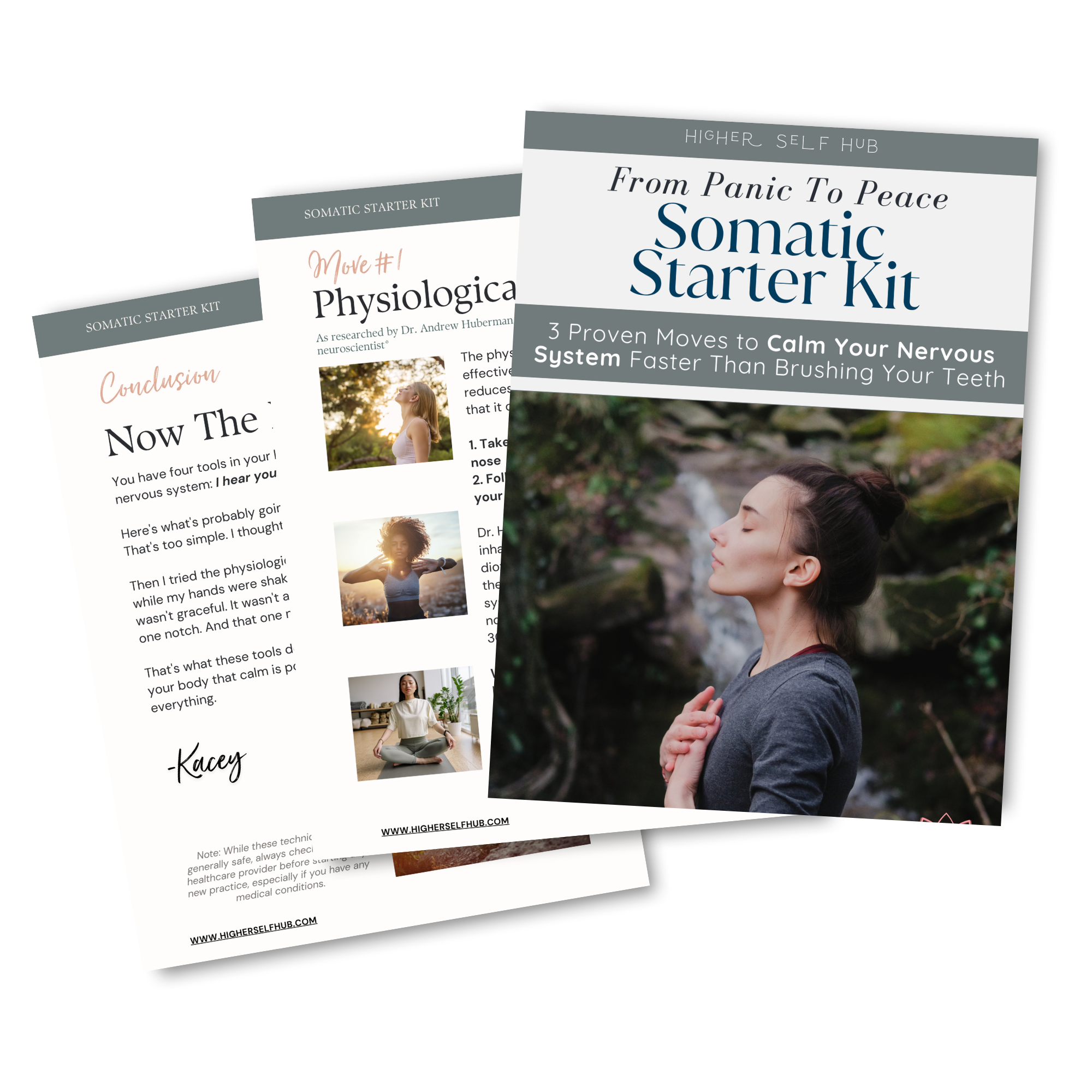
Your Free Somatic Starter Kit
3 science-backed tools to go from panic to peace in under 60 seconds.
Your inbox stays calm, too. Unsubscribe anytime. We respect your privacy.
Somatic Movement
Gentle, intentional somatic exercises that help your body discharge stored tension. This can be shaking, stretching, swinging your arms across your body, or even tossing a ball back and forth. Crossbody stimulation helps re-engage the left and right parts of your brain so that your prefrontal cortex (the thinking, rational part) can come back online.
When we get agitated, that thinking brain literally turns off. The amygdala takes over so we can react fast. That’s great if you’re in actual danger. But most of the time, we’re not. Somatic therapy gives you tools to signal safety so your thinking brain can come back.
Grounding Techniques
When you feel yourself drifting, dissociating, or spiraling, grounding exercises bring you back to right now. It can be as simple as saying out loud: It’s Tuesday afternoon. My feet are on the floor. I’m in my kitchen. The sun is shining.
It sounds almost too simple. But when your nervous system is spinning, these self soothing techniques are what bring you back to the present. You’re not worrying about the future or reliving the past. You’re right here.
Why Somatic Therapy Works When Other Things Haven’t
If you’ve tried talk therapy and it helped some but didn’t get to the root of what your body was holding, that makes sense. Talk therapy works with your conscious mind. However, trauma and chronic stress often live below conscious thought. They live in your muscles, your gut, your nervous system patterns.
Somatic therapy works because it goes to where the problem actually lives.
It’s not the level of the trauma that matters. It’s how it gets stuck and stored in our body if we don’t have the skills to process it at the time. What I love about somatic healing exercises is that they don’t require reliving past experiences. They don’t take hours and hours of talk therapy. Your body can release what it’s holding without your mind having to replay every detail.
On top of that, On top of that, somatic therapy teaches your nervous system something new. Instead of just understanding why you feel the way you do (which is what talk therapy is great at), somatic work helps your body experience calm. Even briefly. Even imperfectly. That experience of calm is what builds emotional regulation over time, naturally.
This is neuroplasticity in action. Your brain can change. The pathways that feel stuck right now can be rewired through repetition and practice. These somatic techniques work because they start with small moments of felt safety, repeated often enough that your nervous system starts to believe it.
Simple Ways to Start Somatic Therapy Today
You don’t need a $150 appointment to begin. Here are a few places to start, wherever you are right now:
1. Do a 60-Second Body Check-In
Pause. Close your eyes if that feels okay. Scan from the top of your head to your toes. Where do you feel tension? Heaviness? Heat? Numbness? You don’t have to fix anything. Just notice. Name it. That’s somatic awareness, and it’s the first step.
2. Try the Physiological Sigh
One inhale in through your nose. Then another little sip of air in through your nose. Then a long, slow exhale out through your mouth like a sigh. Try it two or three times. Feel what shifts.
3. Use Crossbody Movement
Stand up and gently swing your arms across your body, left and right. In yoga, this is called “knocking on heaven’s door.” It looks like nothing, but it helps both sides of your brain sync up. Try it for 30 seconds when you feel scattered or overwhelmed.
4. Ground Yourself With What’s Real
Name five things you can see, four you can hear, three you can touch, two you can smell, one you can taste. Or just say where you are and what day it is. Anything that anchors you here. This is especially helpful when you feel yourself checking out or going numb.
5. Start With Your Toes
If calming your whole body feels like too much (and some days it will), start smaller. Can you relax just your toes? Just your hands? Just your jaw? You don’t have to calm everything at once. One tiny piece of connection to the present moment is enough.
What If You Want to Go Deeper With Somatic Therapy?
If these simple practices resonate and you want more structure, here are some paths forward:
Find a somatic therapist. Look for practitioners trained in Somatic Experiencing, sensorimotor psychotherapy, or other body-based modalities. Meet a few before choosing. The right fit matters more than the right credentials.
Read the books that changed everything. Dr. Peter Levine’s Waking the Tiger is the foundational text. Dr. Claire Weekes’ Hope and Help for Your Nerves explains how the nervous system works in language that actually makes sense. Both are worth your time.
Try an online somatic course. There are excellent programs that teach you body-based tools from home. These can be a great entry point if sitting in a therapy office feels overwhelming in itself.
Use a journal or tracker to notice patterns. You don’t need anything fancy. Even a few lines at the end of the day about what you noticed in your body can reveal patterns you’d never see otherwise. Over time, that kind of somatic awareness becomes its own quiet form of healing.
If you want to understand more about why calming down doesn’t always work (and what does), I break it all down in this free guide: Why Calming Down Doesn’t Work (And What Finally Will)
You Don’t Have to Get This Perfect
Somatic therapy isn’t another thing to add to your list. It’s not a protocol to follow perfectly. Not something you can fail at.
It’s an invitation to listen to the body wisdom that’s been trying to talk to you for a long time.
Some days you’ll do the sigh and feel something shift. Other days you won’t feel anything at all. Both are fine. Both are part of the process.
Ultimately, the healing doesn’t happen in one breakthrough moment. It happens in the repetition. In the small, quiet moments where you pause and ask your body what it needs instead of telling it to be quiet. That’s somatic therapy at its simplest.
Ready to try it? Here is a gentle starting point: somatic exercises to reduce cortisol. And if you want the bigger picture, this guide covers 11 things you need to know about somatic healing.
And if the only thing you take from this post is the permission to stop fighting what your body is doing and start working with it instead, that’s more than enough.
Your body isn’t broken. It’s protecting you. Somatic therapy just helps you both get on the same page.
If this post felt useful, save it for later. Pinterest is a great place to keep things like this close for the days when you need a reminder.
Want to start before your first session (or instead of one for now)? Grab the free Somatic Starter Kit below and let your body take it from here.
Your Free Somatic Starter Kit
3 science-backed tools to go from panic to peace in under 60 seconds.
Your inbox stays calm, too. Unsubscribe anytime. We respect your privacy.