

Healthy Morning Routine: 7 Simple Habits Your Body Will Thank You For
You’re already three hours into the day before your feet hit the floor. And the idea of a healthy morning routine? It sounds like something meant for someone else. And the idea of a healthy morning routine? It sounds like something meant for someone else.
Your jaw is clenched. Your brain is running through the school schedule, the grocery list, the email you forgot to send yesterday. You grab your phone and scroll for twenty minutes without realizing it. By the time you actually stand up, you’re already behind.
If that’s your morning, you’re not lazy. You’re not doing it wrong. Your nervous system just got there before you did.
A healthy morning routine isn’t about waking up at 5am or journaling by candlelight. It’s about giving your body a few minutes to land before the world starts pulling at you. And it can be a lot simpler than you think.

What Makes a Morning Routine Actually Healthy?
Most morning routine advice sounds great on paper. Meditate for 20 minutes. Work out. Drink a green smoothie. Journal three pages.
Here’s the thing: if your nervous system is already in overdrive the moment you open your eyes, none of that is going to stick. You’ll white-knuckle your way through it for a week, maybe two, and then quit. Not because you’re undisciplined. Because your body wasn’t ready.
A truly healthy morning routine starts with regulation, not productivity. It meets your nervous system where it is. Instead of forcing calm, it invites it. Instead of adding more to your plate, it creates a pause before the plate gets full.
That’s the difference between a morning routine that looks good and one that actually feels good.
Why Your Body Needs a Healthy Morning Routine (Not Just Your Brain)
Your nervous system has two main modes: alert (sympathetic) and rest (parasympathetic). Most of us wake up already tilted toward alert. The alarm goes off, cortisol spikes, and your body shifts into go-mode before you’ve even had coffee.
Over time, that pattern becomes your default. You’re not choosing to feel wired at 7am. Your body is just doing what it’s learned to do.
A body-first healthy morning routine gently interrupts that pattern. It sends a signal to your vagus nerve, the longest nerve in your body running from your brain to your gut, that says: you’re safe. You can slow down. (source)
As a result, that signal gets stronger over time. Your morning habits become less about discipline and more about repetition. Repetition builds safety. Safety builds consistency. And consistency is what actually changes how you feel.
7 Healthy Morning Habits That Start With Your Body
These aren’t assignments. They’re invitations. Start with whichever one sounds like the least amount of effort. That’s the right one.
1. Notice Before You Move
Before you get out of bed, pause. Feel the weight of your body on the mattress. Notice which hip feels heavier. Wiggle your toes. Take one slow breath.
This isn’t meditation. It’s just a moment of arriving. Letting your brain catch up to the fact that you’re awake. It takes ten seconds and it changes the trajectory of your entire morning.
2. Try a Physiological Sigh
This is the single most effective nervous system reset you can do in bed. One inhale through your nose, then a small second sip of air through your nose, followed by a long slow exhale through your mouth.
It’s called a physiological sigh, and it physically shifts your body from alert to calm. Not a magic pill. But a pattern you can feel in your body, of going from highly sensitized to something softer. Do it two or three times before your feet touch the floor.
If mornings feel like a race before your feet hit the floor, my free guide explains why (and how to change what your body wakes into).
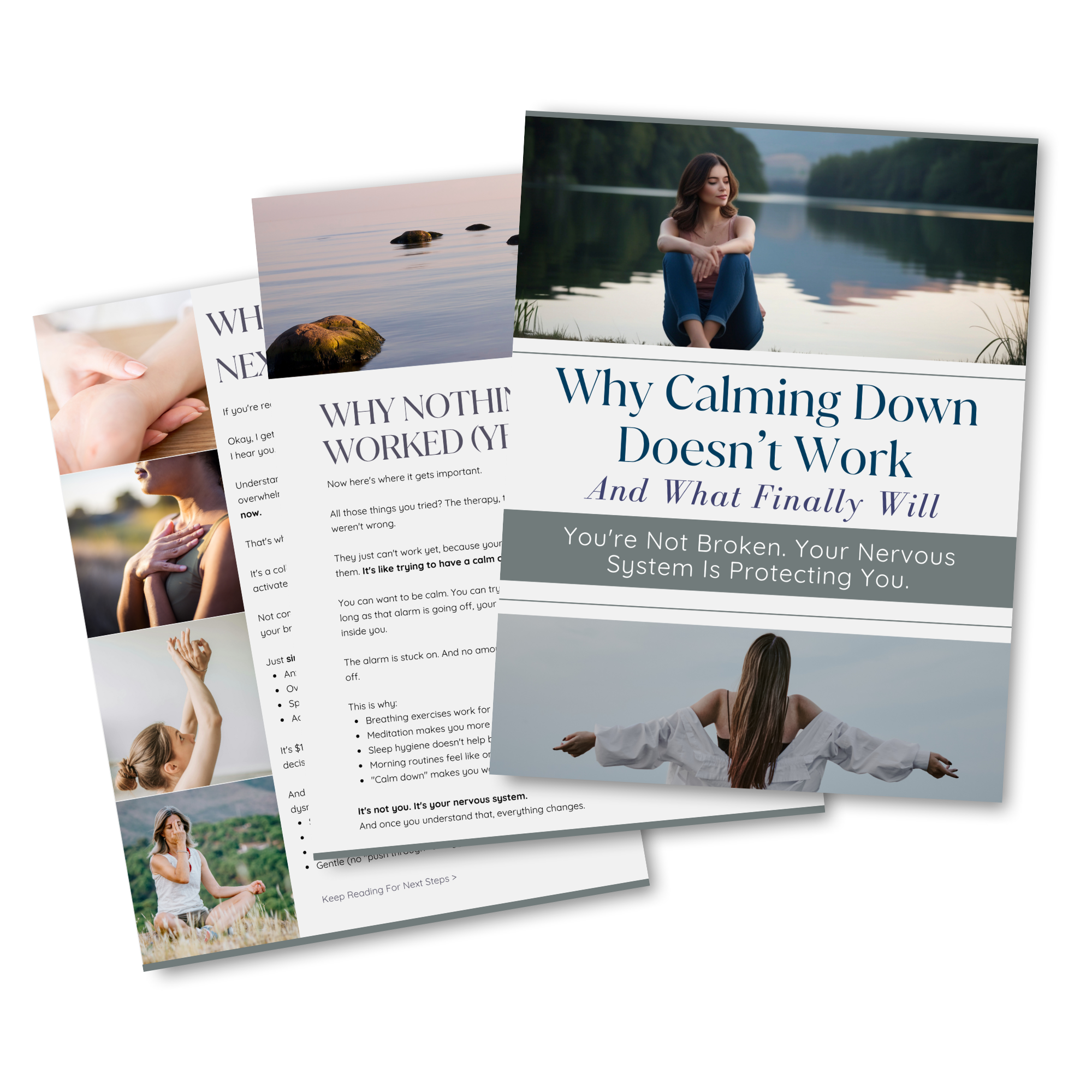
Free Guide: Why Calming Down Doesn’t Work
(And What Finally Will)
You’re Not Broken. Your Body Is Protecting You.
Your inbox stays calm, too. Unsubscribe anytime. We respect your privacy.
3. Ground Your Feet
When you stand up, stand still for a moment. Feel your feet on the floor. Say something simple to yourself, even silently: It’s Friday morning. My feet are on the floor. I’m in my kitchen. The sun is coming through the window.
In other words, these simple awareness statements pull you out of the spiral and into the present. That’s grounding. It doesn’t require a special mat or a morning yoga session (although those are wonderful too). Just your feet and your attention.
4. Move Gently (Think Somatic, Not Cardio)
You don’t need a full workout to benefit from morning movement. A few minutes of gentle somatic exercises can do more for your nervous system than an hour on the treadmill.
For example, try this: stand with your feet hip-width apart and swing your arms gently side to side, letting them wrap around your body. It’s called crossbody stimulation, and it helps re-engage both sides of your brain. When you’re overwhelmed or foggy in the morning, your prefrontal cortex (the thinking part) has literally gone offline. This simple movement helps bring it back.
Even a short morning stretch routine counts. Roll your shoulders. Twist your spine. Let your body wake up on its own terms.
5. Hydrate Before You Caffeinate
This one is simple. Drink a glass of water before your coffee. Your body has been fasting all night and dehydration affects focus, mood, and energy more than most people realize (source).
You don’t need lemon water or a special recipe. Just water. Room temperature is fine. Do it while the coffee brews.
6. Breathe With Intention (Even for 60 Seconds)
You don’t have to sit cross-legged for 20 minutes to get the benefits of morning meditation. Even 60 seconds of intentional breathing can shift your nervous system.
Stand at the kitchen counter. Close your eyes. Breathe in for four counts, hold for four, out for six. That’s it. Similarly, that extended exhale activates your parasympathetic nervous system and tells your body the day can start from a place of calm, not chaos.
If you want to go deeper, a vagus nerve reset takes less than two minutes and you can do it before anyone else in the house is awake.
7. Write One Line (Not Three Pages)
Journaling doesn’t have to mean morning pages. It can be one sentence. Today I feel heavy. Something feels lighter. Today I just want to make it to bedtime.
That single line of awareness creates a pattern of checking in with yourself. Over weeks, it becomes a record of your healing. A quiet note to yourself that says: I noticed. I showed up. Even on a hard day.
If you want a structure for that, somatic journaling is a gentle way to track what your body is telling you without turning it into homework.
What If Your Healthy Morning Routine Falls Apart?
It will. Some mornings the kids are screaming, the dog needs out, and you’re already late before your eyes are fully open. That’s not failure. That’s just life with a nervous system.
On those mornings, here’s what works: just say reset. That’s what we call it in our house. If one of my kids is having a meltdown, we offer everybody a reset. Do you want to start fresh? We can put everything behind us. And if I need one too, I’ll say, “Mom needs a reset. I’m going to go outside and walk for ten minutes.”
No expectations on it solving everything. But it resets my nervous system. And then I can decide what comes next.
A healthy morning routine isn’t something you can fail at. There’s no ideal sequence. No benchmark to hit. If you did one thing from this list, even just noticing your feet on the floor, that counts. That’s your body learning a new pattern. And ultimately, that’s enough.
If you want to understand more about why calming down doesn’t always work (and what does), I break it all down in this free guide: Why Calming Down Doesn’t Work (And What Finally Will)
Free Guide: Why Calming Down Doesn’t Work
(And What Finally Will)
You’re Not Broken. Your Body Is Protecting You.
Your inbox stays calm, too. Unsubscribe anytime. We respect your privacy.
Your Morning Doesn’t Have to Be Perfect
Your body has been carrying a lot. It doesn’t need another thing to be good at. It needs permission to be exactly where it is.
So start with one habit. The one that sounded easiest. Not the one that sounded most impressive. Because the healthy morning routine that works is the one you can repeat, even on the hard days. Especially on the hard days.
If this post helped, save it for later. Pinterest is a great place to keep things like this close for the days when you need a gentle reminder that a healthy morning routine is always an option, on your terms.
If your morning routine needs a nervous system reset, this 10-minute holistic morning routine is a great place to start. And for building lasting habits that actually stick, learn how microhabits support a healthy nervous system.