

11 Things You Need to Know About Somatic Healing
Tell me honestly…
How many times have you told yourself, “I can get through this,” and then your body hijacks you anyway?
Don’t worry, I get it too.
You’ve tried meditation apps, talk therapy, positive affirmations, and maybe even medication. And yet here you are, still feeling like your body is stuck in a loop you can’t think your way out of
By the end of this post, you will have a complete understanding of somatic healing and why it might be the missing piece you’ve been searching for
Because somatic healing and nervous system regulation can feel like a dense, science-y topic, we’re going to walk through it in plain, human language. No jargon, no gold stars required.
As someone who has navigated severe agoraphobia and traumatic brain injury before creating Higher Self Hub, it’s my mission to help women like you stop white-knuckling your way through life and start working with your body instead of against it.
If you’ve tried calming techniques and still feel stuck, it helps to understand why that happens. I explain this more gently in a short, free guide below.
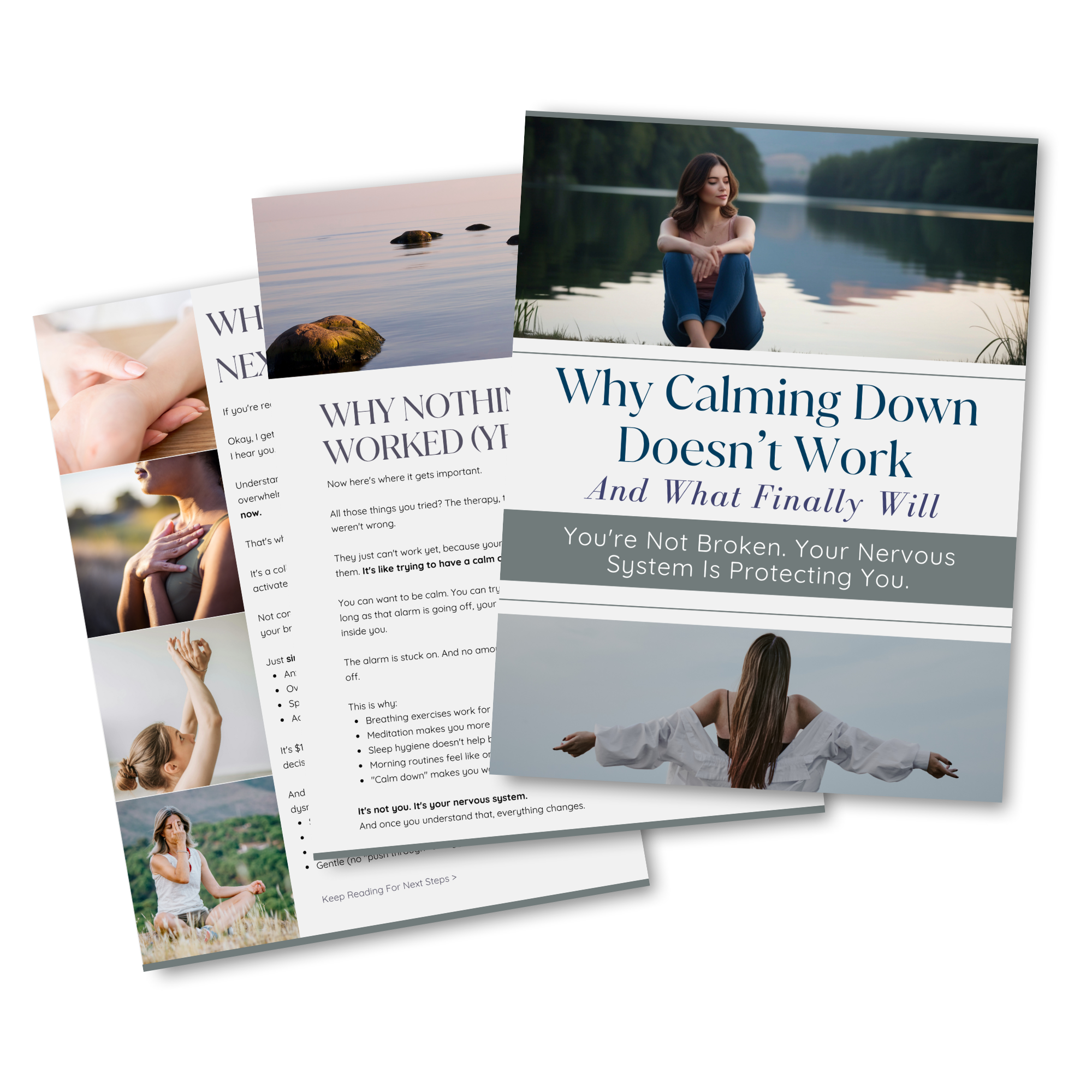
Free Guide: Why Calming Down Doesn’t Work
(And What Finally Will)
You’re Not Broken. Your Body Is Protecting You.
Your inbox stays calm, too. Unsubscribe anytime. We respect your privacy.
Alright, let’s dive into 11 things you really need to know about somatic healing.
Table of Contents
Use the links below to jump to a section, or just scroll at your own pace:
- What somatic healing actually is
- Why you can’t “think” your way out of stress
- How to know if your nervous system is dysregulated
- It’s not just for “big T” trauma
- Somatic healing doesn’t have to be heavy or re-traumatizing
- Numbness and disconnection are not “failures”
- How to fit somatic tools into a busy day
- How somatic work helps with overthinking + spirals
- What’s safe to do on your own (and when to get support)
- How long somatic healing takes (and what progress really looks like)
- What somatic healing looks like in everyday life
At the end, you’ll find Key Takeaways plus links to go deeper.
#1: What Somatic Healing Actually Is
Before we get fancy, let’s keep it simple:
Somatic healing is the practice of working with your body (nervous system, breath, sensations, movement) to gently complete and release stored stress and emotion.
Your body is always recording your life:
- Every time you swallowed your feelings to keep the peace
- Every time you had to push through when you wanted to cry or rest
- Every time your body wanted to shake, cry, yell, or collapse—but you were in a meeting, in public, or around people who didn’t feel safe
In nature, animals complete their stress cycles: they shake, run, tremble, pant, and then return to calm. They don’t sit around overthinking the argument they had with the lion.
Humans? We override that process constantly. As we hold it together, we stay polite. What we do to keep ourselves safe, stresses our system.
Over time, this can look like:
- Chronic tight shoulders, jaw, gut
- Feeling “on edge” for no clear reason
- Being easily triggered into the same emotional loops
Somatic healing isn’t about digging for drama. It’s about giving your body safe ways to do what it already knows how to do: complete the stress response and come back to regulation.
🧰 Want a few guided examples?
They’re inside the Somatic Starter Kit. You’ll get simple, nervous-system-friendly tools you can practice in 5 minutes.

#2: Why you can’t “think” your way out of stress
You can be incredibly self-aware and still feel hijacked by your body.
Here’s why:
When your body perceives danger (real or remembered), your survival brain comes online:
- Fight, flight, freeze, or fawn
- Heart racing, tight chest, tunnel vision, racing thoughts
In that state, your prefrontal cortex (the logical, rational, “let’s be reasonable” part of your brain) goes partially offline. Your system is not interested in your affirmations. It’s interested in not dying.
That’s why:
- You can’t “just calm down”
- You can’t positive-think your way out of a panic spiral
- You forget every coping skill you know in the moment
We have to speak to the primal brain in its own language:
- Breath
- Movement and posture
- Sensory input (pressure, warmth, temperature, sound)
- Rhythm and repetition
Somatic exercises don’t replace mindset work, therapy, or medication. They make those tools more effective because your body is actually able to receive them.
#3: How to know if your nervous system is dysregulated
You don’t need a clinical diagnosis to know your nervous system needs support. Some common signs:
- You live in “wired but tired” mode
- You swing between overdoing and total shutdown
- You overthink every interaction or decision
- You struggle to fall asleep or wake up exhausted
- You feel like you’re always bracing for something to go wrong
- You snap at people you love and then feel guilty
- You have a hard time relaxing even in a calm environment
Dysregulation doesn’t mean you’re broken. It means your body has learned patterns to keep you safe that are now overfiring.
If you want to explore this gently, you can use journaling to map your patterns:
Try a Somatic Journal–style prompt:
- “When I feel triggered, I notice these sensations in my body…”
- “My nervous system feels safest when…”
- “Places in my life where I override my body’s ‘no’ are…”
✨ You can try a Somatic Journal or Somatic Gratitude Journal sample to gently build this kind of awareness into your routine.
#4: It’s not just for “big T” trauma
Somatic healing is often talked about in trauma spaces, and yes. It can be powerful for people with intense histories.
But it’s also for:
- The woman who’s been chronically stressed for years
- The mom who never gets a minute alone
- The people-pleaser who’s never been allowed to have needs
- The high achiever who lives on cortisol and coffee
- The person healing from chronic health issues and burnout
Your nervous system doesn’t only respond to catastrophic events. It responds to:
- Ongoing stress
- Misattunement (not feeling seen/heard as a child or adult)
- overwhelm, overwork, and “no time to recover”
If you have a human body and you’ve been alive for more than a few years, you are absolutely allowed to benefit from somatic work.

#5: Somatic healing doesn’t have to be heavy or re-traumatizing
A huge fear many women have is:
“If I do somatic work, am I going to end up sobbing on the floor, reliving the worst moments of my life?”
Short answer: No.
Good somatic work is:
- Titrated – tiny, digestible doses instead of diving into the deep end
- Grounded in choice – you never have to go somewhere you don’t want to go
- Resourcing – you build safety and capacity before touching heavier material
Many somatic practices feel like:
- Gentle stretching
- Rocking or swaying
- Grounding your feet
- Adding weight (like a blanket)
- Simple breath patterns
Sometimes emotions come up, yes. But they’re not the goal. Regulation is the goal.
If you want soft, approachable starter practices, that’s exactly what’s inside the Somatic Starter Kit.
#6: Numbness and disconnection are not “failures”
A lot of women say things like:
- “I’m bad at feeling my feelings.”
- “I don’t feel anything in my body.”
- “I just go blank.”
Numbness is not you failing at healing. It’s your nervous system saying:
“This was too much for too long, so I had to turn the volume down to protect you.”
That shutdown / freeze state is a survival strategy.
Instead of forcing yourself to “feel more,” we start with very small, safe signals:
Try:
- Noticing just one neutral sensation (like your feet on the floor)
- Holding something warm (mug, heat pack) and naming how it feels
- Tuning into one body area for 5 seconds, then stopping
Over time, your system learns: “Oh, it’s safe to tune in here. I won’t be flooded.”
This is where a Somatic Gratitude Journal–style practice can help. For example:
- “Today, I’m grateful my body allowed me to…”
- “One small way my body supported me today was…”
You’re rebuilding a relationship, not demanding instant intimacy.

#7: How to fit somatic tools into a busy day
You do not need a 60-minute routine on a yoga mat with candles and whale sounds.
Think regulation snacks, not regulation marathons.
Examples you can weave into a packed day:
- Transition rituals
- 30 seconds of shaking before you walk in the door after work
- 5 slow exhales before you start your inbox
- Anchor habits
- While you brush your teeth, feel your feet and soften your jaw
- While the kettle boils, do a gentle standing twist
- Stealth regulation
- Pressing your tongue to the roof of your mouth and dropping your shoulders in a meeting
- Slow, silent exhales while your kids argue in the next room
If you want ready-made, plug-and-play ideas, the Somatic Starter Kit gives you simple tools you can literally do in 1–3 minutes between tasks.
#8: How somatic work helps with overthinking + spirals
Overthinking isn’t just “a mindset problem.” It’s also a nervous system state.
When your body feels unsafe, your mind tries to solve it by:
- Replaying conversations
- Predicting every possible outcome
- Planning for worst-case scenarios
But your body doesn’t calm down because the threat feels physical, not intellectual.
Somatic tools give your brain proof that:
“Right now, in this moment, I am physically safe.”
You can interrupt spirals with:
- Orienting: slowly turn your head and eyes, noticing a few objects around you and naming them
- Handshake with reality: feel a solid surface (chair, floor, wall), press your hands or feet into it
- Patterned breathing: e.g., exhale slightly longer than you inhale
Once your body begins to settle, your thoughts naturally soften. Then all the mindset tools, affirmations, and reframes finally land.
🌿 If you like having soothing support in your back pocket, this is where my Hope in Your Pocket Bundle comes in. Short audio practices and calming supports you can use when you’re spiraling.

#9: What’s safe to do on your own (and when to get support)
You can absolutely do basic somatic regulation on your own:
Great for DIY:
- Grounding and orienting practices
- Gentle breath work
- Light stretching, shaking, walking, dancing
- Journaling about sensations, triggers, and safety cues
- Using resources like the Somatic Starter Kit and Somatic Journal pages
Times you may want a therapist, coach, or practitioner:
- You have a history of significant trauma and feel easily overwhelmed
- You notice intense flashbacks or dissociation when you try body work
- You feel stuck in deep freeze or collapse and can’t shift on your own
- You’re navigating chronic illness or pain and need tailored support
Think of it like this:
- Daily nervous system hygiene? You can absolutely do that yourself.
- Deep surgery on old wounds? It’s okay (and wise) to have a trusted professional with you.
#10: How long somatic healing takes (and what progress really looks like)
I know you want to hear: “Do these three exercises and your nervous system will be healed in 7 days.”
That’s not how bodies work—and that’s okay.
Somatic healing is more like strength training than a detox:
- Consistent, small reps over time
- Slowly increasing your “capacity”
- Gentle, sustainable change rather than big spikes
Progress might look like:
- You still get triggered—but you come back to yourself more quickly
- You notice your body’s cues earlier instead of after the blow-up
- You catch yourself before saying yes when your body is a hard no
- You have more neutral days instead of constant high-highs and low-lows
Keep your focus on 1% shifts, not perfection.
If you want simple structure, you can use:
- A Somatic Journal spread to track what helps you regulate
- A Gratitude Journal page focused on your body’s wins
- The practices in your Somatic Starter Kit as your “daily reps”

#11: What somatic healing looks like in everyday life
Somatic healing isn’t just what you do on your mat. It’s how you move through your actual, messy life.
It can look like:
- Taking 3 slow breaths before responding to a snappy text
- Shaking out your hands after a hard conversation instead of stuffing it down
- Lying on the floor for 2 minutes with your legs up on the couch to reset your system
- Saying, “I need a moment,” and walking outside instead of pushing through
- Noticing your jaw clench in traffic—and choosing to soften it
- Crying for 30 seconds in the bathroom and letting your body complete that wave
That’s somatic healing: micro-moments of listening to your body and responding with care.
It doesn’t have to be aesthetic. It has to be honest.
Key Takeaways
Let’s pull the threads together:
- Your body stores unprocessed stress and emotion, just like animals—but unlike them, we rarely complete the cycle.
- In fight/flight, your prefrontal cortex goes offline, so you can’t think your way out—you need body-based tools.
- Somatic healing isn’t just for “big trauma”; it’s for anyone living in a stressed-out, modern body.
- Numbness isn’t failure; it’s protection. We work with it gently, in tiny doses.
- You don’t need more willpower—you need nervous system support woven into your real life.
- Progress is subtle and steady: faster recovery, more choice, more compassion for your body.
Ready to start practicing (not just reading)?
Here’s your next step:
👉 If this reframes some of what you’ve been taught about stress and healing, you’re not alone. I put the fuller explanation into a short, free guide you can read at your own pace.
Free Guide: Why Calming Down Doesn’t Work
(And What Finally Will)
You’re Not Broken. Your Body Is Protecting You.
Your inbox stays calm, too. Unsubscribe anytime. We respect your privacy.
Then, if you want to deepen the work:
- Explore a Somatic Journal to map your patterns and track your nervous system wins
- Try a Somatic Gratitude Journal sample to slowly shift from body blame to body appreciation
- And when you’re ready for soothing, on-the-go support, peek at the Hope in Your Pocket Bundle—your calm, compassionate voice note in your pocket.
You’re not behind. Your body is simply asking to be part of the healing conversation.
And that’s exactly what somatic healing is. 🌿