

8 Of The Most Valuable Books For Somatic Healing (Ranked For 2026)
Fun fact: Did you know that 89% of people who start somatic healing books never finish them? I’ll help you avoid that trap by showing you exactly which books match your needs and how to use them effectively.
You know that feeling when you’re staring at an endless list of somatic healing books on Amazon, completely overwhelmed? Yeah, I’ve been there.
Three years ago, I dove headfirst into somatic healing after a particularly stressful period in my life left me with chronic tension headaches. I’ve since read over 20 books on the subject, tested countless exercises, and made plenty of mistakes along the way.
Today, I’m sharing the 8 books that actually made a difference in my healing journey.
Disclaimer: Please note, this post contains affiliate links. If you purchase through these links then I will be rewarded at no extra cost to you.

What to Look for in a Somatic Healing Book
Before we dive into the reviews, let’s talk about what makes a somatic healing book worth your time and money. I learned this the hard way after spending weeks on a book that was way too advanced for my beginner status!
The best somatic healing books share these crucial features:
- Clear Exercise Instructions: You shouldn’t need a decoder ring to figure out what to do. The books I recommend include step-by-step guidelines that actually make sense.
- Safety First Approach: Good books emphasize the importance of moving at your own pace and include clear warnings about when to seek professional help. Trust me, this matters more than you’d think.
- Scientific Backing: While personal experiences are valuable, the best books balance anecdotal evidence with solid research. I particularly appreciate when authors reference recent neuroscience findings about body-based healing.
- Practical Applications: Theory is great, but you need books that help you take action. The ones I’ve selected include concrete exercises you can start using immediately.
8 Best Somatic Healing Books Reviewed
1. Waking the Tiger by Peter Levine

This book completely changed my understanding of how trauma lives in the body. When I first picked it up, I was skeptical about the whole concept of stored trauma. However, Levine’s clear explanations and practical exercises helped me recognize and release tension patterns I didn’t even know I had.
Best for: Beginners who want to understand the foundations of somatic healing
Pros:
- Clear scientific explanationsFoundational exercises for beginners
Cons:
- Could use more structured exercise guides
- Limited coverage of complex trauma
2. The Body Keeps the Score by Bessel van der Kolk
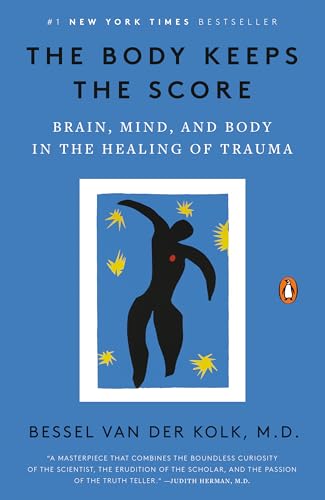

I actually had to read this book twice to fully grasp its wealth of information. While it’s not strictly a somatic healing book, it provides crucial context about how trauma affects our bodies. The research-backed approaches discussed here gave me a solid framework for understanding why somatic practices work.
Best for: Readers who want to understand the science behind body-based healing
Pros:
- Comprehensive research backing
- Engaging writing style
- Bridges mind-body connection
- Valuable clinical insights
Cons:
- Can be emotionally heavy
- More theory than practice
- May overwhelm some readers
I definitely had to take breaks from reading this one. The survivors’ stories are intense, but eye-opening. Spoiler alert: despite their circumstances, they do go on to live good lives after.
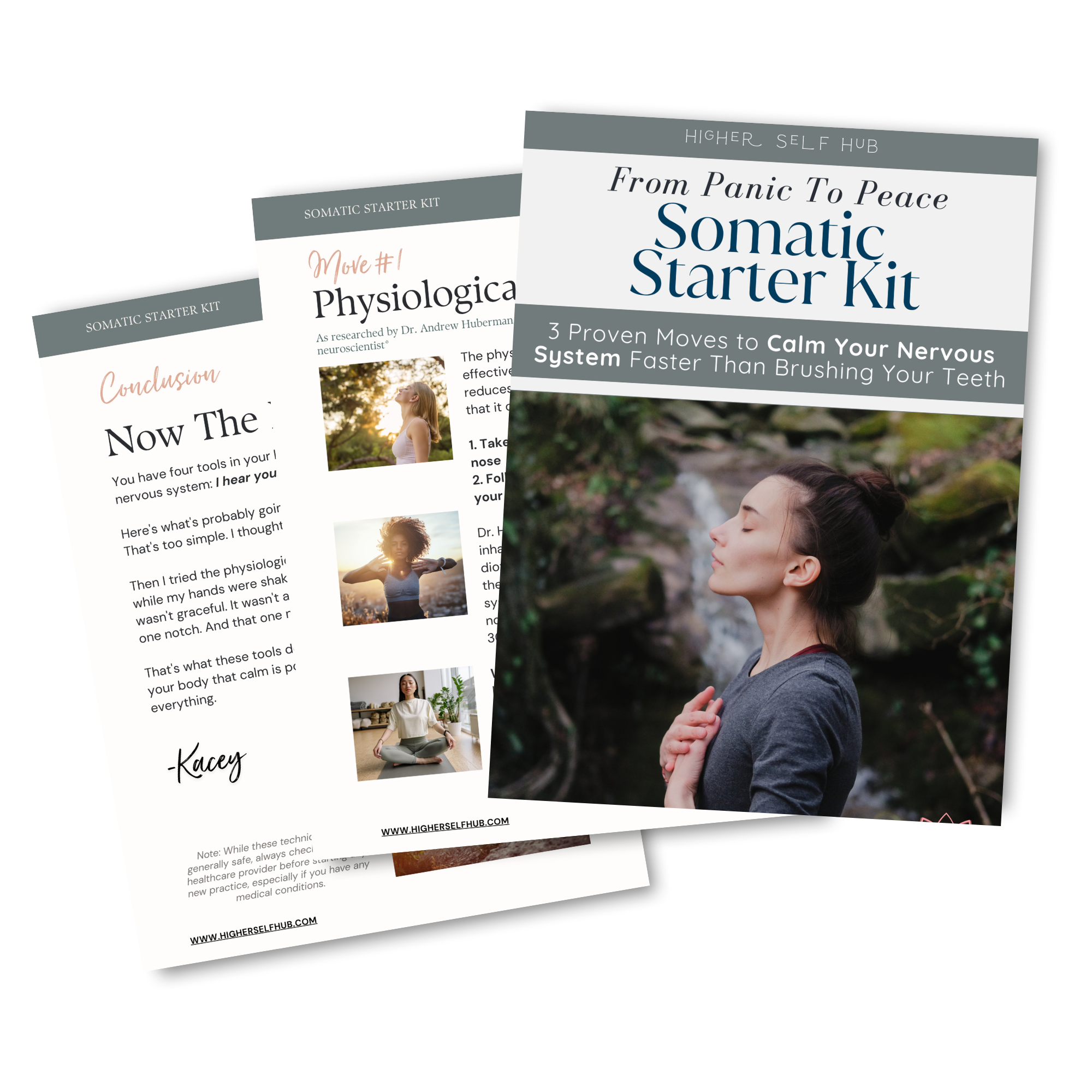
Your Free Somatic Starter Kit
3 science-backed tools to go from panic to peace in under 60 seconds.
Your inbox stays calm, too. Unsubscribe anytime. We respect your privacy.
3. Healing Trauma by Peter Levine

This shorter companion to “Waking the Tiger” holds a special place in my collection. It comes with a CD (or downloadable audio) of guided exercises, which was exactly what I needed when starting out. I still use the 12-step self-guided exercise regularly when I feel overwhelmed.
Best for: Hands-on learners who prefer guided exercises
Pros:
- Includes guided audio exercises
- Compact and practical
- Perfect for beginners
- Clear, step-by-step instructions
Cons:
- May be too basic for advanced practitioners
- Limited theoretical background
- Some exercises require the audio component
4. Accessing the Healing Power of the Vagus Nerve by Stanley Rosenberg

I stumbled upon this gem when researching nervous system regulation. It transformed my understanding of how the vagus nerve influences everything from anxiety to digestion. The exercises seemed strange at first (who knew moving your eyes could affect your nervous system?), but they’ve become an essential part of my daily routine.
Best for: Those interested in the scientific aspects of nervous system regulation
Pros:
- Unique, practical exercises
- Strong scientific foundation
- Clear illustrations
- Immediate application potential
Cons:
- Technical language may intimidate some readers
- Exercises can feel mechanical
- Requires patience to see results
5. Body Awareness as Healing Therapy by Moshe Feldenkrais

This book challenged everything I thought I knew about movement and body awareness. While it’s not strictly about trauma healing, its insights into body patterns and movement awareness have been invaluable in my somatic healing journey. I particularly appreciate the subtle movement lessons that helped me identify unconscious tension patterns.
Best for: Those interested in movement-based healing approaches
Pros:
- Unique perspective on movement and healing
- Detailed movement lessons
- Integration of mind-body awareness
- Builds fundamental body awareness
Cons:
- Writing style can be dense
- Concepts may seem abstract
- Requires significant practice time
6. In an Unspoken Voice by Peter Levine

This book expanded my understanding of how trauma manifests in everyday life. What sets it apart is its exploration of subtle, often overlooked trauma responses. The case studies were eye-opening, especially the one about a man whose chronic shoulder pain stemmed from a minor childhood incident.
Best for: Intermediate to advanced practitioners seeking deeper understanding
Pros:
- Rich case studies
- Advanced concepts
- Integrates multiple healing approaches
- Excellent for practitioners
Cons:
- May overwhelm beginners
- Dense theoretical sections
- Requires background knowledge
7. Sensorimotor Psychotherapy by Pat Ogden

Best for: Therapists and serious students of somatic healing
Pros:
- Comprehensive theoretical framework
- Detailed clinical applications
- Evidence-based approaches
- Excellent reference material
Cons:
- Expensive
- Very technical language
- Can be overwhelming for beginners
8. The Polyvagal Theory in Therapy by Deb Dana

Initially, I almost gave up on this book because of its technical language. I’m glad I didn’t! It provided crucial insights into how our nervous system responds to stress and trauma. The mapping exercises helped me understand my own nervous system patterns and create better self-regulation strategies.
Best for: Those wanting to understand nervous system responses
Pros:
- Clear explanation of polyvagal theory
- Practical applications
- Practical applications
- Useful exercises and worksheets
- Good for practitioners
Cons:
- Technical terminology
- Requires focused study
- Price point may be high for some
In-Depth Reviews of Top 3 Picks
Let me share something personal: When I first started practicing somatic exercises from books, I did them wrong for weeks. I was rushing through them like I was checking items off a to-do list (totally missing the point!). That’s why I’m going to break down exactly how to use my top three picks effectively.
1. Waking the Tiger Deep Dive
The game-changer in this book comes in Chapter 4, where Levine introduces the “felt sense” exercise. Here’s how I learned to use it properly:
First attempt: I rushed through the body scanning, expecting immediate results. Nothing happened.
Second attempt: I slowed down, following Levine’s guidance about taking “as long as you need.” That’s when I first noticed the subtle sensation patterns he describes.
Key exercises that worked for me:
- Pendulation (Chapter 5)
- Resource building (Chapter 3)
- Grounding sequence (Chapter 7)
2. The Body Keeps the Score Deep Dive
This book fundamentally changed my approach to healing when I first read it in my therapist’s waiting room. Let me share how I navigated its wealth of information effectively:
Initial Challenge: The scientific terminology felt overwhelming. I nearly gave up in Chapter 3.
Solution: I started keeping a “concepts journal” where I’d write down key terms and their simple explanations. This became my personal dictionary for understanding trauma responses.
Breakthrough Moments:
- Brain imaging section (Chapter 3) helped me understand why my body reacted certain ways
- Mirror neuron explanation (Chapter 7) transformed how I approached social situations
- Understanding the role of rhythm in healing (Chapter 13) led me to incorporate drumming into my practice
Most Valuable Chapters:
1. Chapter 2: The rediscovery of trauma (provides crucial foundation)
2. Chapter 13: Healing rhythms (practical applications)
3. Chapter 20: Finding your voice (integration techniques)
Pro Tip: Don’t skip the case studies! I initially thought they were just fillers, but they actually helped me recognize subtle patterns in my own experience.

3. Healing Trauma Deep Dive
This book became my daily companion during my most intense healing period. Here’s how I maximized its potential:
Key Discovery: The audio exercises work best when done at specific times of day. Through trial and error, I found that:
- Morning exercises (Track 1-3): Best for setting nervous system tone
- Afternoon practices (Track 4-5): Ideal for stress reset
- Evening sequences (Track 6-7): Perfect for nervous system regulation
Exercise Progression I Used:
1. Weeks 1-2: Basic resource grounding only
2. Weeks 3-4: Added pendulation exercises
3. Weeks 5-6: Incorporated boundary work
4. Weeks 7-8: Full integration of all exercises
Most Effective Exercises:
- Self-holding exercises (Chapter 4)
- Start with 5 minutes
- Build to 15 minutes
- Notice subtle changes in body temperature
- Boundary establishment (Chapter 6)
- Begin seated in a quiet room
- Progress to practicing in public
- Document boundary sensations
Personal Tips for Success:
1. Create a dedicated practice space
2. Use a timer for exercises
3. Keep a sensation journal
4. Start with shorter sessions
5. Record your own voice reading the instructions
Implementation Strategy:
- Monday/Wednesday: Basic grounding
- Tuesday/Thursday: Pendulation work
- Friday: Boundary exercises
- Weekend: Integration and rest
A Note About Resistance: Around week three, I hit what I call the “resistance wall” – where everything felt pointless and I wanted to quit. This is actually a common part of the process! I pushed through by scaling back to just 5 minutes of practice daily until the resistance passed.
Common Pitfalls I Encountered:
1. Rushing through exercises (take your time!)
2. Skipping the preparation steps (don’t!)
3. Expecting immediate results
4. Practicing when overly tired
5. Not documenting sensations
Special Considerations:
- If you’re dealing with acute trauma, start with Chapter 2 exercises only
- Build a support system before starting Chapter 5 work
- Consider working with a therapist while using this book
- Take breaks when needed – it’s not a race
The real magic of these books happens in the integration. I spent six months working with these three books in rotation, which allowed me to cross-reference concepts and deepen my understanding. Remember, healing isn’t linear – some days you’ll feel like you’re moving backwards, and that’s completely normal.
What made these three books particularly powerful was their complementary nature:
- “Waking the Tiger” provided the theoretical foundation
- “The Body Keeps the Score” offered scientific validation
- “Healing Trauma” gave practical tools for daily use
Integration Tips:
1. Read all three books once through first
2. Create a study schedule
3. Practice exercises from one book at a time
4. Keep detailed notes about what works
5. Review and adjust your approach monthly

How to Use These Books Effectively
Look, I wasted three months trying to read these books front-to-back like novels. Big mistake! Here’s the strategy that actually worked for me:
1. Start with just one book (I recommend “Waking the Tiger” for beginners)
2. Read only one chapter at a time
3. Practice each exercise for at least a week before moving on
4. Keep a journal to track your experiences
5. Join online communities to discuss your progress
Remember, somatic healing isn’t a race. Some days you’ll feel like nothing’s happening, and that’s perfectly normal. I spent two weeks practicing one simple grounding exercise before I noticed any changes.
Your Free Somatic Starter Kit
3 science-backed tools to go from panic to peace in under 60 seconds.
Your inbox stays calm, too. Unsubscribe anytime. We respect your privacy.
Frequently Asked Questions
Q: How long before seeing results?
A: In my experience, small changes can happen within 2-3 weeks of consistent practice. Major shifts typically take 2-3 months. Remember that one person’s timeline won’t match another’s.
Q: Can I practice alone?
A: Yes, but start with the basic exercises first. I recommend recording yourself reading the exercise instructions so you can fully focus on the experience.
Q: Are digital copies as effective as physical books?
A: In my experience, physical books work better for somatic work. I found myself taking better notes and absorbing the material more deeply with physical copies. However, digital versions can be helpful for searching specific terms or exercises quickly. I actually keep both versions of my favorite books – physical for deep study and digital for quick reference.
Q: What if I get overwhelmed while doing the exercises?
A: This happened to me several times! The key is to have grounding resources ready before you start. Keep a “resource list” nearby – things that make you feel safe and calm. If you feel overwhelmed, stop the exercise, use your resources, and return to it another day. Remember, there’s no shame in going slowly or taking breaks.
Q: Should I read multiple books at once?
A: I tried this initially and it was a mistake. Start with one book and master its basic concepts before moving on. I recommend spending at least a month with each book before adding another to your practice. This gives you time to really integrate the material.
Q: What about supplementary materials?
A: Many of these books recommend additional tools like journals, yoga mats, or audio recordings. While helpful, you don’t need everything at once. Start with just a notebook and perhaps a comfortable cushion. Add other materials as your practice develops.
Q: How do I know if I’m doing the exercises correctly?
A: This was one of my biggest concerns too! Look for subtle changes in your body sensations – warmth, tingling, relaxation, or even slight tension. These are signs that you’re engaging with the practice. If you’re really unsure, consider having at least one session with a somatic practitioner who can guide you through the basics.
Q: What’s the best time of day to practice?
A: From my experience, consistency matters more than timing. I found morning practices worked best for me because I was fresh, but some exercises (especially from “Healing Trauma”) work well before bed. Experiment to find your optimal time, then stick to it.
Q: Can these books replace therapy?
A: While these books are valuable tools, they’re not substitutes for professional help when needed. I used them alongside therapy, which created a powerful combination. The books helped me understand and practice between sessions, while my therapist guided the overall healing process.
Q: What if I don’t feel anything during the exercises?
A: This is more common than you might think! When I started, I felt nothing for weeks. Start with the basic awareness exercises in “Waking the Tiger” – they help build sensitivity to subtle body sensations. Remember, numbness is also a sensation worth noting.
Q: How should I track my progress?
A: Keep a simple journal with these elements:
- Date and time of practice
- Exercise performed
- Physical sensations noticed
- Emotional state before and after
- Questions that arise
- Insights gained
Q: What about trauma triggers?
A: Always prioritize safety. If a book or exercise triggers uncomfortable memories or sensations:
1. Stop the exercise immediately
2. Use grounding techniques
3. Return to your last safe exercise
4. Consider working with a professional
5. Start with gentler exercises
Q: Can I share these exercises with others?
A: While you can share your experience, avoid teaching the exercises to others unless you’re qualified. Instead, point them to the books and encourage them to explore at their own pace.
Q: How long should each practice session be?
A: Start small – 5-10 minutes is plenty. I made the mistake of doing hour-long sessions at first and got overwhelmed. Build up gradually as your capacity increases. Quality matters more than quantity.
Conclusion
After spending countless hours with these books, I can confidently say that “Waking the Tiger” is the best starting point for most people. However, if you’re more scientifically minded, begin with “The Body Keeps the Score” to understand the research first.
Remember, the best somatic healing book is the one you’ll actually use. Start with one that matches your current knowledge level and commitment to practice. Don’t try to tackle everything at once – I learned that lesson the hard way!
Have you tried any of these books? I’d love to hear about your experiences in the comments below. And if you’re just starting your somatic healing journey, remember: slow and steady wins this race.
Ready to put what you read into practice? Start with somatic exercises to reduce cortisol for a gentle entry point, or go deeper with our list of 5 more books that heal the body.

The Somatic Journal
$7.00
Something is off and you can’t name it. The tension in your neck, the racing thoughts at 2am, the feeling of being stuck in your own body without a way out.
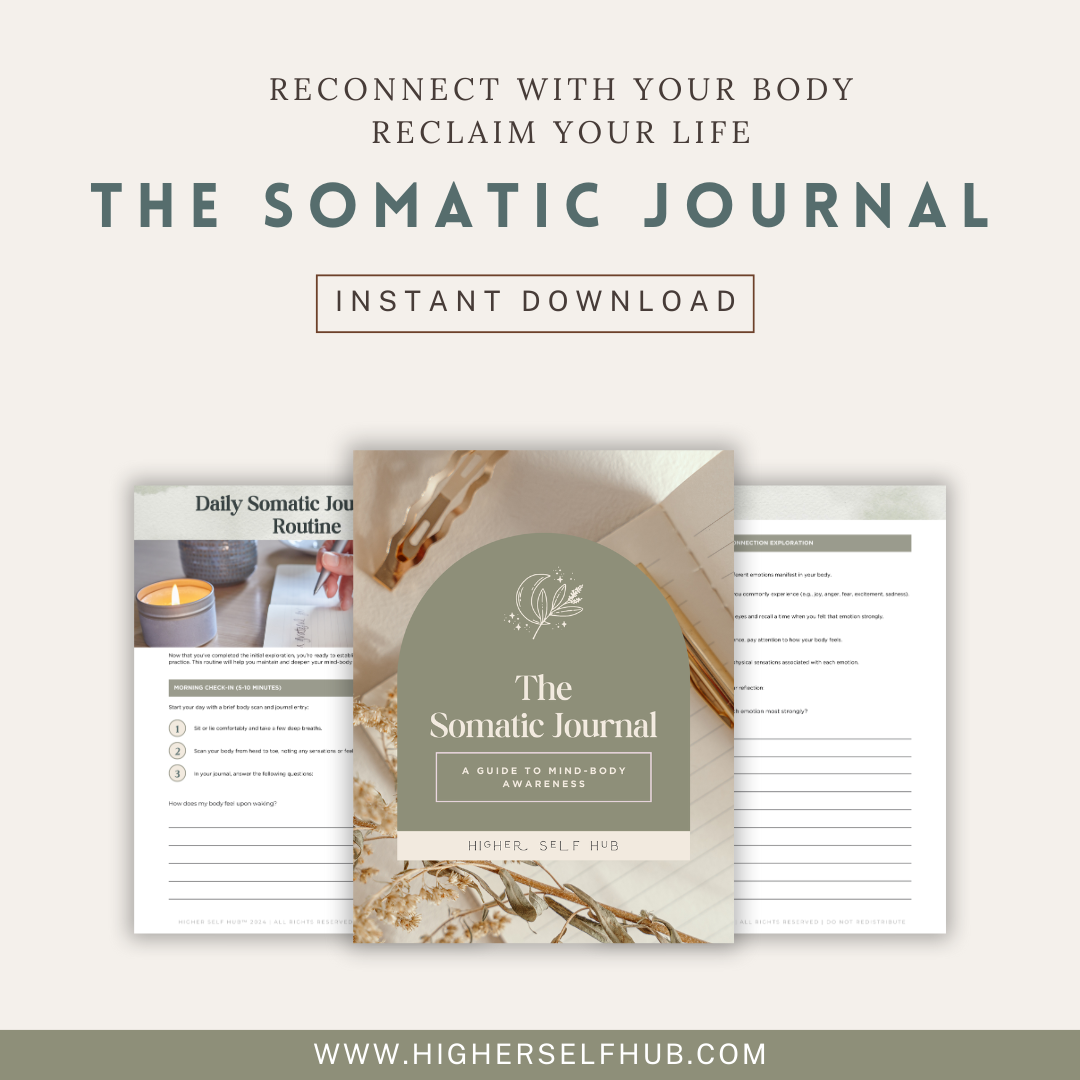
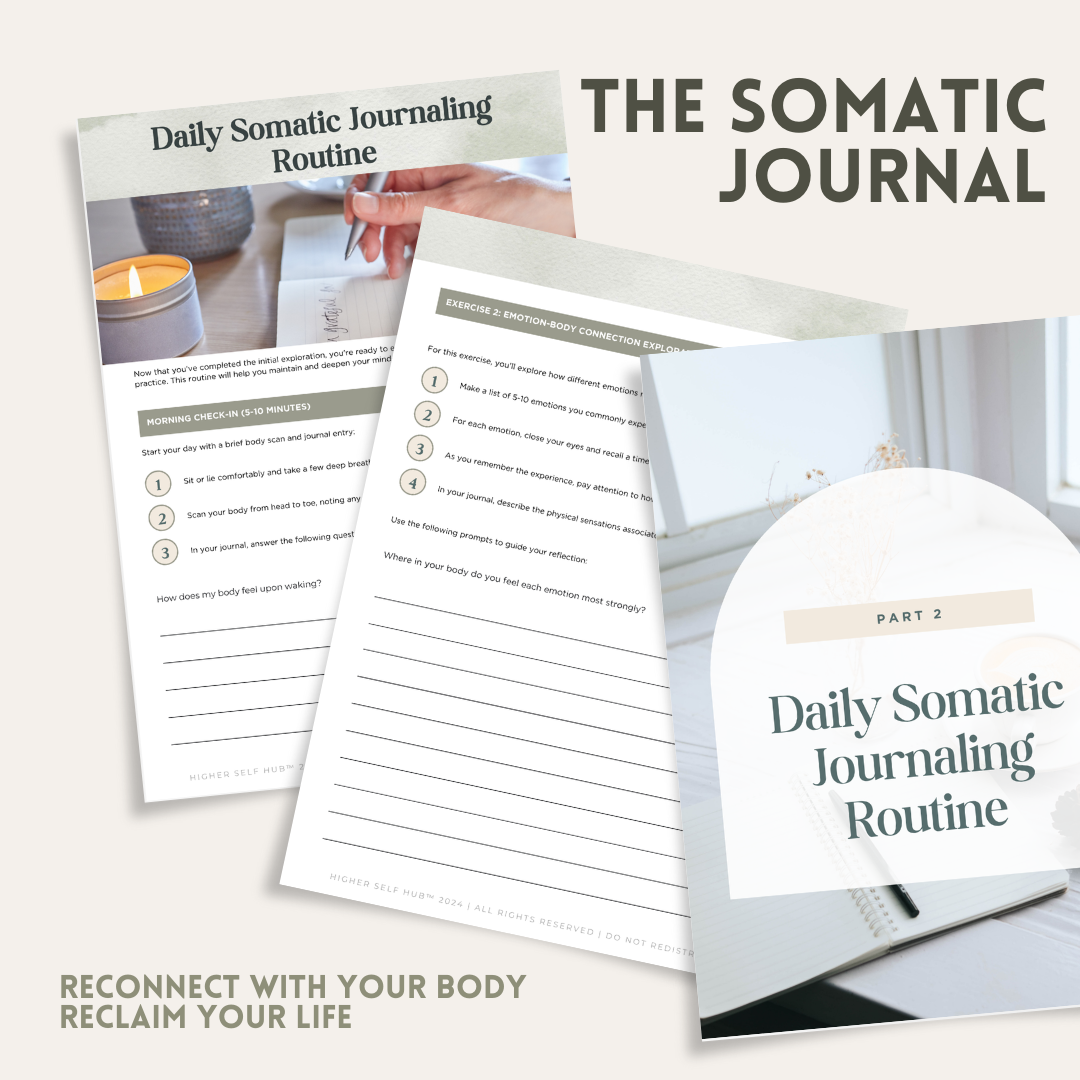
This 52-page printable journal helps you stop guessing and start noticing what your nervous system is actually trying to tell you. Daily body awareness check-ins, pattern tracking, and guided reflections that take 5-10 minutes.
Not a gratitude journal. Not a mood tracker. A 30-day nervous system conversation with your own body.
Description
I used to think anxiety was something to push through. Ignore it. Outwork it. I’d wake up with my heart racing and spend the day trying to think my way out of what my body was feeling. Then I learned something that changed everything for me: it wasn’t a mind problem. It was a nervous system problem. Positive thinking isn’t the enemy. Ignoring the physical is. That’s what this journal is built around. Not writing about your feelings. Writing WITH your body.The difference between regular journaling and somatic journaling
Regular journaling asks: “How do I feel today?” Somatic journaling asks: “What is my nervous system trying to tell me?” One of our readers put it this way: “Now I understand.” Two words. That’s the whole transformation this journal is after. Not healing. Not fixing. Understanding.What’s Inside (52 pages)
- Daily check-in pages with simple body awareness prompts (5 minutes)
- Pattern recognition tracking so you can spot your unique triggers and stress signals
- Weekly integration exercises to make sense of what your body is teaching you
- Emergency reset techniques for moments of overwhelm
- Progress pages to track your wins (because noticing your jaw unclenched counts)
Your 30-Day Path
Week 1: The physical sensations start making sense. Week 2: You catch stress signals before they escalate. Week 3: Your body starts feeling like an ally, not an enemy. Week 4: You handle triggers that used to derail your entire day.Why this instead of just asking yourself the questions?
Because you won’t. Not consistently. Not with a system that shows you the pattern over time. One check-in is a snapshot. Thirty days of check-ins is a map. And the map is where the clarity lives. One of our buyers said she came here because she was “struggling with not feeling good enough and feeling like I don’t know what’s going on in my head and body.” This journal was made for exactly that. For the space between knowing something is off and understanding what it is.This journal is for you if:
- You feel things in your body but don’t know what they’re trying to say
- You want practical tools, not “think positive” advice
- You’d rather spend 10 minutes with a focused prompt than hours overthinking
- You’ve tried journaling before and it felt like writing in circles
This journal is NOT for you if:
- You need clinical support (this is a self-guided tool, not therapy)
- You’re looking for a one-time fix








Reviews
There are no reviews yet.