

Why Your Somatic Healing Practice Isn’t Sticking (And the Simple Fix That Changes Everything)
You tried somatic exercises. They worked.
Not in a dramatic, life-changing way. But in a real way. Your shoulders dropped. Your breathing slowed. That buzzing in your chest went quiet for a few minutes. You thought: oh. This is what people are talking about.
So you did it again the next day. Maybe the day after that.
And then you didn’t. Something came up. The kids got sick. Work got loud. You forgot. Or you just… stopped. Not on purpose. Not because you decided it wasn’t working. It just faded out, the way things do.
Now you’re back to scrolling somatic exercise videos at 10pm, saving them to a board you never open, wondering why you can’t make this one thing stick.
You’re not broken. You’re not lazy. And you definitely don’t need more willpower.
Somatic healing is the process of releasing stored tension, stress, and emotion through the body rather than the mind.
It works. The science is clear. A 2014 randomized controlled trial found that somatic experiencing significantly reduced PTSD symptoms compared to controls (Journal of Traumatic Stress). And the research on nervous system regulation shows that body-based practices can create measurable, lasting shifts in how your body handles stress.
But here’s the part nobody talks about: knowing it works isn’t enough to make you keep doing it. And the reason has nothing to do with discipline.

The Real Reason Your Somatic Healing Practice Drops Off
Your nervous system has a default. It’s the state your body returns to when nothing is actively pulling it somewhere else. For most of us, that default was set years ago, shaped by stress, by childhood patterns, by the way we learned to survive.
When you do a somatic exercise, you temporarily shift out of that default. You feel calmer. Softer. More present. But unless you repeat that shift consistently, your body slides right back to what it knows.
This isn’t failure. It’s neuroscience.
Your nervous system doesn’t change because of one good day. It changes through repetition. Repeated signals of safety, felt in the body, over and over, until the new pattern starts to feel more familiar than the old one.
After my brain injury, the doctors said I’d never operate the same again. I decided I wasn’t going to accept that. I learned about neuroplasticity, how we can rewire pathways through repetition and repeated exposure. That’s what somatic healing runs on. The same science. The same mechanism. Not willpower. Wiring.
So the issue isn’t that somatic healing doesn’t work for you. The issue is that the one-off practice doesn’t have a container. There’s nothing holding it in place when life gets loud.
If you want a simple starting point for somatic work, the Somatic Starter Kit walks you through it. It’s free, and it’s yours whenever you’re ready.
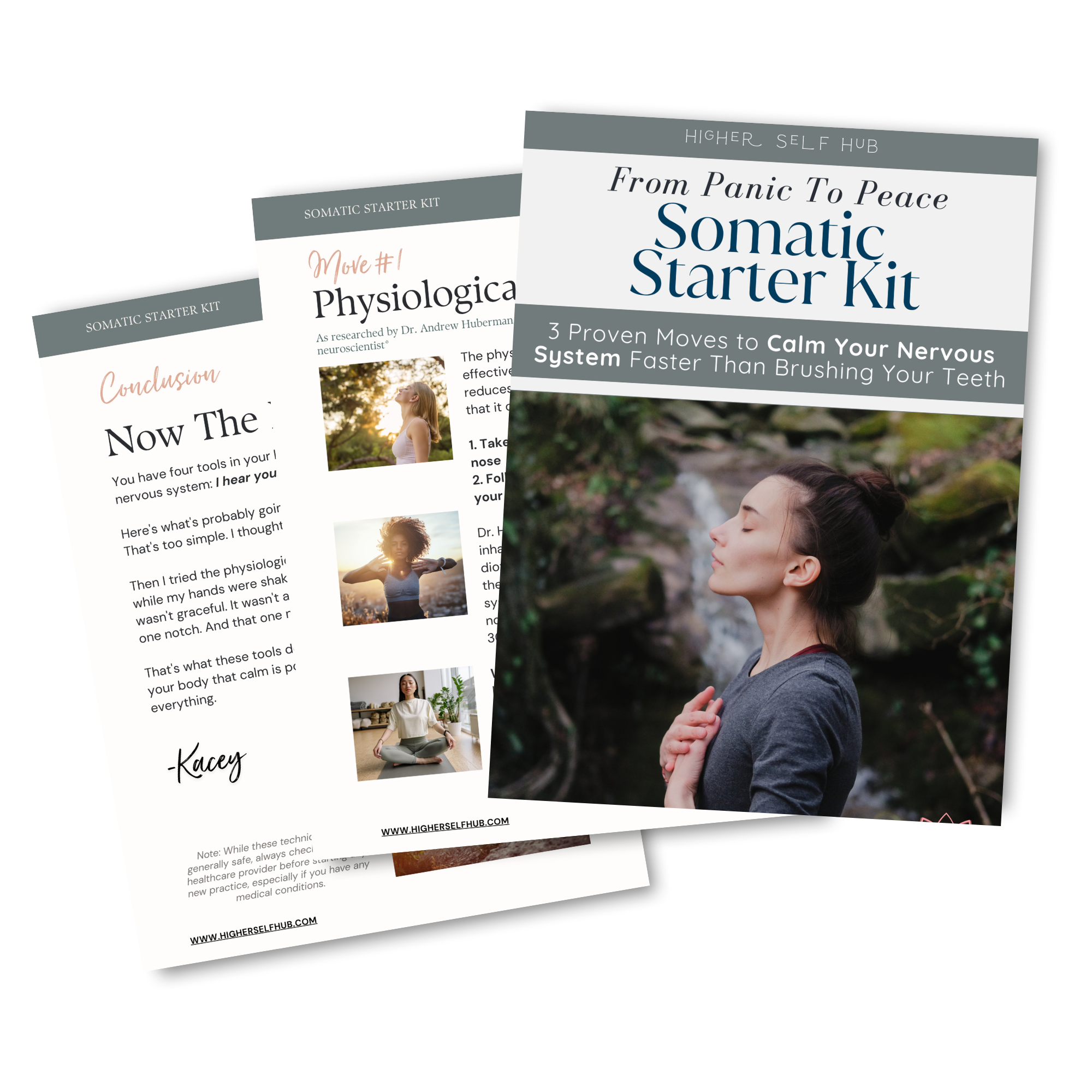
Your Free Somatic Starter Kit
3 science-backed tools to go from panic to peace in under 60 seconds.
Your inbox stays calm, too. Unsubscribe anytime. We respect your privacy.
Why Willpower Is the Wrong Tool for This
Every January, millions of people set goals. Eat better. Move more. Start a practice. And by February, most of those goals are gone.
The common explanation is “lack of discipline.” But somatic healing doesn’t respond to discipline the same way a fitness goal does. You can’t muscle your way into nervous system regulation. In fact, the harder you push yourself, the more your body reads it as threat, which activates the exact stress response you’re trying to calm.
Think about it: if your nervous system is already in a pattern of overwork and pushing through, then adding another thing to your “should” list doesn’t help. It just creates one more thing to fail at. And that failure becomes another data point your body files under see? Nothing works for me.
The fix isn’t trying harder. The fix is making the practice so small and so visible that your nervous system barely registers it as effort.
The Simple Fix: Make It Visible
Here’s what actually makes a somatic healing practice stick. Not motivation. Not a 30-day challenge.
Tracking.
Simple, low-pressure tracking. And I know that word might make you tense up. Tracking sounds like measuring. Grading. Performing. But that’s not what this is.
Somatic tracking is just noticing, on paper, what you did and how your body responded.
What Tracking Does for Your Nervous System
When you write down “did the shake-off this morning, shoulders dropped afterward,” you create something your brain can reference later. You’re building evidence that the practice works. Not someone else’s evidence. Yours.
On the days you don’t feel like doing anything (and those days will come), that evidence is what keeps you going. Not guilt. Not discipline. Just the quiet memory: oh right. Last Tuesday I did the breathing thing and my jaw unclenched for the first time all week. Maybe I’ll try that again.
Tracking also makes the invisible visible. Somatic exercises create subtle shifts that are easy to miss in real time. But when you look back at a week of entries and see “tight, tight, tight, slightly softer, softer, open,” you can see the trajectory your body couldn’t feel day to day.
What to Track (Keep It Ridiculously Simple)
Three things. That’s it.
- What you did. (Shake-off. Breathing. Walk. Body scan.)
- How your body felt before. (One word is fine. Wired. Heavy. Tight.)
- How your body felt after. (One word. Softer. Lighter. Same.)
If you do more, great. If some days all you write is a checkmark, that counts too.
The point isn’t perfection. The point is a thread of continuity that your nervous system can follow.
What Changes When You Track for 28 Days
Something happens around week 2 or 3. You start to notice things without trying.
You’ll catch yourself sensing your surroundings before you reach for your phone. Your jaw will unclench without thinking. You’ll feel a stress spiral start, and your body will already know what to do.
That’s not because you’re more disciplined than you were on Day 1. It’s because your nervous system has had enough repeated input to start building a new pattern. The tracking didn’t make you do the work. It just kept the practice visible long enough for the rewiring to take hold.
A somatic morning routine layered on top of this tracking creates something even more powerful: a daily anchor point. When the practice has a time and a place in your day, it survives the weeks that don’t go according to plan.
This Is Exactly Why the Tracker Exists
I created the 28-Day Somatic Exercise Habit Tracker & Wellness Journal because I watched this pattern happen over and over. Women would discover somatic exercises. Feel them work. And then lose the thread within two weeks.
Not because the exercises failed. Because there was nothing to hold the practice in place.
The tracker is simple on purpose. A daily space to check in with your body. Room for the before and after. A weekly review to notice the patterns. And 28 days of structure, designed for your worst day, not your best one.
It’s just a printable place to keep going, even when life makes it hard to remember why you started.
Save This For Later

You Already Have the Proof
If somatic healing has ever worked for you, even once, even for a few minutes, that’s your proof. Your body can do this.
The gap between “it worked once” and “it changed my life” isn’t talent or discipline or buying the right course. It’s repetition. And repetition needs a container.
Start with the smallest version. One exercise. One moment of tracking. One note about what your body felt like afterward.
Do it again tomorrow. And the day after that. Not because you have to. Because your body remembers what it felt like the last time, and it wants to go back.
The Somatic Starter Kit gives you exercises and a starting point. It’s free.
Your Free Somatic Starter Kit
3 science-backed tools to go from panic to peace in under 60 seconds.
Your inbox stays calm, too. Unsubscribe anytime. We respect your privacy.