

What Is Body Mapping? A Somatic Approach to Understanding Your Body’s Signals
Your body is trying to tell you something, and you can learn to read it. When you do, stress, tension, and emotional holding patterns become actionable data, not mystery. That’s what body mapping does. And this somatic practice can accelerate your insight.
Your body is rarely in danger, even if it responds like it is. Neck tension, clicky jaw, hunched shoulders – these are the signs. It’s been holding onto unprocessed emotions for years. Maybe decades.
That disconnect between feeling everything and understanding none of it? It has a name. And there’s a simple, somatic practice that can help you close the gap.
Body mapping is a somatic practice that helps you get curious about your body’s signals instead of confused by them. It’s not about diagnosing yourself or fixing anything. It’s about finally seeing what’s been going on underneath (in the places you’ve been clenching, bracing, and holding without even realizing it).
And once you see it? Everything starts to make a little more sense.
What Body Mapping Actually Is (And What It’s Not)
At its core, body mapping is a way of noticing where physical sensations show up in your body, then connecting those sensations to emotions, patterns, or nervous system responses.
Think of it like creating a personal weather map, except the landscape is your body.
You might discover that your chest tightens every time you feel unheard. Or that your stomach drops when you sense conflict (even if it’s just an email). Maybe your shoulders hike up the moment you walk into your parents’ house, and you never even noticed until you started paying attention.
Body mapping helps you notice those patterns. Not to judge them. Just to see them.
It draws from somatic healing traditions that understand the body as the place where emotions live, not just the brain. Research from institutions like the University of Aalto in Finland has shown that different emotions produce distinct physical sensation patterns across the body. Anger lights up the chest and hands. Sadness settles heavy in the throat and limbs. Your body already knows this. Body mapping just gives you a language for it.
What body mapping is NOT:
- It’s not a medical assessment or diagnosis
- It’s not something you can get wrong
- It’s not a one-time exercise you check off a list
- It’s not only for people who “feel things deeply” (everyone holds something somewhere)
Why Your Body Holds Emotions in the First Place
Here’s the thing nobody talks about enough: your nervous system stores experiences in your body before your brain fully processes them.
When something overwhelming happens (even something small, like a tense conversation or a news headline that hits wrong), your body absorbs the impact. It tightens, braces, holds. That’s your nervous system doing exactly what it’s designed to do: protecting you.
The problem isn’t that your body holds emotions. The problem is that most of us were never taught how to check in with those holding patterns. So they build up like layers of sediment. Years of clenching. Decades of shallow breathing. A lifetime of white-knuckling through hard days.
According to Harvard Health, chronic activation of this survival response can affect everything from digestion to sleep to immune function. Your body isn’t malfunctioning. It’s just stuck in a loop. It needs a way to show you what’s happening so you can gently interrupt it.
That’s what body mapping does. It gives your nervous system a voice.
If you want to understand more about why calming down doesn’t always work (and what does), I break it all down in this free guide: Why Calming Down Doesn’t Work (And What Finally Will)
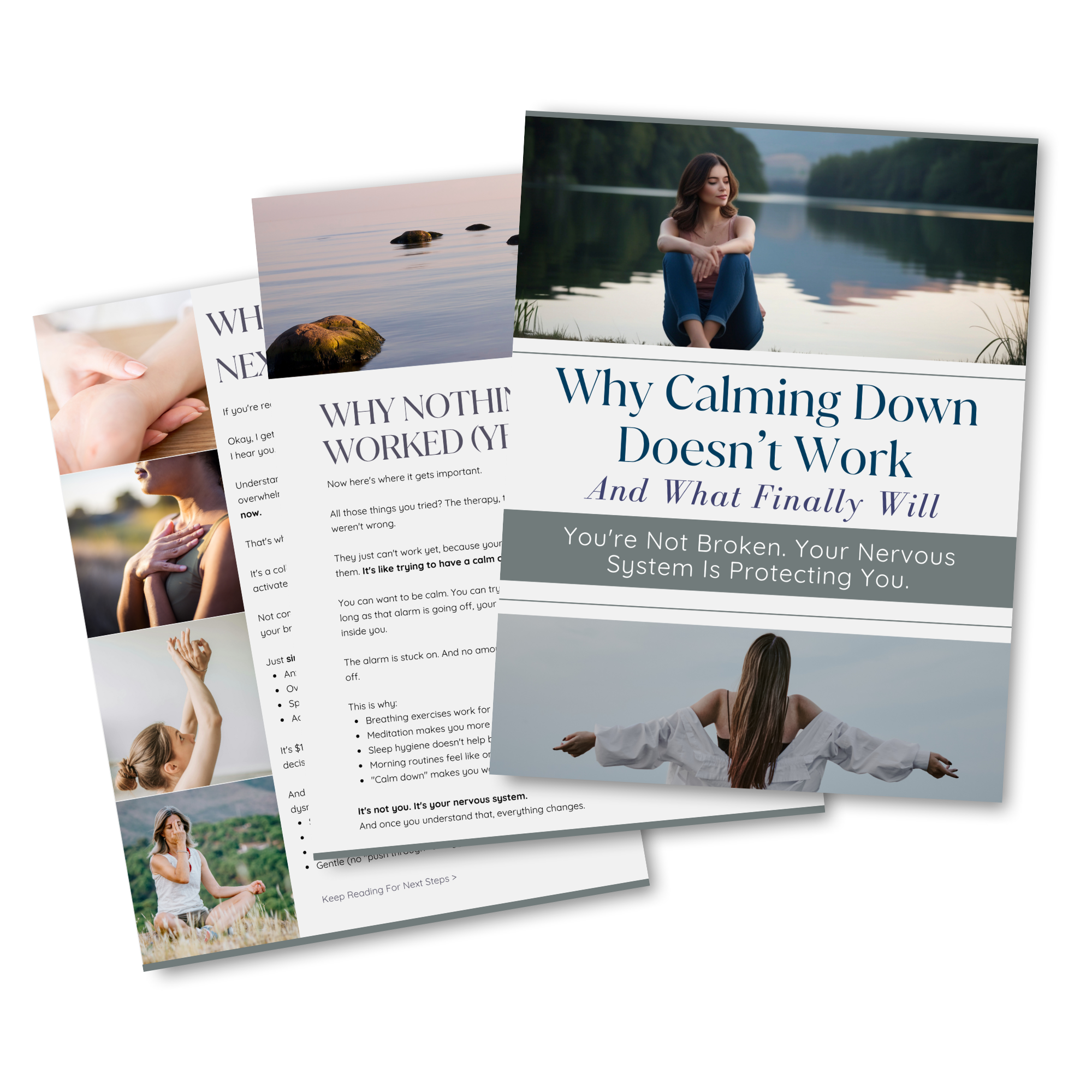
Free Guide: Why Calming Down Doesn’t Work
(And What Finally Will)
You’re Not Broken. Your Body Is Protecting You.
Your inbox stays calm, too. Unsubscribe anytime. We respect your privacy.
How Body Mapping Works (It’s Simpler Than You Think)
You don’t need special training, a therapy appointment, or even a quiet room. Body mapping can be as simple as pausing for two minutes and asking yourself: where do I feel that?
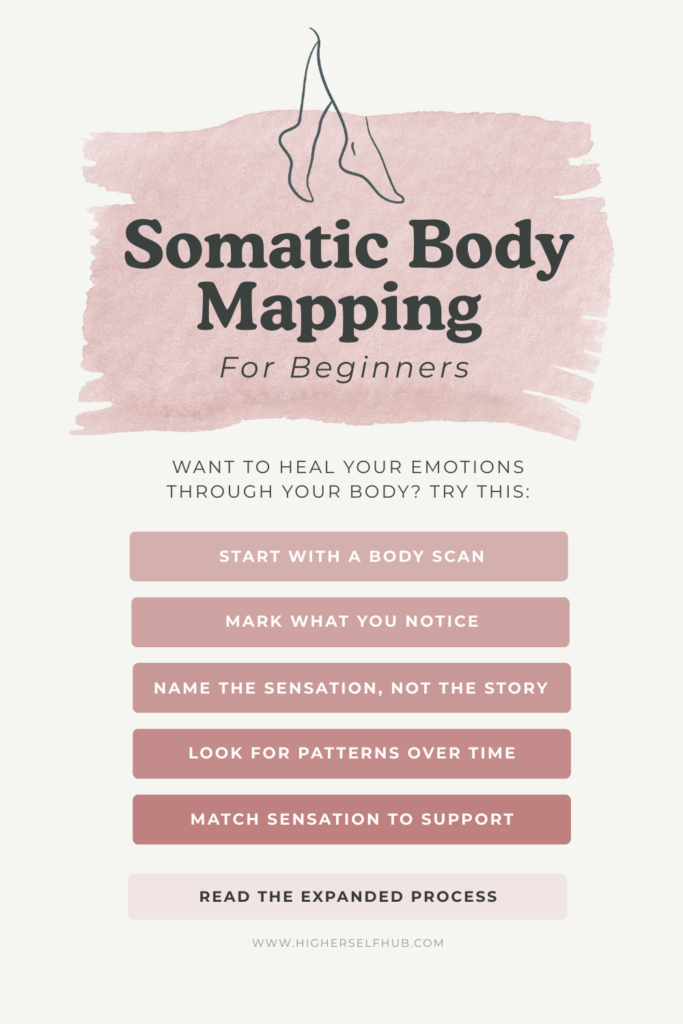
Here’s a basic approach to get you started:
1. Start With a Body Scan
Close your eyes (or soften your gaze) and mentally scan from the top of your head to the soles of your feet. Don’t try to change anything. Just notice. Where do you feel tension? Heaviness? Heat? Buzzing? Nothing at all? All of it counts.
2. Mark What You Notice
Using a simple body outline (even a rough sketch on a sticky note), mark the areas where you felt something. Color them in, draw arrows, use symbols. There’s truly no wrong way to do this. Some people use different colors for different sensations (red for heat, blue for tightness). Others just circle the spots that spoke loudest.
3. Name the Sensation, Not the Story
This is where body mapping gets interesting. Instead of jumping to why (“I’m tight because my boss was rude”), stay with the what (“My shoulders feel like they’re made of concrete”). The sensation itself is the data. The story can come later.
4. Look for Patterns Over Time
One body map is a snapshot. Several body maps? That’s a mirror. When you do this practice over days or weeks, you start to see what keeps coming back. Maybe your jaw always holds tension on Mondays. Maybe your chest opens up after you spend time outside. These patterns are your nervous system trying to communicate, and body mapping is how you start to listen.
5. Match Sensation to Support
Once you know where your body holds emotions, you can choose somatic techniques designed for those exact areas. Tight jaw? A gentle jaw release or humming exercise can help. Heavy chest? Try a slow exhale with soft pressure on your sternum. This part of the practice turns awareness into action, without forcing anything.
Make it easier to see patterns, track over time, and choose techniques that actually help with the Somatic Body Map Workbook.

Body Mapping for Emotions: Why It Goes Deeper Than Journaling
If you’ve tried traditional journaling and felt like it didn’t quite reach the thing you were processing, you’re not imagining that.
Journaling works with thoughts. Body mapping works with sensations. They’re complementary, but different.
When you journal about a hard day, you’re narrating it through your cognitive brain. That’s useful. But sometimes the feeling in your body doesn’t have a tidy narrative. It’s just a knot in your stomach, or a shakiness in your hands, or an ache in your chest that won’t explain itself in words.
Body mapping emotions gives you a way to honor that experience, the felt, pre-verbal, body-level one, without needing to make it make sense first. In fact, many women find that the emotional understanding comes after the body awareness, not before.
It’s also why body mapping is used in somatic therapy and art therapy as a way to access experiences the thinking mind can’t easily reach.
What to Do Once You’ve Started Body Mapping
So you’ve started noticing. Maybe you’ve done a body scan or two, marked up an outline, started to see where your body keeps score.
Now what?
This is where a structured tool can really help. Something that walks you through the full process (the scan, the tracking, the matching of sensations to techniques) so you’re not just building awareness in a vacuum.
That’s exactly what the Somatic Body Map & Nervous System Regulation Workbook was designed for. It gives you printable body outlines, daily check-in trackers, and a personalized technique matching guide, so you can go from “I feel something” to “I know what to do about it.” On your terms. At your pace.
Not homework. Not an assignment. Just a quiet, honest conversation between you and your body.

You Don’t Have to Decode Your Body Alone. Start Body Mapping Today
If there’s one thing I want you to take from this, it’s that body mapping isn’t about getting it right. It’s about getting curious.
Your body has been holding, protecting, and communicating for years. It’s not digestible all in one sitting. You don’t have to do this perfectly. All you need to do is start noticing.
So try it tonight. Lie down, close your eyes, and ask: where do I feel something right now?
That’s the first line of your body map. And it’s more than enough.
If this post resonated, save it for later. Pinterest is a great place to keep things like this close.
Related posts you might like: