
How to Build a Somatic Morning Routine You’ll Actually Keep (Even on Hard Days)
You already know what a “perfect” morning routine looks like. You’ve seen it pinned a hundred times. Wake up at 5am. Journal. Meditate. Move your body. Drink something green. Somehow finish before anyone else in the house opens their eyes.
That’s not your morning.
Your morning is the baby monitor going off before your alarm. It’s coffee reheated twice. It’s standing at the kitchen counter trying to remember if you already packed the lunch or if that was yesterday. Your nervous system is already 3 tasks ahead before your feet even touch the floor.
So when someone suggests adding a “morning routine,” your body tenses. Because the last thing you need is one more thing to fail at before 8am.
A somatic morning routine is a set of small, body-based exercises you do in the first moments of your day to help your nervous system start from a regulated place instead of a reactive one. It doesn’t require 30 minutes. It doesn’t require silence. Some of these you can do while the coffee brews.
Why Your Morning Sets the Tone for Your Nervous System
Here’s what most morning routine advice misses: your nervous system doesn’t reset overnight.
If you went to bed stressed, your body probably woke up stressed.
That jaw you’ve been clenching since 2am? That tightness in your chest before you even open your eyes? That’s not a fresh start. That’s your body continuing the pattern from yesterday.
A somatic morning routine interrupts that pattern. Instead of launching straight into tasks and demands (which your nervous system reads as threat), you give your body a few minutes of intentional input first. This signals safety. And a nervous system that starts from safety handles the chaos of the day very differently than one that starts from survival.
Research from Stanford Medicine found that intentional breathwork can shift the nervous system from sympathetic (fight-or-flight) to parasympathetic (rest-and-digest) activation in under 90 seconds. That’s not an hour of meditation. That’s less time than it takes to heat up your coffee.
If you want a simple starting point for somatic work, the Somatic Starter Kit walks you through it. It’s free, and it’s yours whenever you’re ready.
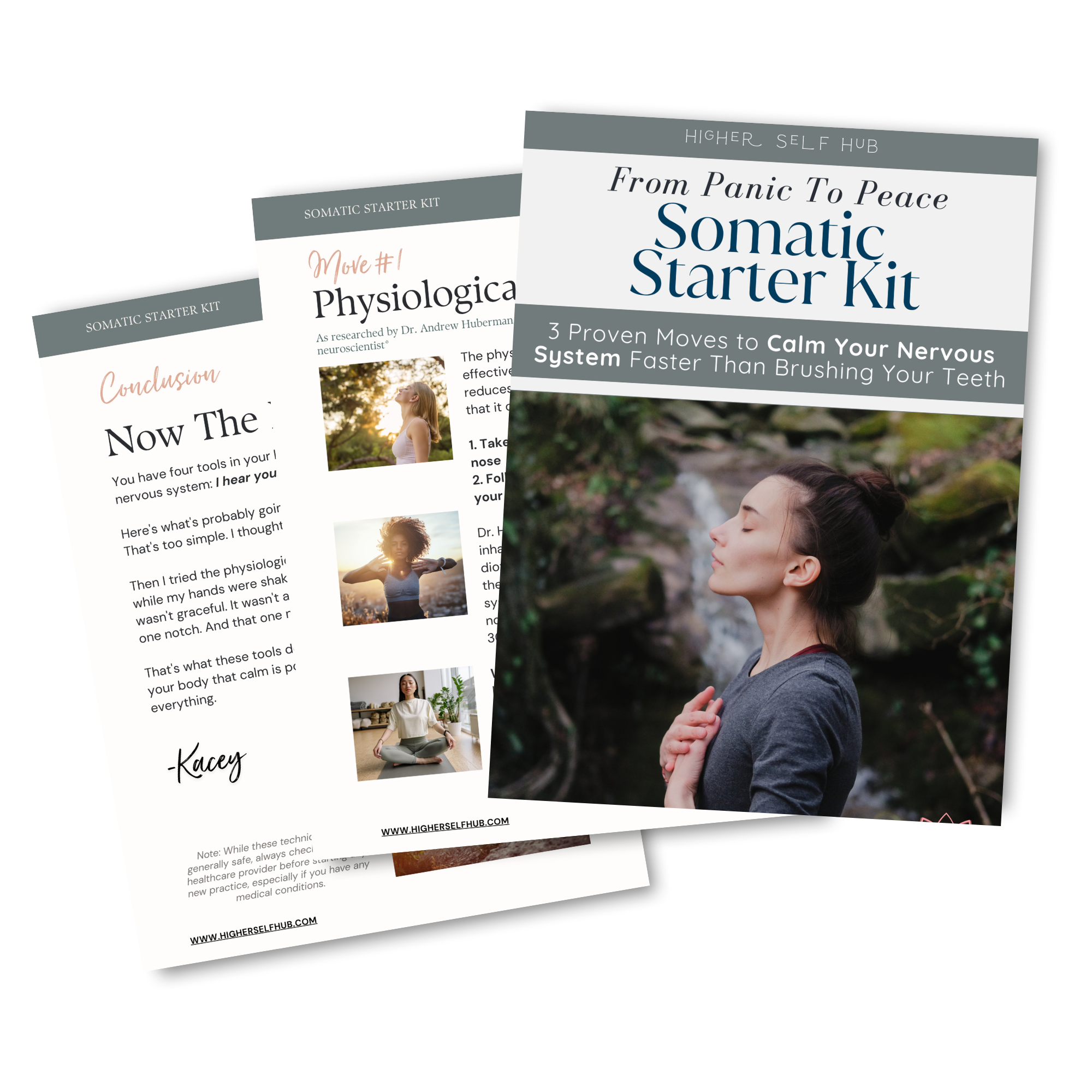
Your Free Somatic Starter Kit
3 science-backed tools to go from panic to peace in under 60 seconds.
Your inbox stays calm, too. Unsubscribe anytime. We respect your privacy.
5 Somatic Morning Exercises (For Real Mornings)
These are designed for the life you actually live. Not the aspirational 5am version. The real one, with interruptions and noise and cereal on the floor.
Pick one. Rotate. Let your body decide what it needs each morning. Start with whichever one feels like the least amount of effort today.
1. The Before-You-Get-Up Reset (In Bed, 90 Seconds)

Before you reach for your phone. Before you swing your legs over the side. Lie there for just a moment.
Place one hand on your chest and one on your belly. Take 3 slow breaths, making the exhale longer than the inhale. Inhale for 4, exhale for 6.
This kind of breathing was the first thing that ever actually worked for me. Not a magic pill, because none of these are. But a pattern I could feel in my body of going from highly sensitized to more calm.
Then do a quick body scan. Not a meditation. Just a question: where am I tight right now? Jaw. Shoulders. Fists. Low back. Just notice it. You don’t have to fix it.
This takes less than 2 minutes and it does something powerful. It interrupts the pattern of waking up and immediately going. Instead, you start from awareness.
2. The Kitchen Counter Shake (2 Minutes)
You’re standing there waiting for the coffee anyway. Use those 2 minutes.
Feet hip-width apart. Bounce gently on your knees. Let your arms dangle and shake. Let your jaw go loose. Bounce for 60 seconds, then stand still and notice what changed.
Neurogenic tremoring releases stored tension from the night before. It resets muscle tone, calms the nervous system, and wakes up your body in a way that feels different from caffeine. Somatic exercises like these work specifically with your body’s stress response instead of powering through it.
3. The Doorframe Reset (30 Seconds, Anywhere)
Walk up to a doorframe. Place both hands on either side at chest height. Lean gently into it, opening your chest and stretching across the front of your shoulders.
Hold for 5 slow breaths.
Your chest and shoulders compress when your body is in a protective posture (which is most of the time, especially after sleeping curled up). This simple stretch opens the ribcage, gives your lungs more room, and tells your body: you can take up space today.
Do it every time you walk through a specific doorway. The kitchen. The bathroom. The bedroom. It becomes automatic within a week.
4. The Crossbody Wake-Up (60 Seconds)
Standing or sitting, alternate tapping your right hand to your left knee and your left hand to your right knee. Just a gentle, rhythmic cross-body pattern.
This bilateral stimulation re-engages both hemispheres of your brain and helps bring the prefrontal cortex (your thinking, decision-making brain) online. On mornings when you feel foggy, reactive, or like you’re already behind, this is the fastest way to feel like yourself again.
Try it while your kids are eating breakfast. In the bathroom after brushing your teeth. On the porch with your coffee. It looks like a silly march, and it works.
5. The Car Transition (Before You Drive)
If your morning involves driving (school drop-off, commute, errands), use the moment before you turn the key.
Hands on the steering wheel. Press your palms firmly into it for 5 seconds, then release. Repeat 3 times. Then take one physiological sigh: double inhale through the nose, long exhale through the mouth.
This clears the stress of getting-everyone-ready and creates a clean transition into the next part of your day. You arrive wherever you’re going as you, not as the frazzled version that just survived the morning scramble.
The Secret to a Somatic Morning Routine That Actually Sticks
It’s not about willpower. It’s not about waking up earlier. The secret is making the routine so small and so attached to something you already do that your body starts doing it automatically.
Coffee = shake-off. Doorway = chest stretch. Bed = breath and scan. Car = steering wheel press.
You’re not adding a new block of time. You’re layering somatic moments onto the morning that already exists. This is exactly how everyday nervous system practices become second nature.
Three 60-second practices woven into your morning will do more for your nervous system than one 20-minute session you skip half the week.
And if you want to track your somatic morning routine and how your body responds, even just a checkmark or a few words, that’s where it starts to compound. The 28-Day Somatic Exercise Habit Tracker & Wellness Journal gives you a simple, printable place to mark it down each morning. Not to perform. Just to remember: I did something for my body today.
Start With Tomorrow Morning
Tomorrow, try the bed reset before you pick up your phone. That’s it. One practice. One morning. See what happens.
The walking habit is another great place to start if you’re building toward more movement. But for now, just start with tomorrow.
The Somatic Starter Kit gives you the exercises. Grab it free below.
Your Free Somatic Starter Kit
3 science-backed tools to go from panic to peace in under 60 seconds.
Your inbox stays calm, too. Unsubscribe anytime. We respect your privacy.
Save this for later.