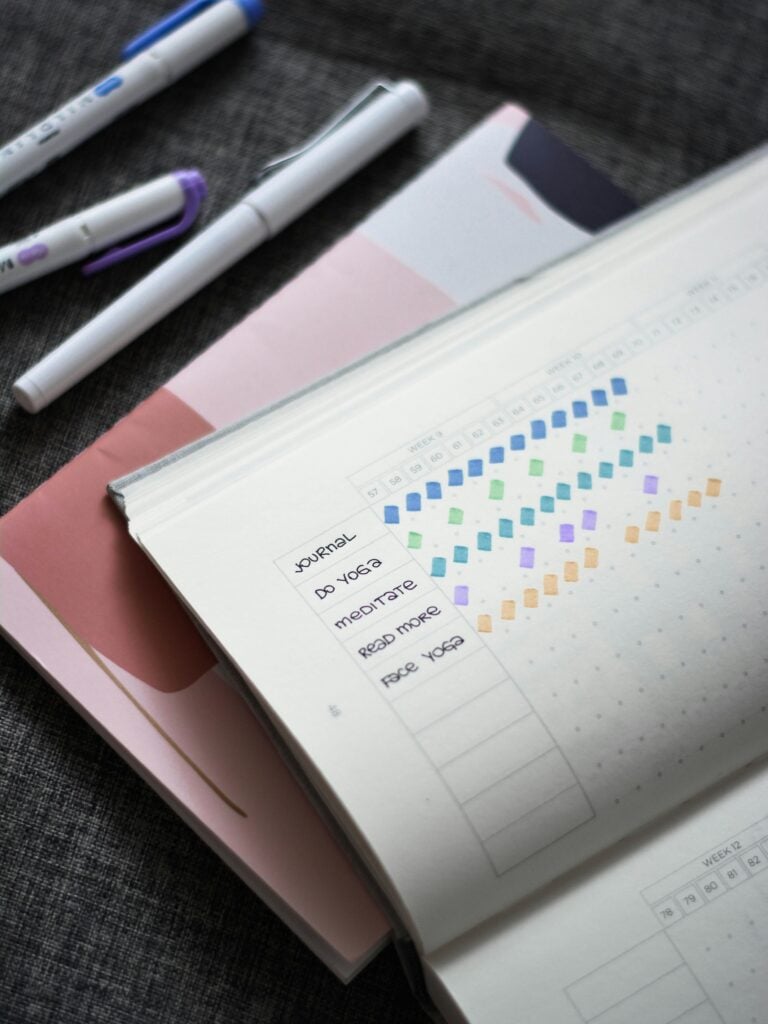

How to Start a Gratitude Journal (When You’re Already Exhausted)
Did you know that 76% of women report feeling more stressed during the holidays than any other time of year? And yet here we are, being told to add one more thing to our plates.
Let me guess: you’ve heard about gratitude journaling. You know it’s supposed to help with stress and presence and all those things you desperately want.
But the thought of maintaining another daily practice? Honestly, it feels like a lot.
Here’s what I want you to know: a gratitude journal doesn’t have to become another thing you fail at. It can actually become the thing that helps you feel less scattered.
And I’m going to show you exactly how to start one without adding to your overwhelm.
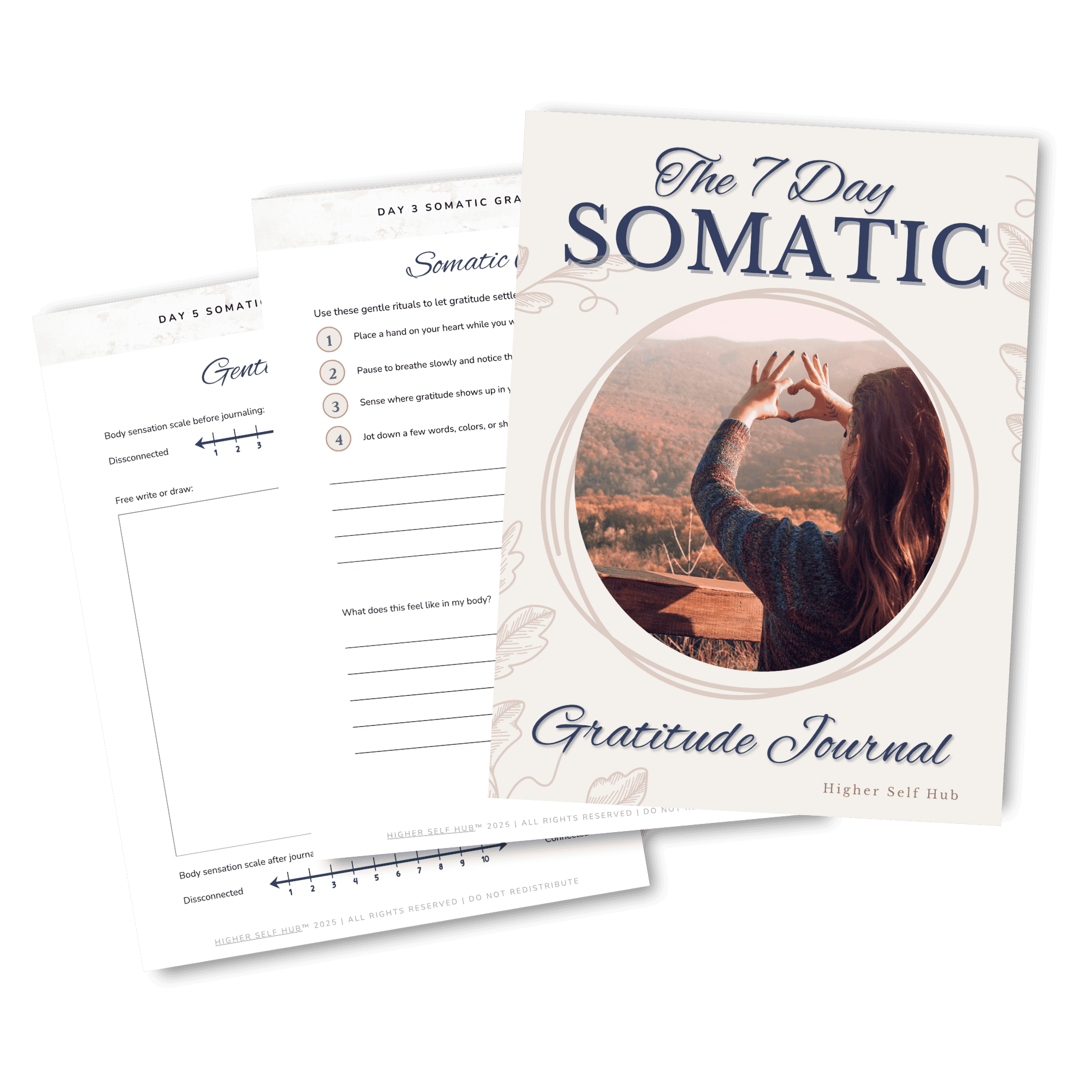
Begin To Release Years of Stress In The Next 7 Days
Get the free Somatic Gratitude Journal for body-based prompts that help you feel grounded instead of guilty.
Your inbox stays calm, too. Unsubscribe anytime. We respect your privacy.
Why Gratitude Journaling Works (Even When You’re Skeptical)
Your nervous system runs on fumes right now. Between holiday planning, year-end work deadlines, and the mental load of everything, you exist in constant fight-or-flight mode.
A gratitude journal physically interrupts that pattern. It signals safety to your brain.
This isn’t toxic positivity—it’s a nervous system regulation tool backed by actual science.
When you consistently notice what’s working (even tiny things), you train your brain to scan for safety instead of only scanning for threats. Your reticular activating system—the part of your brain that filters information—starts looking for more of what you tell it to find.
Think of your gratitude journal as a spotlight. Right now, that spotlight shines on everything going wrong, everything you’re behind on, everything that might fall apart.
Your gratitude journal redirects that spotlight, even for just two minutes a day. You’re not ignoring the hard stuff. You’re just refusing to let it be the only thing you see.
And here’s the permission slip you need: it doesn’t have to look Instagram-perfect. In fact, the messier it is, the more honest it probably feels.
The Real Reason You Haven’t Started a Gratitude Journal Yet

You think you need more time. A better system. The right notebook.
But that’s not what stops you. What stops you is the fear that you’ll start strong and quit within a week, proving once again that you can’t stick with things.
I see you. And I’m telling you right now: that story doesn’t get to win anymore.
A gratitude journal works because you show up imperfectly. Because you write “coffee” for the third day in a row. Because some days you only manage one word.
The magic lives in the returning, not the perfection.
So let’s remove every barrier between you and starting. No fancy supplies. No elaborate system. Just you and two minutes.
The 3-Minute Gratitude Journal Method That Actually Fits Your Life
Forget everything you think you know about journaling. You don’t need a fancy notebook, beautiful handwriting, prompts, or even full sentences.
Here’s what actually works when you feel burned out and overstretched:
Morning Version (2 minutes):
Before you check your phone—yes, before—write down three things. That’s the entire assignment.
They can be absurdly tiny: “Hot coffee.” “Quiet house for 10 minutes.” “My dog’s ridiculous face.”
You’re not writing these things to feel warm and fuzzy (though you might). You’re writing them to teach your brain what to look for as you move through your day.
Your brain naturally scans for what you prime it to see. Start the day by priming it to notice good things, safe things, manageable things.
Keep your gratitude journal and a pen on your nightstand. Don’t make yourself go searching for supplies at 6 AM.
Evening Version (3 minutes):
Before bed, jot down one moment from today that didn’t feel heavy. One conversation that went well. One bite of food you actually tasted. One breath where you weren’t worried about the next thing.
This practice signals to your nervous system that the day ended okay. That you made it through. That you found something worth remembering.
When you consistently end your day with your gratitude journal, you sleep better. Your brain processes the day differently. You wake up slightly less braced for disaster.
I know that sounds dramatic, but your body keeps score. And right now, the score reads: everything is urgent, nothing is safe, you’re barely keeping up.
Your gratitude journal changes that score, one small entry at a time.
Here’s What You Actually Write in Your Gratitude Journal

Real examples from real women who felt just as skeptical as you might feel right now:
“I’m grateful my meeting got cancelled so I could breathe for 30 minutes.”
“The way the light came through my kitchen window this morning.”
“My friend texted me exactly when I needed to hear from someone.”
“I actually rested today without guilt (okay, with less guilt).”
“The barista remembered my order and I felt seen.”
Notice something? None of these sound like Instagram captions. They sound human. They sound true.
Your gratitude journal doesn’t need profound revelations. It needs honest observations.
Some days, your list will include “I didn’t snap at anyone” or “I’m grateful this day is almost over.” Write it anyway. That’s not cheating—that’s survival gratitude, and it counts.
What to Do When Your Gratitude Journal Feels Fake
Let’s address the elephant in the room: sometimes gratitude feels performative, especially when you genuinely struggle.
If writing “I’m grateful for my health” makes you want to roll your eyes, you’re approaching it wrong. Your gratitude journal should feel true, not aspirational.
Try this language shift instead:
Instead of “I’m grateful for my family,” try “I’m grateful my sister made me laugh today.”
Rather than, “I’m grateful for my job,” try “I’m grateful I solved that problem without asking for help.”
Instead of “I’m grateful for my body,” try “I’m grateful my legs carried me on that walk.”
See the difference? Specificity over platitudes. Honesty over positivity.
Your gratitude journal will feel fake if you force yourself to be grateful for things that currently cause you stress. You don’t have to be grateful for your overwhelm. You just have to notice one thing that didn’t add to it.
That’s the practice. Find the one thing that felt different, easier, lighter. Write that down.
Begin To Release Years of Stress In The Next 7 Days
Get the free Somatic Gratitude Journal for body-based prompts that help you feel grounded instead of guilty.
Your inbox stays calm, too. Unsubscribe anytime. We respect your privacy.
The Somatic Shift: Making Your Gratitude Journal a Body Practice
Here’s where most people miss the deeper layer of gratitude journaling: they stay in their heads.
They list things. They write words. But they never drop into their bodies to actually feel the gratitude.
Your nervous system doesn’t regulate through thoughts alone. It regulates through felt experience.
Try this when you write in your gratitude journal: After you write something you’re grateful for, pause. Close your eyes for just ten seconds.
Where do you feel that gratitude in your body? Does your chest soften? Do your shoulders drop? Does your belly unclench?
Put your hand there. Feel it.
This is somatic gratitude journaling, and it’s what transforms this practice from a mental exercise into nervous system medicine.
You’re teaching your body what safety feels like. You’re giving it a reference point to return to when stress hits.
Write in your gratitude journal: “I feel warmth in my chest when I think about that hug.” “My jaw relaxed when I remembered that moment.” “My whole body exhaled when I wrote that down.”
Your gratitude journal becomes a map of how peace lives in your body. And the more you notice it, the more your nervous system learns to find its way back to that state.
When You Miss Days (Because You Will)

You’ll skip days. Maybe many days. This doesn’t mean your gratitude journal failed or you failed.
It means you’re human and life got lifey.
Here’s what you do: you open your gratitude journal on the next available day and write one thing. You don’t catch up on missed days. No need to apologize to yourself. You just start again.
The practice of starting again—without shame, without a whole production—teaches you something crucial: you can come back. To yourself, your intentions, and to the things that help you.
Your gratitude journal becomes the safest place to practice coming back without punishment.
And honestly? Learning to come back to yourself without self-criticism might be the most valuable thing you do all year.
The Mistake Most People Make With Their Gratitude Journal
They wait to write in their gratitude journal until they feel grateful. But that’s backwards.
You don’t write gratitude to feel grateful. You write it to become someone who notices what’s working, even in the middle of what’s not.
Especially on the hard days. When you’re touched out and behind on everything. When you want to hide under the covers.
Those are the days your gratitude journal matters most. Not because it magically fixes anything, but because it reminds you that hard and holy can exist simultaneously.
You can be exhausted and grateful you got to rest for five minutes. Frustrated and grateful someone showed up for you. Overwhelmed and grateful you’re still trying.
Your gratitude journal holds space for all of it.
How Your Gratitude Journal Talks to Your Nervous System
Here’s what’s happening beneath the surface when you keep a gratitude journal consistently:
Your nervous system lives in one of three states: safe and social (ventral vagal), fight-or-flight (sympathetic), or shut down (dorsal vagal).
When you’re burned out and overwhelmed, you ping-pong between fight-or-flight and shutdown. Your body never gets to rest in the safe and social state.
A gratitude journal—especially when you add the somatic component—activates your ventral vagal system. It tells your body: we’re okay right now. We can notice good things. We’re not in danger.
Do this enough times, and your nervous system starts to trust that safety exists. It stops treating every moment like a crisis.
This is why your gratitude journal works even when your circumstances don’t change. You’re not fixing your life. You’re regulating your response to your life.
And that makes everything more bearable.
Starting Your Gratitude Journal This Week (Like, Actually Starting)
You don’t need to wait until you have the perfect setup or the right headspace. You start today, exactly as you are.
Grab whatever’s nearby—your phone notes app, a random notebook from a drawer, a legal pad, the back of a receipt.
Set a timer for two minutes. Write three things. Don’t edit, don’t make it pretty, don’t worry if they’re “good enough.”
Then try the somatic piece: pick one thing you wrote. Close your eyes. Notice where you feel it in your body. Put your hand there for three breaths.
Tomorrow, do it again. That’s the whole practice.
The magic of a gratitude journal doesn’t live in doing it perfectly. It lives in doing it consistently, even messily, especially when you don’t feel like it.
What Changes When You Keep a Gratitude Journal
The first week, you might not notice anything. You’re just writing words.
The second week, you might notice yourself pausing mid-day, thinking “Oh, that’s going in my gratitude journal later.”
That pause? That’s the shift. You’re training yourself to notice good moments as they happen, not just in retrospect.
By week three or four, something deeper changes. You stop waiting for everything to feel good before you let yourself feel okay.
You give yourself permission to hold both the stress and the sweetness. The behind-schedule and the moment of beauty. The imperfect day and the one thing that went right.
Your gratitude journal teaches you that you don’t have to wait for permission from your circumstances to feel grounded in yourself.
And your body? Your body starts to remember what calm feels like. Not the absence of stress, but the presence of your own steady hand on your own chest, reminding yourself: I’m here. I’ve got me.
This Holiday Season, Give Yourself This
The holidays demand so much from you. They ask you to show up, host, give, decorate, plan, remember, coordinate, and somehow do it all with joy.
What if this year, you gave yourself something back? Not another obligation—a refuge.
Your gratitude journal becomes that refuge. Two minutes where no one needs you. Where you don’t have to perform. Where you simply notice one thing that didn’t ask anything of you.
And if you add that somatic element—even just ten seconds of feeling where gratitude lives in your body—you give your nervous system a moment to remember what peace feels like.
That might be the most radical thing you do this December. In a season of constant output, you create a practice of receiving. Of noticing. Of letting yourself be held by the small, true things.
Start your gratitude journal today. Not because you have to. Because you deserve a place to remember that you’re more than your to-do list.
You’re the woman who notices light through windows. Who feels grateful for cancelled meetings. Who writes “my dog’s face” in her gratitude journal and means it with her whole heart.
That woman? She’s going to make it through this season. Not perfectly, but truly.
Your gratitude journal will remind her of that every single day.
Begin To Release Years of Stress In The Next 7 Days
Get the free Somatic Gratitude Journal for body-based prompts that help you feel grounded instead of guilty.
Your inbox stays calm, too. Unsubscribe anytime. We respect your privacy.