

A Morning Routine for Moms Who Wake Up Already Overwhelmed
The alarm hasn’t gone off yet but your brain is already listing things. Lunches. Permission slips. The appointment you forgot to reschedule. Whether there’s enough milk. Something from yesterday that still doesn’t feel finished.
Your body is tight before your feet hit the floor. Shoulders up, jaw clenched, stomach doing that low-grade hum of I’m already behind.
And then someone small calls your name from the other room. The day has started. You were never going to get those quiet 20 minutes the internet promised you.
Here’s the thing: most mom morning routine advice was written for a version of motherhood that doesn’t actually exist. The one where you wake up before everyone, sit in silence, journal, stretch, drink something green, and then greet your children with the patience of a woman who slept 8 hours. That’s not a routine. That’s a fantasy.
A mom morning routine that actually works doesn’t start with a productivity checklist. It starts with your body. Because when your nervous system is already activated before the chaos begins, no amount of meal prep or motivational quotes will make the morning feel steady.
Why Your Mornings Feel Like Survival Mode (It’s Not a Discipline Problem)

If your mornings feel frantic, reactive, and like you’re managing instead of living, that’s not a failure of planning. It’s your nervous system.
Cortisol peaks in the first 30 to 60 minutes after waking. For most people, this natural spike creates alertness and energy. However, for moms carrying chronic stress, sleep debt, sensory overload, and the invisible mental load of running a household, that cortisol spike can feel more like a starting gun.
Your body interprets morning chaos (loud voices, competing needs, time pressure, decisions before coffee) as a low-grade threat. Your amygdala takes over. Your prefrontal cortex, the part of your brain that makes calm decisions and patient responses, goes partially offline.
That’s why you snap at your kid over something small and then feel terrible about it for the rest of the day. It’s not that you’re a bad mom. It’s that your nervous system was running in protection mode before you even got to the kitchen.
So the question isn’t how do I wake up earlier to fit in a routine? The question is: how do I help my body feel safe enough to be present for the morning I already have?
If you want to understand more about why calming down doesn’t always work (and what does), I break it all down in this free guide: Why Calming Down Doesn’t Work (And What Finally Will)
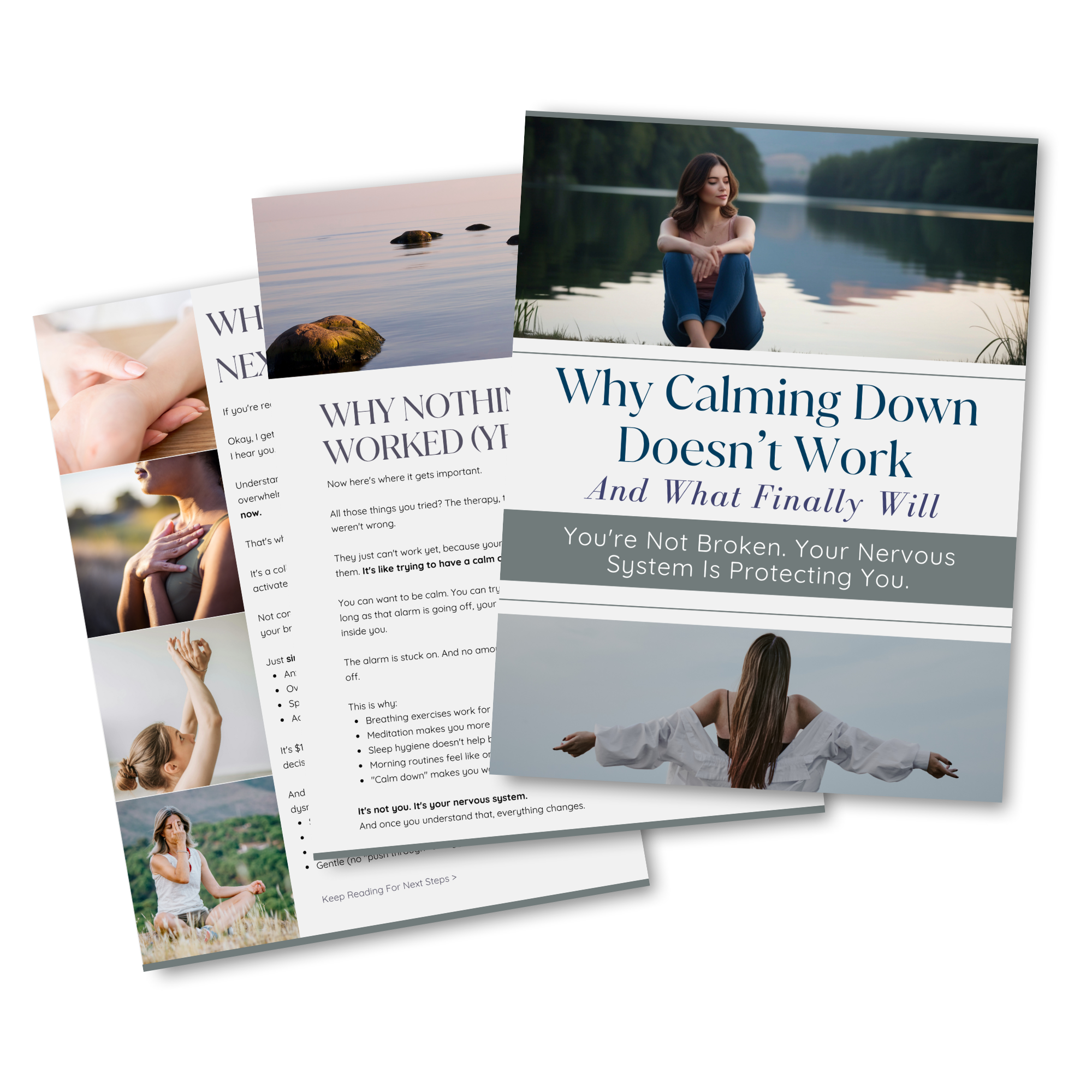
Free Guide: Why Calming Down Doesn’t Work
(And What Finally Will)
You’re Not Broken. Your Body Is Protecting You.
Your inbox stays calm, too. Unsubscribe anytime. We respect your privacy.
A Body-First Mom Morning Routine (That Fits Inside the Chaos)
These aren’t things you do before the kids wake up. They’re things you can do while the kids are awake, while the morning is happening around you. None of them require silence, solitude, or extra time. Just a few seconds of intentional body awareness woven into what’s already happening.
1. The 10-Second Reset (Before Your Feet Hit the Floor)

Before you stand up, before you respond to the first request, take one physiological sigh. Two quick inhales through your nose, then a long exhale through your mouth.
It takes 10 seconds. You can do it with your eyes still closed.
This signals your parasympathetic nervous system to engage. Research has shown it lowers heart rate and cortisol faster than several minutes of mindfulness meditation. One breath. That’s the reset.
In our house, we actually use the word “reset.” If someone is overwhelmed, having a meltdown, or just needs a fresh start, anyone can call it. Mom needs a reset. It’s become family language. Even the kids use it.
2. Feet on Cold Floor (A 30-Second Grounding Practice)

After that first breath, put both feet flat on the floor. If the floor is cold, even better. Cold sensation on the soles of your feet sends a grounding signal through your nervous system.
While you’re standing there, notice three things: where your weight falls on your feet, the temperature of the floor, and whether your jaw is clenched. If it is, let it drop. Just a little.
That’s 30 seconds. You haven’t left the bedroom. You haven’t added anything to your morning. You’ve just given your body a moment to arrive before the demands start.
3. The Kitchen Swing (2 Minutes While Something Heats Up)

This is one of the simplest somatic exercises, and it works beautifully in the kitchen while something heats up, while you pour cereal, while you wait for the toaster.
Stand with your feet about hip-width apart and gently swing your arms across your body, letting your torso rotate left and right. In yoga they call this “knocking on heaven’s door.” It looks like nothing. It feels like everything.
Crossbody movement re-engages both hemispheres of your brain. When you’re activated, your prefrontal cortex partially shuts down and your amygdala takes over. This gentle swinging helps bring your thinking brain back online so you can respond to the cereal spill with patience instead of a reaction that doesn’t match the moment.
Your kids might look at you funny. That’s fine. Mine do too. Sometimes they join in.
4. The Warm Mug Check-In (While You’re Already Holding Coffee)

Wrap both hands around your coffee or tea. Feel the warmth. Notice the weight of the mug.
Then do a quick 5-4-3-2-1:
- 5 things you see (the counter, the cereal box, the light through the window)
- 4 things you feel (the mug, the floor, the fabric of your shirt, the air on your face)
- 3 things you hear
- 2 things you smell
- 1 thing you taste
This takes less than a minute and you’re already holding the coffee. Nothing extra required. Often, grounding works best when it’s layered onto something you’re already doing rather than added as a separate task.
What it does: pulls your awareness out of the mental loop of everything I need to do today and anchors it in the actual present moment. Your nervous system can’t be in fight-or-flight and fully present at the same time. Presence wins.
But What If the Kids Are Already Up?
Let’s be honest. Some mornings, there is no “before the kids wake up.” They’re already in your bed, already asking for waffles, already vibrating at a frequency your nervous system was not prepared for.
Those mornings don’t have to be a write-off. Because body-based regulation doesn’t require silence or solitude. It works with little humans attached to you.
Hold Them First

Before you do anything else, before you start pouring cereal or negotiating screen time, sit down and hold your child. Two minutes. That’s it.
When you hold your child close, both of your nervous systems start to sync. This is called co-regulation, and it’s one of the most powerful nervous system tools that exists. Your child’s body borrows your calm (even if you don’t feel particularly calm yet). And here’s the part no one mentions: your body borrows theirs back. The weight of a small person against your chest, the rhythm of their breathing, the warmth. It regulates you too.
Two minutes of holding your child isn’t losing time. It’s building the steadiest foundation your morning can have.
Get on the Floor

Kids live on the floor. They build things down there, they crash things down there, they sprawl.
Getting down on the floor with them does something your nervous system doesn’t expect: it changes your physical position, engages your senses, and pulls you out of the mental loop of everything I have to do today. You’re suddenly touching carpet, stacking blocks, noticing the weight of a toy car in your hand. That’s grounding. It just doesn’t look like a meditation cushion.
You don’t have to play for 30 minutes. Five minutes on the floor, at their level, doing whatever they’re doing. Your body shifts from task mode to present mode. The to-do list will still be there when you stand up. But you’ll approach it from a different place.
Sing Through It

This one sounds too simple, but the science is real. Singing and humming activate your vagus nerve. The vibration in your throat, combined with the longer exhale it naturally creates, sends a direct calming signal to your nervous system.
It also does something very practical: you physically cannot sing and yell at the same time. If the morning is already loud and you feel the frustration building, putting a song to whatever you’re doing changes the whole tone.
This is the way we brush our teeth, brush our teeth, brush our teeth. This is the way we brush our teeth, early in the morning.
Shoes on, shoes on, let’s get our shoes on. One foot, two foot, now we’re almost done.
It doesn’t matter if you can’t carry a tune. Your vagus nerve doesn’t care about pitch. It cares about vibration, rhythm, and the exhale. The kids think it’s fun. Your nervous system thinks it’s regulation. Everybody wins.
What This Looks Like on a Hard Day

On a good day, maybe you do all four of these things. Maybe the morning feels steady. Maybe you respond instead of react. Maybe you notice the shift.
On a hard day? Just the sigh. Just the one breath before your feet hit the floor.
That still counts. A mom morning routine built on body-based regulation doesn’t fall apart on hard days because it was never about doing everything perfectly. It’s about doing one small thing that helps your nervous system remember it’s safe before the noise starts.
And here’s what changes over time: your body starts to recognize the pattern. The sigh becomes a cue. The feet-on-the-floor moment becomes automatic. Your nervous system learns that mornings can include a pause, even a tiny one, before it has to perform. Repetition builds that pathway. Not perfection. Just repetition.
If tracking which practices help your mornings feel steadier sounds useful, a simple tracker can make that easier. One page. A few check boxes. A quiet record of what helped, so you can notice the pattern instead of guessing.
You Don’t Have to Earn a Calm Morning

You don’t have to wake up at 5 a.m. to earn a calm morning. You don’t have to meditate for 20 minutes or finish a workout before anyone else is up. You don’t have to be a different kind of mom.
The mom morning routine that works is the one your body can actually do, on a Tuesday when someone woke up with a stomach ache and the dog needs out and the permission slip is due by 8:15.
One breath. Feet on the floor. A few seconds of swinging in the kitchen while the toast burns a little.
That’s not giving up on having a good morning. That’s building one from the inside out. Starting with the only thing that actually sets the tone for everything else: your nervous system.
Remember that feeling from the opening? Jaw tight, shoulders up, brain already three hours ahead? That’s your nervous system running without a pause.
Now imagine one breath before all of it begins. One exhale that says not yet. That’s the whole routine. And it changes everything about what comes after.
Want to Go Deeper?
If you want to understand more about why calming down doesn’t always work (and what does), I put together a free guide that breaks it all down: Why Calming Down Doesn’t Work (And What Finally Will)
Free Guide: Why Calming Down Doesn’t Work
(And What Finally Will)
You’re Not Broken. Your Body Is Protecting You.
Your inbox stays calm, too. Unsubscribe anytime. We respect your privacy.