The Holistic Lifestyle Advice Nobody Gives You (Body First, Not Mindset First)
You’ve read the articles. “10 Holistic Lifestyle Tips You Need.” Drink lemon water. Journal every morning. Go organic. Meditate for 20 minutes. Cut your screen time in half.
You’ve probably done most of those things. Maybe all of them. And you still don’t feel whole.
Because here’s what none of those lists tell you: if your nervous system is stuck in survival mode, no amount of lemon water is going to fix that. Your body has to come first. Not your habits. Not your mindset. Your body.
A holistic lifestyle is an approach to daily living that treats your body, mind, and emotional health as one connected system, not separate problems to fix. Most advice in this space starts with the mind: think better, plan better, be more intentional. But when your system is running on fumes and cortisol, your mind can’t lead. Your body has to go first.
That’s the piece almost everyone skips.
Why Most Holistic Lifestyle Advice Doesn’t Stick
There’s nothing wrong with drinking lemon water or writing in a journal. Those are fine things. The problem is the order.
Most holistic lifestyle advice assumes you’re starting from a regulated place. It assumes your brain is online, your sleep is decent, and your nervous system isn’t running a low-grade alarm in the background 24 hours a day.
For a lot of women, that’s not where they’re starting. They’re starting from a body that’s been in fight-or-flight for years. Chronic stress keeps cortisol elevated, which has been linked to weight gain, sleep disruption, and immune suppression (Harvard Health Publishing). So when you try to layer good habits on top of a dysregulated system, they don’t stick. Not because you lack discipline. Because your body is too busy surviving to build anything new.
That’s why regulation comes before discipline. Always.
“You can’t outsource your health to anybody.”
What a Holistic Lifestyle Actually Looks Like (Body First)
This isn’t a checklist. It’s a shift in how you approach your entire day. Instead of starting with what you should do, you start with what your body actually needs.
Start With the Body, Not the Belief System
Before the vision board. Before the affirmations you don’t actually believe yet. Ask your body one question: what do you need right now?
Sometimes the answer is a 60-second breathing exercise. Other times it’s lying on the floor. Sometimes it’s shaking your hands for 30 seconds to complete a stress cycle your body started three hours ago.
Somatic tools, nervous system regulation techniques, and movement that processes (not performs) are the foundation of a holistic lifestyle that actually holds up on hard days. If you want to understand how these tools work at a deeper level, 11 things you need to know about somatic healing breaks it all down.
Simplify Instead of Adding More
The wellness world loves to add things to your plate. One more supplement. Another morning ritual. One more tracker. For a lot of women, the answer isn’t more. It’s less, done with intention.
“Everything we do is multipurpose and supportive of an intentional lifestyle.”
One walk can be exercise, nature exposure, bilateral stimulation for your nervous system, and quality time with your kids. That’s not cutting corners. That’s designing a holistic lifestyle around a body that’s already carrying enough.
If you’ve tried the mindset work and your body never got the memo, my free guide explains the piece everyone skips.
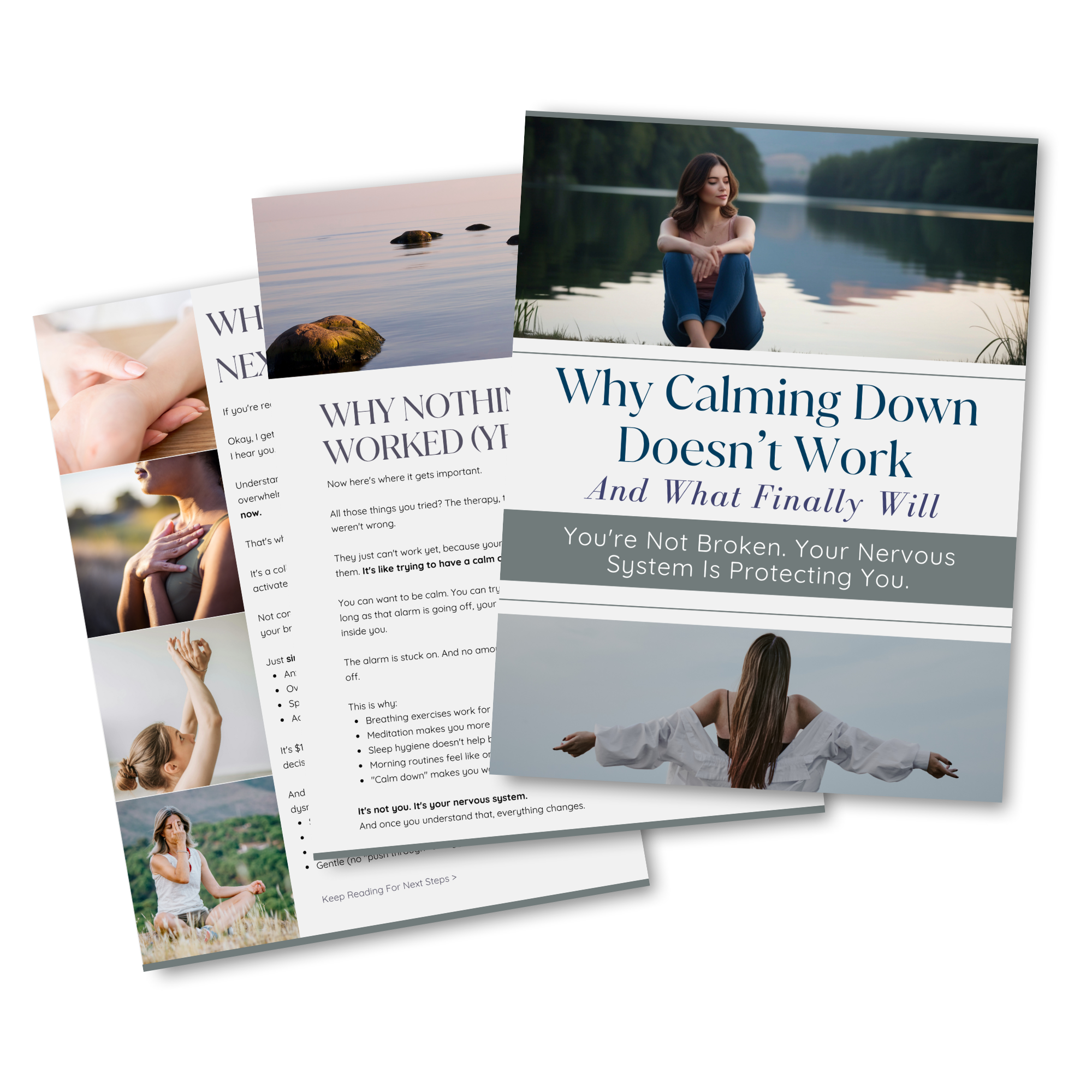
Free Guide: Why Calming Down Doesn’t Work
(And What Finally Will)
You’re Not Broken. Your Body Is Protecting You.
Your inbox stays calm, too. Unsubscribe anytime. We respect your privacy.
Design Your Environment for Calm
Your nervous system doesn’t just respond to what you do. It responds to what surrounds you. The noise level in your house. The light on your screen at 10pm. Whether your mornings start with chaos or quiet.
You don’t need a homestead to design for calm (though it helps). You need small shifts: screens off after a certain hour. A corner of your house that’s just yours. Ten minutes outside before the day starts. Research from the University of Cambridge found that people with higher interoceptive awareness (the ability to notice what’s happening inside your body) make better emotional decisions. Designing calm into your space gives your body room to actually feel.
Feed Your System, Not the Trend
Whatever the latest supplement trend is, it probably won’t be the thing that changes everything for you. Holistic nutrition isn’t about chasing what’s popular. It’s about paying attention to how your body actually responds.
“It’s not always the herb suggested in the top-level recipes. Sometimes it takes a lot of trial and error.”
Real food. Herbs that work for your system (not someone else’s). Less processed, less rushed, less mindless. This is the unsexy part of a holistic lifestyle. But it’s the part that compounds over time.
Let Your Kids Watch You Live It
You don’t have to teach your kids about nervous system regulation. You just have to let them watch you do it.
When you pause and take a breath before reacting. Or saying “I need a reset” instead of powering through. When you name what you’re feeling out loud instead of burying it. Those moments are building something in them that no parenting book could replicate.
“With my family, we do the reset plan. If somebody is throwing a fit or tossing a tantrum, we say: do you want to reset?”
Kids don’t learn regulation from a curriculum. They learn it from watching the person they trust most navigate hard moments honestly. If you’re looking for a place to start, holistic health habits that actually fit real life has some practical entry points.
Stop Performing Wellness
There’s a version of holistic living that looks great on Instagram. Matching workout sets. Color-coded meal prep. A meditation corner with candles and crystals.
And then there’s the version that actually works. The one where you sometimes eat cereal for dinner because today was too much. Where your “meditation” is sitting in the car for two extra minutes before going inside. Where your holistic lifestyle looks nothing like anyone else’s and you’ve stopped apologizing for that.
“Pushing yourself to exhaustion because that’s what other people do. That’s what doesn’t need to be carried forward.”
Building a Holistic Lifestyle on Your Own Terms
This doesn’t have to look like anyone else’s version. It just has to be something your body can sustain. On good days and bad ones. On days when you have energy and days when you’re running on four hours of sleep and leftover coffee.
A holistic lifestyle isn’t a destination. It’s a relationship with your body that you keep showing up for. Some days that looks like a grounding walk and a cup of herbal tea. Other days it looks like lying on the floor and breathing until the world feels a little less loud.
Both count.
If you’re curious about what slow living actually looks like (and why it’s not as boring as it sounds), that’s worth a read.
The Fact That You’re Still Searching Says Something
The fact that you’re still here, still reading, still looking for something that actually works? That’s not desperation. That’s discernment. You’ve been through enough approaches to know what doesn’t fit. And the reason you haven’t given up is because some part of you already knows that holistic living isn’t another thing to add to your list. It’s the thing that makes the list shorter.
If you want to understand more about why calming down doesn’t always work (and what does), I break it all down in this free guide: Why Calming Down Doesn’t Work (And What Finally Will)
Free Guide: Why Calming Down Doesn’t Work
(And What Finally Will)
You’re Not Broken. Your Body Is Protecting You.
Your inbox stays calm, too. Unsubscribe anytime. We respect your privacy.