

Somatic Workout: 7 Unexpected Benefits To Make You Strong & Calm
Search “somatic workout benefits” and you will get the same seven results on repeat. Rewire your brain. Release tension. Transform your stress response. Build functional strength. All of it true. All of it the obvious list.
I want to talk about the other ones. The weirder ones. The shifts that show up around week four of a consistent somatic workout practice, make you pause mid-sentence, and think huh, that wasn’t on the brochure.
A somatic workout is a slow, body-first movement practice that uses small, deliberate motions to release chronic tension patterns and retrain your nervous system out of fight-or-flight. The benefits you would expect (less pain, better mobility, lower cortisol) are real. The ones nobody warns you about are the ones that actually change your life.
None of what follows is a clinical claim. These are quiet observations. The kind of things women mention to me almost sheepishly, like they are not sure they count. They count.
Your body has been holding so much that you forgot it was holding any of it. Until one day you notice you stopped.
Quick Body Awareness Check
Before we get into the unexpected stuff, do this. Right where you are:
- Notice your jaw. Clenched, even a little?
- Notice your shoulders. Creeping toward your ears?
- Notice your breath. Sitting in your chest or in your belly?
- Notice your stomach. Braced, like you are waiting for impact?
Whatever you found, you did not choose it. That is the whole point. Your body made those patterns to keep you safe. A somatic workout is the process of convincing your body it is safe enough to let them go.
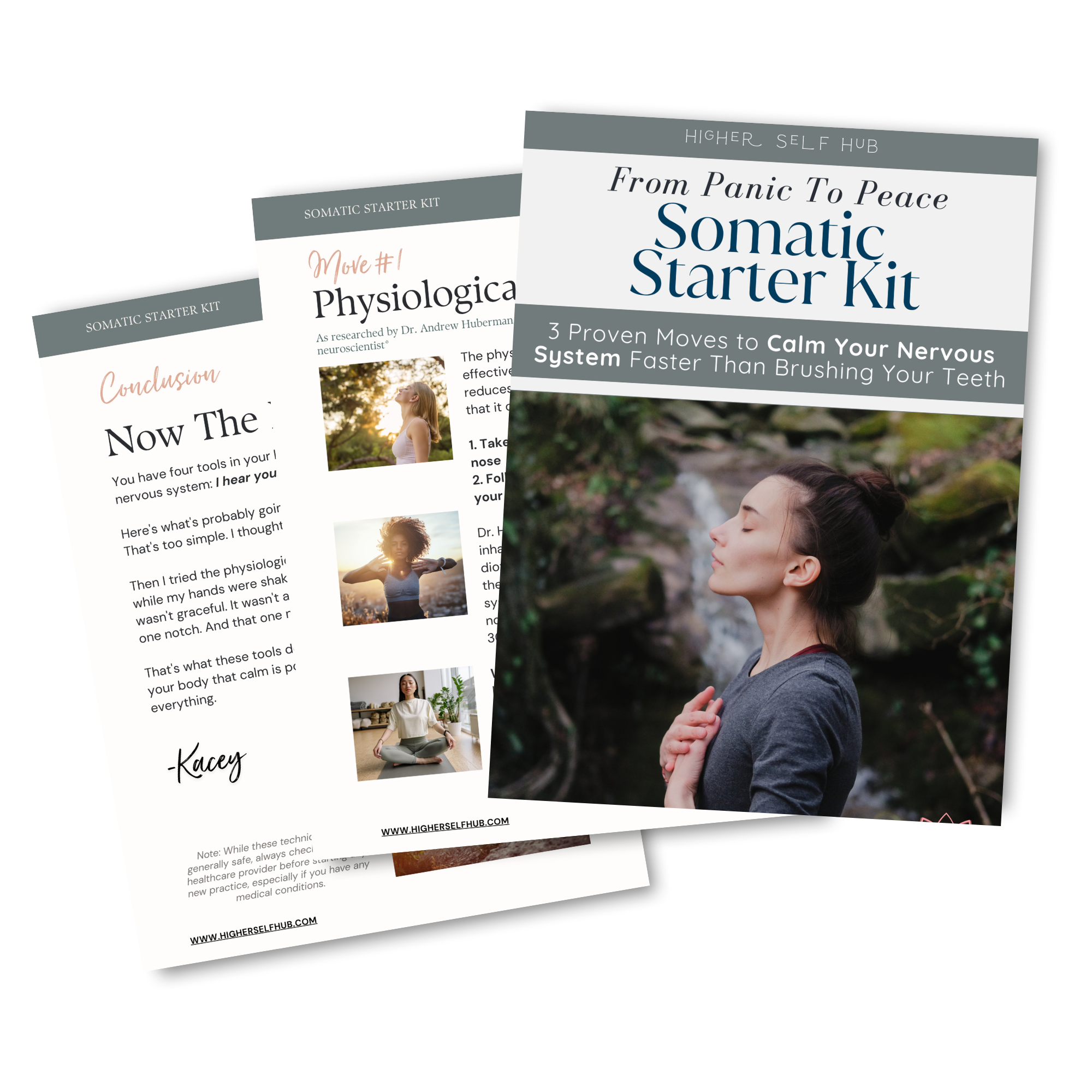
Your Free Somatic Starter Kit
3 science-backed tools to go from panic to peace in under 60 seconds.
Your inbox stays calm, too. Unsubscribe anytime. We respect your privacy.
What Makes a Somatic Workout Different
A regular workout asks your body to perform. A somatic workout asks your body to notice. That is the entire difference, and it is why the benefits land in places you do not expect.
You are not counting reps. Not burning calories. You are moving slowly and deliberately, two to ten minutes at a time, tracking what you feel as you go. Pandiculation. Gentle rocking. Micro-movements of the spine. Breath that matches your pace instead of chasing it.
The nervous system learns through repetition, not intensity. Ten minutes a day. Three weeks in, something shifts. Your body is not broken. It has just been patterned. Patterns can be rewritten.

7 Unexpected Benefits of a Somatic Workout (The Ones Nobody Writes About)
Not in the brochure. These are the ones women mention in passing, then lean in because nobody ever explained why it was happening.
1. You Stop Apologizing Before You Even Speak
If your sentences start with “sorry, but…” or “I might be wrong, but…” you know exactly what I mean. The pre-emptive apology. The reflex to smooth everything over before anyone is upset. It is a fawn response, and it lives in your body long before it reaches your mouth.
Fawn patterns show up as chronic bracing. Tight chest. Locked pelvis. Hunched shoulders. Shallow breath. When your body has been braced for years, apologizing feels like the only safe way to enter a room. Loosen the bracing and something strange happens. You start speaking without the buffer.
Try This Now: Stand up. Drop your shoulders. Soften your belly. Say a simple sentence out loud: “I think we should do it this way.” Notice what it feels like to say it without the preamble.
2. Your Kids’ Tantrums Get Shorter
Co-regulation is the quiet thing nobody mentions in parenting books. Your nervous system is the thermostat. Your kids set theirs to match yours. If you are mostly braced, they are mostly braced. If you can find ground, they borrow it.
A somatic workout does not just change how you feel. It changes the room. Moms tell me their three-year-old stops spiraling faster. Their teenager picks fewer fights. Their toddler falls asleep easier. They think they are doing something differently. They are not. They are just less activated, and everyone downstream feels it.
Try This Now: Next time your kid melts down, do ten seconds of somatic breath before you respond. Exhale longer than you inhale. Soften your jaw. Feel your feet on the floor. Then speak. Watch what happens.
3. You Stop Grinding Your Teeth at Night
Your dentist told you to wear a mouthguard. The mouthguard does not fix the grinding. It just keeps your molars intact while your body does whatever it is doing in the dark. The grinding is a nervous system problem, not a dental one.
Here is what jaw clenching will never respond to: willpower. You cannot decide to stop grinding at 2 a.m. What you can do is teach your body, during the day, that it has permission to let the jaw go. Pandiculation of the jaw and neck area, done daily, is the intervention that changes the nighttime pattern.
Try This Now: Open your mouth wide. Stretch every muscle around the jaw. Release slowly over about ten seconds. Do it three times. You will feel your whole face let go.
| Signs Your Jaw Is Running the Show | What It Means |
|---|---|
| Dull morning headaches | Night grinding you did not know about |
| Clicking when you chew | TMJ strain from chronic clench |
| Tension headaches by afternoon | Day-long low-grade clenching |
| Neck and shoulder tightness | Jaw tension traveling down the chain |

4. You Actually Know When You’re Hungry
Interoception is the science word for knowing what is happening inside your body. Hunger. Thirst. Fullness. Temperature. The urge to pee. Chronic bracing mutes every one of those signals. You eat because the clock says so. You drink when you remember. You stop listening because your body stopped talking.
Three weeks into a somatic workout practice, the dial turns back on. You will notice you are hungry at an odd time. You will notice you are not actually hungry, you are tired. You will notice you want water, not coffee. The signals are not new. You just finally have the bandwidth to hear them.
Try This Now: Before your next meal, close your eyes for thirty seconds. Ask your body, “what do you actually want right now?” Listen without editing the answer. It might surprise you.
5. Your Handwriting Loosens Up
This one sounds absurd. It is also the one that makes people sit up when I mention it.
Shoulder tension does not stop at your shoulder. It runs down the arm. Through the elbow, the wrist, the fingers, all the way to whatever you are gripping. If your shoulders have been creeping toward your ears for a decade, your pen grip is tight. Your letters are cramped. Your signature is a knot.
Release the shoulders and something downstream changes. Your handwriting opens up. Your typing softens. You stop gripping the steering wheel like it might get away. The body is a chain, and tension in one link pulls on every other one.
Try This Now: Write your name right now, in your usual grip. Then roll your shoulders back and down, shake out your hands for ten seconds, and write it again. Compare.
6. Old Injuries Finally Start Healing
You have that one thing. The shoulder that never quite recovered. The low back that tweaks when you sneeze. The ankle you sprained in 2014 that still clicks. Years of PT. Years of ibuprofen. Nothing quite closes the loop.
Guarded tissue does not heal. When a muscle has been protecting an old injury for years, it stays clenched, and clenched tissue does not get the blood flow it needs to repair. A somatic workout is sometimes the first time in a long time that old injury hears the message: safe to let go. When it does, the body finally gets on with the work it has been trying to do all along.
Try This Now: Find the old injury. Place your hand on it. Breathe into it for thirty seconds. Not trying to fix anything. Just acknowledging it. That is the first step in giving that tissue permission to soften.
7. You Cry Less at Random Moments (and More on Purpose)
The public crying. The tears that ambush you at checkout lines, in meetings, during a commercial. That is not you being overly emotional. That is stored emotion leaking out the cracks because the body had nowhere else to put it.
A somatic workout gives emotion a channel. You will find yourself crying on your mat for a minute, then stopping, then feeling lighter for a week. You will cry at your kid’s school play on purpose because you are present enough to feel it. You will stop leaking. You will start processing. There is a real difference.
Try This Now: If you feel any emotion rising, put both hands on your chest, press gently, and exhale slowly. You are not trying to stop the emotion. You are telling your body that this is a safe place to feel it.

Your 7-Day Somatic Starter Plan
Ten minutes a day. That is the whole ask.
- Day 1: Jaw and neck pandiculation. Three rounds. Focus on the release, not the stretch.
- Day 2: Gentle spinal rolls on the floor. Knees to chest, small side-to-side rocking.
- Day 3: Shoulder release sequence. Arms overhead, then down slowly with full exhale.
- Day 4: Hip openers. Figure-four on your back. Slow pelvic tilts.
- Day 5: Vagus nerve sequence. Slow side-to-side gaze. Humming on the exhale.
- Day 6: Full-body scan lying down. Five minutes of noticing, five minutes of gentle movement.
- Day 7: Your choice. Whatever your body is asking for that day.
On day eight, you start again. Somatic practice is a rhythm, not a destination. You are not trying to finish anything. You are building a relationship with a body that has been waiting years for you to come back.
| When You Show Up Daily | What Actually Changes |
|---|---|
| Week 1 | Jaw softens, shoulders drop, sleep starts to deepen |
| Week 3 | Interoception returns (hunger, thirst, tired vs sad) |
| Week 6 | Old bracing patterns loosen, grinding eases, patience expands |
| Week 12 | The unexpected benefits land: fewer apologies, shorter tantrums, calmer voice |
Common Questions
How is a somatic workout different from yoga? Yoga teaches postures. A somatic workout tracks sensations. You might hold a shape in yoga to stretch a muscle. In a somatic practice, you move in and out of that shape slowly to teach the nervous system it is safe to release the muscle. Different goal, different result.
How long until I feel something? Most women feel the first shift inside of a week. The unexpected benefits usually show up between weeks three and eight. The body moves on its own timeline, not yours. Consistency matters more than intensity.
Can I do this if I have an injury? Yes, in most cases. Somatic work is often the safest movement option because it is slow, gentle, and you control the intensity. If something hurts, you stop. Your body is giving you data, not a command to push through.
Do I need equipment? No. A soft surface helps. A yoga mat is nice. Loose clothing. That is it.
Ready to Experience the Difference?
A somatic workout is the slowest path to change you have ever heard of. It is also the one that actually lasts. You do not have to push. You do not have to perform. You do not have to get anywhere new.
You just have to show up, for ten minutes, and let your body do the work it has been trying to do all along.
If you are ready to go deeper, start with our guide to somatic exercises to reduce cortisol, or build a daily rhythm with the 28-day somatic workout plan. Both are built on the same truth: the body is not the problem. The pattern is.
That is it. That is the whole thing. Start small, show up, let the rest come.
Your Free Somatic Starter Kit
3 science-backed tools to go from panic to peace in under 60 seconds.
Your inbox stays calm, too. Unsubscribe anytime. We respect your privacy.