

11 Small Ways to Reconnect With Your Body When You’re in Survival Mode
Some days end with the realization that you never ate lunch. Not because the day was packed. The signal just never made it to the front of the line.
For a couple of years, I dropped my kids off at summer camp with sweaty hands and vision that narrowed down to a tunnel. I had enough tools to get through it. I could not have told you one single thing my body actually needed while I did.
That gap has a name, and it explains a lot more than most people expect.
Survival mode is what happens when your nervous system decides that getting through the day matters more than anything happening inside your body, so signals like hunger, tension, and exhaustion stop making it to the front of the line.
It’s efficient. It’s also expensive. And the longer it runs, the more normal it starts to feel.
The good news is that noticing your body is a skill. Skills come back with practice, even ones that have been offline for years.
What Survival Mode Actually Does to Your Body Awareness
Your nervous system has a limited amount of attention to spend. When it’s busy scanning for the next thing that might go wrong, the small internal reports get deprioritized.
Hunger doesn’t disappear. It just stops getting announced.
Harvard Health describes chronic low-level stress as keeping the body’s stress axis switched on, “like a motor that is idling too high for too long.” That idle is what survival mode feels like from the inside. Everything runs. Nothing rests.
The sense you’re rebuilding here has a name too. Interoception is your ability to feel what’s happening inside your own body, the hunger and the heartbeat and the tight jaw. It’s the sense that goes offline first when survival mode takes over, and it’s the one that comes back with the smallest amount of practice.
There’s a physical route back, and it isn’t a metaphor. The vagus nerves carry 75% of your parasympathetic nervous system’s nerve fibers, according to Cleveland Clinic. They run between your brain, your heart, and your gut. That’s the line the practices below are calling on.
Signs You’ve Been in Survival Mode Longer Than You Realized

For me it showed up as finding out I was hungry only once I was already shaky, and as thirty minutes of scrolling I couldn’t account for afterward.
Some people notice a few of these. Some notice none of them, and that’s fine too.
- Shoulders sitting up by your ears, with no memory of lifting them
- Putting off the bathroom until it’s urgent
- Tiredness that arrives as irritation before it arrives as tired
- Noticing pain only after you finally sit down
- Eating standing up and not remembering the taste
- Feeling nothing in particular, most of the time
None of that is a character flaw. It’s a protective response, and a protective response is normal. Survival mode trained your body well, at a job you never asked it to take.
11 Small Ways to Reconnect With Your Body After Survival Mode
Start with whichever one sounds like the least amount of effort. Survival mode doesn’t leave much in the tank, so every one of these is built for a day when there isn’t any.
These aren’t assignments. They’re invitations.
1. Check one signal instead of scanning everything
The One-Signal Check is picking a single body signal and answering only that one. Am I thirsty, yes or no. Then you’re done.
Full-body scans ask a lot of a system that’s already busy. One question is answerable on a hard day, and answering it is what rebuilds the pathway.
2. Say where you are out loud

When I lose half an hour to my phone, this is what brings me back. It’s Tuesday afternoon. My feet are on the floor. I’m in my kitchen. The sun is shining.
Plain awareness statements pull you out of the future and the past at the same time. Say them out loud if you can. Hearing your own voice does more than thinking them does.
3. Relax your toes and nothing else

I was stuck in a drive-through line with my son once, parked, which is the exact situation my body hates most. Relaxing my whole body was not available to me. Relaxing my toes was.
I repeated it until we moved up a space. You don’t have to calm everything at once to prove the connection still works.
4. Take one physiological sigh
One inhale through your nose. A second small sip of air on top of it. Then a long sigh out through your mouth.
This was the first thing that ever worked for me, and it’s still the fastest shift I can feel in my own body. Not a magic pill, because none of these are. It just moves the needle a notch, and you get to feel it move.
5. Feel your feet before you get out of bed
Survival mode tends to start the day before your feet hit the floor. Beating it there by ten seconds changes the order of operations.
Press both feet into the mattress. Notice the weight of your legs. Then get up.
6. Look all the way left, then all the way right

Turn your head slowly and look behind you on each side. This is called orienting, and it tells your brain that you’ve checked the room and nothing’s coming.
My vision narrows when I’m dysregulated. After reading Dr. Claire Weekes, I understood what was happening physically instead of assuming something was wrong with me. Turning my head is what widens it back out.
7. Put a hand on your heart
Warm pressure on your chest gives your body something specific to feel. It also gives you a number to notice, because you can feel whether your heart is fast or steady.
I do this before I say the words I keep on a notecard in my car. This is a protective response. Protective responses are normal.
8. Swing your arms across your body

Stand up and twist your torso side to side, letting your arms wrap around you. In yoga it’s called knocking on heaven’s door.
When you’re agitated, your prefrontal cortex steps back so your amygdala can act fast. That’s the design, not a defect. Crossbody movement helps re-engage both sides of your brain so the thinking part can come back online.
9. Name the emotion, then name where it lives
I used a printed emotion wheel with my son when he was small. What emotion is this? And then: where do you feel it?
Pairing the word with the body part is the part that does the work. Frustrated in my jaw. Nervous behind my ribs. That’s the mind body connection rebuilding itself in real time.
10. Walk for ten minutes without your phone
In our house we call it a reset. I’ll tell the kids that Mom needs a reset, and I go walk our lane.
Ten minutes shifts my whole energy. No expectation that it solves anything, and it still resets my nervous system enough to think clearly again.
11. Hold something warm and actually taste it

Wrap both hands around a mug. Feel the heat before you drink. Then take one sip and pay attention to the taste of it, the whole way down.
Survival mode eats standing up, over the sink, without registering a thing. One deliberate sip is a small argument against that.
If you’d like a few of these in one place you can reach for without thinking, the Somatic Starter Kit is the short list I come back to most.
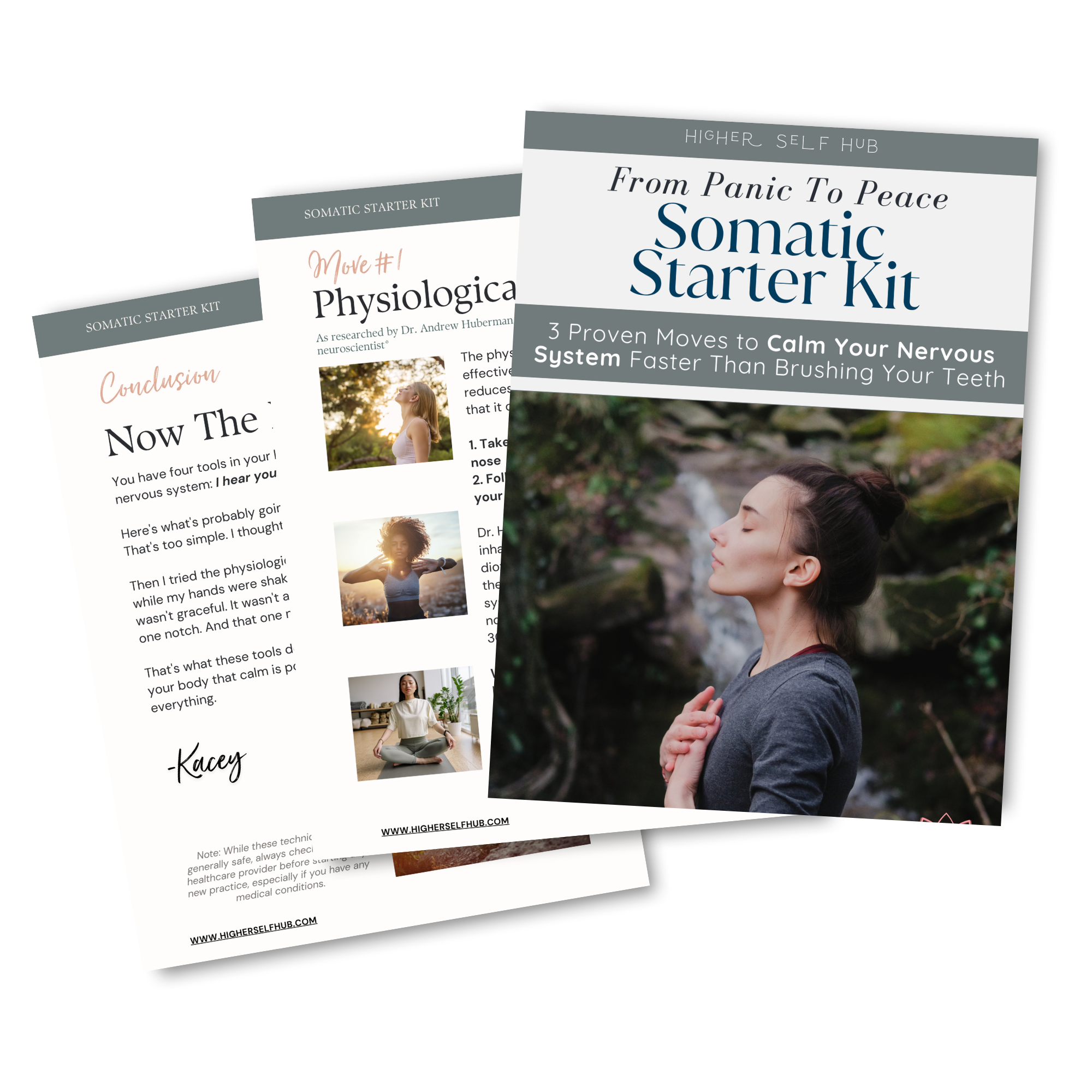
Your Free Somatic Starter Kit
3 science-backed tools to go from panic to peace in under 60 seconds.
Your inbox stays calm, too. Unsubscribe anytime. We respect your privacy.
How Do You Start When You’re Still in Survival Mode?
You design for your worst day, not your best one.
I set a goal once to walk a mile a day for a hundred days. On the migraine days, the voice in my head said I couldn’t, that I needed rest, that it didn’t matter anyway.
Instead of asking how to push through twenty minutes, I asked whether I could go outside for five. Five, then rest. Ten later, then rest. Five more.
I didn’t override my body. I collaborated with it. At the end of that day I didn’t feel heroic, I felt trustworthy, and that was new.
Pick one practice from the list. Attach it to something you already do, like the kettle boiling or the car being in park. If a full body scan feels like too much right now, body scanning can wait until the smaller checks feel steady, and a few easy grounding exercises are a softer place to land in the meantime.
Your Body Has Been Waiting on You
The lunch you skipped wasn’t a discipline problem. The signal went out and nobody was at the desk to receive it.
Survival mode isn’t a personality. It’s a setting, and settings change with repetition.
Your body isn’t broken. It’s been protecting you, and it’s still sending. Answer one signal today and you’ve already started.
📌 Save This For Later
If this one landed, save it somewhere you’ll find it on a hard day. Pinterest is a good place to keep things like this close.
Reconnecting with your body works better when you don’t have to remember what to try. The Somatic Starter Kit is the list I keep for the days I can’t think of one.
Your Free Somatic Starter Kit
3 science-backed tools to go from panic to peace in under 60 seconds.
Your inbox stays calm, too. Unsubscribe anytime. We respect your privacy.