How Simple Somatic Exercises Can Improve Your Mental Wellbeing
You know that feeling when your brain won’t shut off, but your body feels weirdly numb at the same time?
Like you’re thinking all the thoughts, but you can’t actually feel anything except maybe tired or vaguely anxious. Or maybe you’re scrolling, snacking, or rewatching the same show for the third time. Not because you want to, but because everything else feels too hard.
That disconnect? It’s not laziness. And it’s not something you need to fix with more willpower.
What’s actually happening is that your nervous system is trying to protect you. When your body perceives too much stress. Whether that’s a packed schedule, emotional overload, or just existing in a world that never stops, it can start to shut down sensations as a way to cope. In other words, your mental wellbeing is hijacked because your body doesn’t feel like a safe place to be.
This is where somatic exercises come in. Instead of trying to think your way into better mental health, they help you reconnect with your body so your nervous system can actually regulate itself.
Somatic exercises are simple, body-based practices that support your mental wellbeing by helping your nervous system feel safe enough to settle, instead of trying to force yourself calm from the neck up.
What “Somatic” Actually Means (Without the Jargon)

The word somatic just means “relating to the body.” So somatic exercises are any practices that help you tune into physical sensations, movement, or breath. So you don’t have to stay stuck stuck in your thoughts.
They’re not about pushing yourself or performing. In fact, they work best when you slow down.
Think of it this way: your mind and body are constantly sending each other signals. But when you’re stressed or overwhelmed, those signals get scrambled. Your body might be screaming for rest, but your brain is convinced you need to keep going. Or your thoughts are spinning with worry, but your body has gone quiet and frozen.
Somatic work helps restore that communication. Over time, it can genuinely shift how you experience emotional wellbeing, self compassion, and daily stress.
Why This Matters for Mental Wellbeing

Here’s what most mental health practices miss: your body holds information that your brain can’t access through thinking alone.
You can tell yourself to calm down a hundred times. But if your nervous system is stuck in fight-or-flight, your body won’t believe you. On the other hand, when you work with your body through gentle movement, grounding, or breath, guess what happens? You’re actually giving your nervous system proof that it’s safe to settle, and mental wellbeing improves.
That’s not just theory. Research on the connection between a healthy body and healthy mind shows that physical regulation directly impacts mood, focus, and resilience. Meanwhile, ignoring your body’s signals can keep you stuck in cycles of burnout, numbing, or reactivity.
Somatic exercises aren’t about fixing yourself. They’re about creating space for your system to recalibrate.
A Few Gentle Ways to Begin
You don’t need a yoga mat, a quiet room, or an hour of free time to start. In fact, the most effective coping skills for improved mental wellbeing are often the ones you can do in the middle of a regular day. If you want a little more structure, these somatic exercises to reduce cortisol and these everyday practices to regulate your nervous system pair well with what follows.
Here are a few options to explore. Use what feels doable, skip what doesn’t.
1. Notice What You’re Touching

This one is almost too simple, but it works.
Right now, bring your attention to whatever your hands are resting on. A table. Your lap. The arm of a chair. Notice the texture, the temperature, whether it’s soft or firm.
That’s it. You’re not trying to relax or feel better. You’re just anchoring yourself in a physical sensation. This kind of micro-practice can interrupt a thought spiral faster than trying to “think positive.”
2. Move Just to Move

If you’ve been sitting for a while, your body might need something. But it probably doesn’t need a full workout.
Instead, try rolling your shoulders. Stretching your arms overhead. Shaking out your hands like you’re flinging off water. These small movements help release tension and can act as one of those healthy dopamine activities that doesn’t require much effort.
Sometimes the goal isn’t to feel energized. It’s just to feel something.
3. Hum or Sigh Out Loud

Your vagus nerve — the main regulator of your nervous system — responds really well to vibration and breath.
So if you’re feeling stuck or heavy, try humming for a few seconds. Or let out a big, audible sigh. It sounds almost too easy, but these tiny shifts send a signal to your body that it’s okay to release.
You might feel a little silly at first. That’s normal. Do it anyway.
4. Put Your Hand on Your Heart (or Belly)

This is one of the simplest self compassion practices there is.
Place one hand on your chest or your stomach. Breathe slowly. You don’t have to say anything or think anything specific. Just rest your hand there and notice the rise and fall.
Sometimes your body needs to be reminded that someone’s paying attention. Even if that someone is you.
5. Name What You Notice (Without Judgment)

When you’re overwhelmed, emotions can feel like a blur. Somatic awareness helps you slow that down.
Instead of asking why you feel bad, try asking where you feel it. Is your chest tight? Are your shoulders up by your ears? Does your stomach feel clenched or empty?
You’re not trying to fix it. You’re just noticing. That alone can create a tiny bit of space — which is sometimes all you need to shift out of freeze mode.
If reading this is stirring something up, this free guide goes deeper into the nervous system side of your mental wellbeing, and why “just calm down” never works.
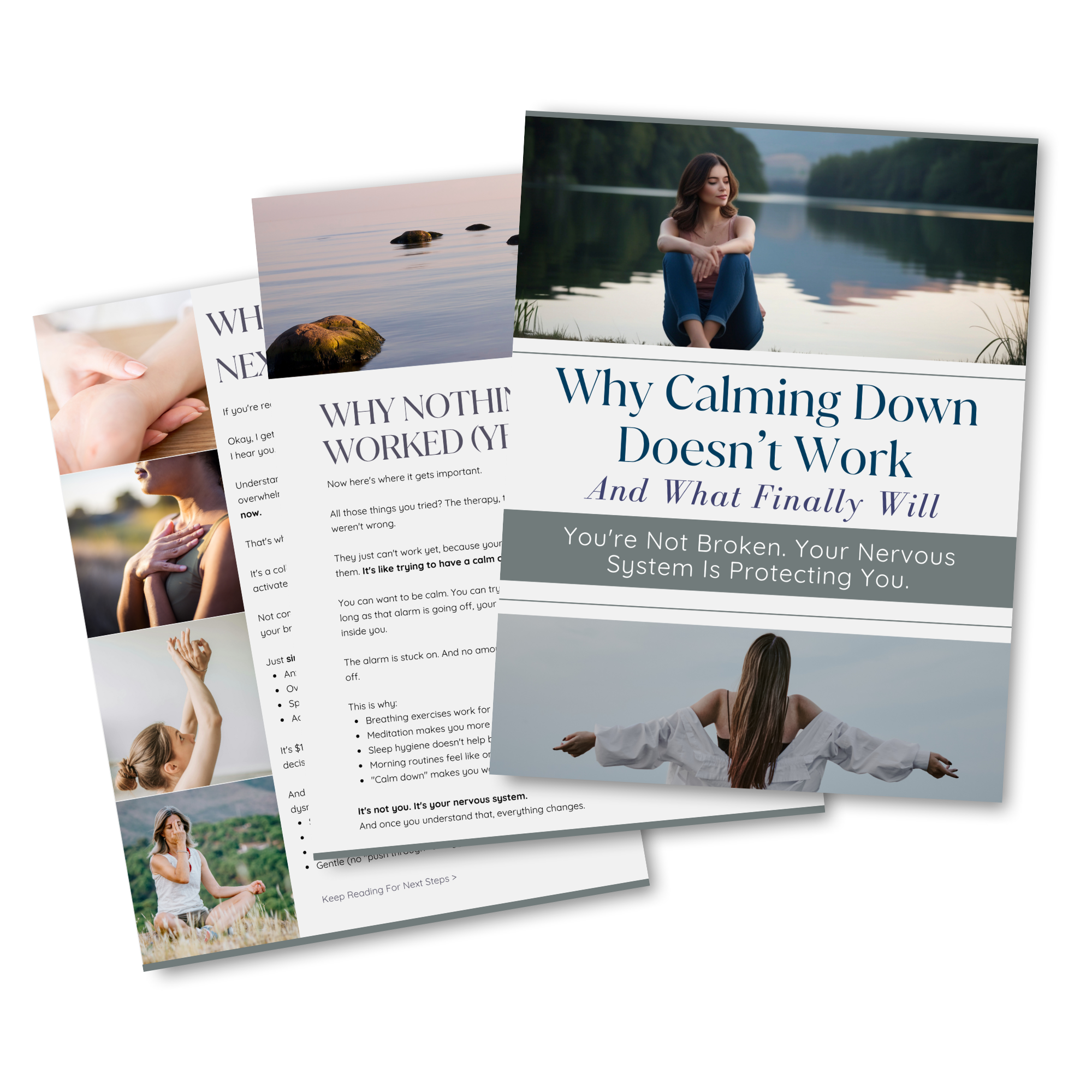
Free Guide: Why Calming Down Doesn’t Work
(And What Finally Will)
You’re Not Broken. Your Body Is Protecting You.
Your inbox stays calm, too. Unsubscribe anytime. We respect your privacy.
The Mental Wellbeing Practices You Can Actually Stick With
Look, you’ve probably tried a lot of things. Journaling. Meditation apps. Morning routines. And maybe some of them worked for a while, but then life got busy or you felt too tired or they just stopped feeling helpful.
That’s not failure. It’s information.
Most practices aimed at improving mental wellbeing are designed for a version of you that has time, energy, and a regulated nervous system. But if your system is already maxed out, adding more “self-care” can feel like another task on the list.
Somatic work is different because it doesn’t require you to be in a good headspace to begin. Actually, it works best when you’re not. You can do it when you’re tired, distracted, or even a little numb. The bar is that low, and that’s on purpose.
Small Shifts Over Time Add Up

Here’s the thing about better mental health: it doesn’t usually happen in one big breakthrough moment.
It happens in the small, repeated choices to check in with your body instead of overriding it. To pause for five seconds instead of pushing through. To treat yourself like someone worth caring for, even when you’re not performing or producing.
Those moments might not feel like much in the moment. But over weeks and months, they add up. Your nervous system starts to trust that you’re paying attention. Your body starts to feel like a place you can actually inhabit, instead of something you’re just dragging around.
And slowly (without forcing it), you might notice that you’re less reactive. More present. A little more able to ride out hard moments without completely shutting down.
That’s not about serotonin hacks or quick fixes. It’s about building a relationship with yourself that’s based on something other than productivity or perfectionism.
Come Back to This When You Need It
This is one of those posts that can be helpful to come back to. If you use Pinterest, saving it can make it easier to find when you need it.
Because here’s the truth: you’re not going to remember all of this in the middle of a hard day. You’re not going to feel motivated to “do the work” when you’re already overwhelmed.
But having something to return to — a reminder that you have options, that your body isn’t the enemy, that small things count — that can make all the difference.
One More Thing Before You Go
If this resonated with you, I made something that might help.
It’s a short guide called “Why Calming Down Doesn’t Work (And What to Do Instead).” It walks through what’s actually happening in your nervous system when you feel stuck — and what you can do about it that doesn’t involve forcing yourself to relax.
It’s free, and you can grab it below. No pressure, just an option if you want a little more support.
Free Guide: Why Calming Down Doesn’t Work
(And What Finally Will)
You’re Not Broken. Your Body Is Protecting You.
Your inbox stays calm, too. Unsubscribe anytime. We respect your privacy.
Your nervous system doesn’t need you to be perfect. It just needs you to pay attention.
Similar Posts
Evening Rituals That Actually Calm Your Nervous System (Not Just Your To-Do List)
It’s 10:47 PM. You’re in bed, phone in hand, eyes burning. Your body is exhausted but your brain is running a highlight reel of every unfinished task, awkward conversation, and tomorrow’s schedule. You tell yourself to put the phone down. You scroll for another 20 minutes instead. You’ve probably tried evening rituals before. The candles….
7 Simple Body Scan Meditation Techniques For When You’re Frazzled
Feeling frazzled? I’ll show you 10 easy body scan meditation techniques to find inner peace and focus.
Valentine’s Self Care Routine: Love Your Higher Self
As Valentine’s Day gets closer, it’s key to focus on loving ourselves. This day is often linked with romantic love. But, it’s just as important to care for our own well-being and connect deeply with ourselves. These Valentine’s self care ideas can boost our overall happiness and help us have a better relationship with ourselves….
Watercolor as Art Therapy for Your Nervous System (Why Something This Simple Actually Works)
This spring, I’ve been watercoloring on my back deck. The trees in the background and the air smelling like pine and dirt. I sit down, open the book to whichever page I left off on, and just… paint. No timer. No goal. No screen telling me what to do next. Just color meeting paper and…
- Nervous System | Breathwork | Higher Self | Holistic Healing | Intentional Living | Mind Body | Somatic Exercises | Sound Healing
9 Simple Swaps to Reset Your Nervous System Fast
In today’s fast-paced world, it’s more important than ever to find ways to reset your nervous system. Most of us are bugging out with the constant overload. We humans simply weren’t designed to handle this much stimulation. The flood of information and sensory input leads to chronic dysregulation, leaving many of us feeling anxious, overwhelmed,…
75 Compassion Quotes for Mental Wellness For When The World Feels Heavy
When our hearts feel heavy and our nervous systems are on edge, sometimes we need gentle reminders that mental wellness healing is possible, one small moment at a time. These 75 quotes aren’t just words; they’re soft places to land when everything feels uncertain. Whether you’re struggling with your own pain or trying to understand…