

How Slow Living Heals Your Nervous System (5 Shifts You’ll Notice)
It’s 5:15 pm, and you’re finally headed home from all-day activities. You’re answering a text at a red light, half-listening to the kids in the back seat. Everything that has to happen before dinner is already running through your head. The laundry never made it to the dryer. Somewhere under all of it, there’s a hum in your chest that never fully turns off.
I lived like that for years. Our family has a name for it now: go-go-go mode. I can tell you exactly what it cost me, because slow living is the thing that finally got me out of it.
Slow living is the practice of intentionally lowering the pace of your daily life so your nervous system can shift out of survival mode and into rest, repair, and presence. It’s not an aesthetic. Not a linen dress and a sourdough starter. It’s a body-first practice, and it might be the one your body has been asking for.
When “Productive” Becomes a Survival State

Here’s what happens when life runs on constant urgency: the sympathetic nervous system, your fight-or-flight response, stays switched on. The body keeps releasing cortisol. The brain keeps scanning for the next demand. Nothing ever quite finishes, so nothing ever quite settles.
From the outside, this can look impressively functional. I know because I lived it. The summer I finally felt ready to drop my kids off at camp, I had enough tools to get through the drive. But then I’d see friends at drop-off. People I never get to see. And I couldn’t genuinely connect with them, because my body was still managing. Still scanning. Still in fight-or-flight under a calm face.
That’s the hidden cost of running in survival mode. You can do the thing and still not be there for it.
Many of us were trained into this pace. We learned to equate worth with output, rest with laziness, presence with falling behind. So we keep moving, even when the moving is the thing wearing us down.
And here’s why willpower alone doesn’t fix it. Your nervous system processes stress signals in as little as 80 milliseconds (Stephen Porges, Polyvagal Theory). That’s faster than conscious thought. You can’t think your way slower. The pace has to change first. The mind follows.
What Slow Living Actually Does for Your Nervous System

Slow living works because of what it signals, not because doing less is morally superior to doing more.
When you intentionally lower your pace, your parasympathetic nervous system gets room to come back online. That’s the rest-and-repair side of your body. Digestion improves. Muscles unclench. The internal alarm finally gets a chance to confirm what your calendar never tells it: there is no threat right now.
Moving deliberately instead of frantically sends that safety signal over and over, until calm stops feeling foreign. That’s the real gift of slow living. It teaches your nervous system what regulation feels like: steady, predictable, grounded. Not as an idea, but as a felt experience your body can find its way back to.
Slow Living Isn’t “Blah Living” (What I Got Wrong at First)

I want to be honest about something, because the aesthetic version of this topic drives me a little crazy. I’m not into slow living as in not doing much. That always felt more like blah living to me. Work, come home, zone out to a few hours of Netflix, call the numbness peace.
Our life is actually full. We run a small farm, I homeschool my kids, and I work from home while managing my own healing. The difference is that we’re not on anybody else’s schedule. And almost everything we do is multipurpose. Farm chores are physical activity, homestead science for the kids, family time, and nervous system regulation all at once.
That’s the version worth building: a slower pace with meaning stacked into it, not an empty calendar. If you’re new to the philosophy side of all this, I wrote a primer on why slow living is worth embracing. This post is about the body side: the pace itself as medicine.
If your body is stuck in go-go-go mode and “just relax” has never once worked, my free guide explains why calming down isn’t the same as slowing down (and what finally helps).
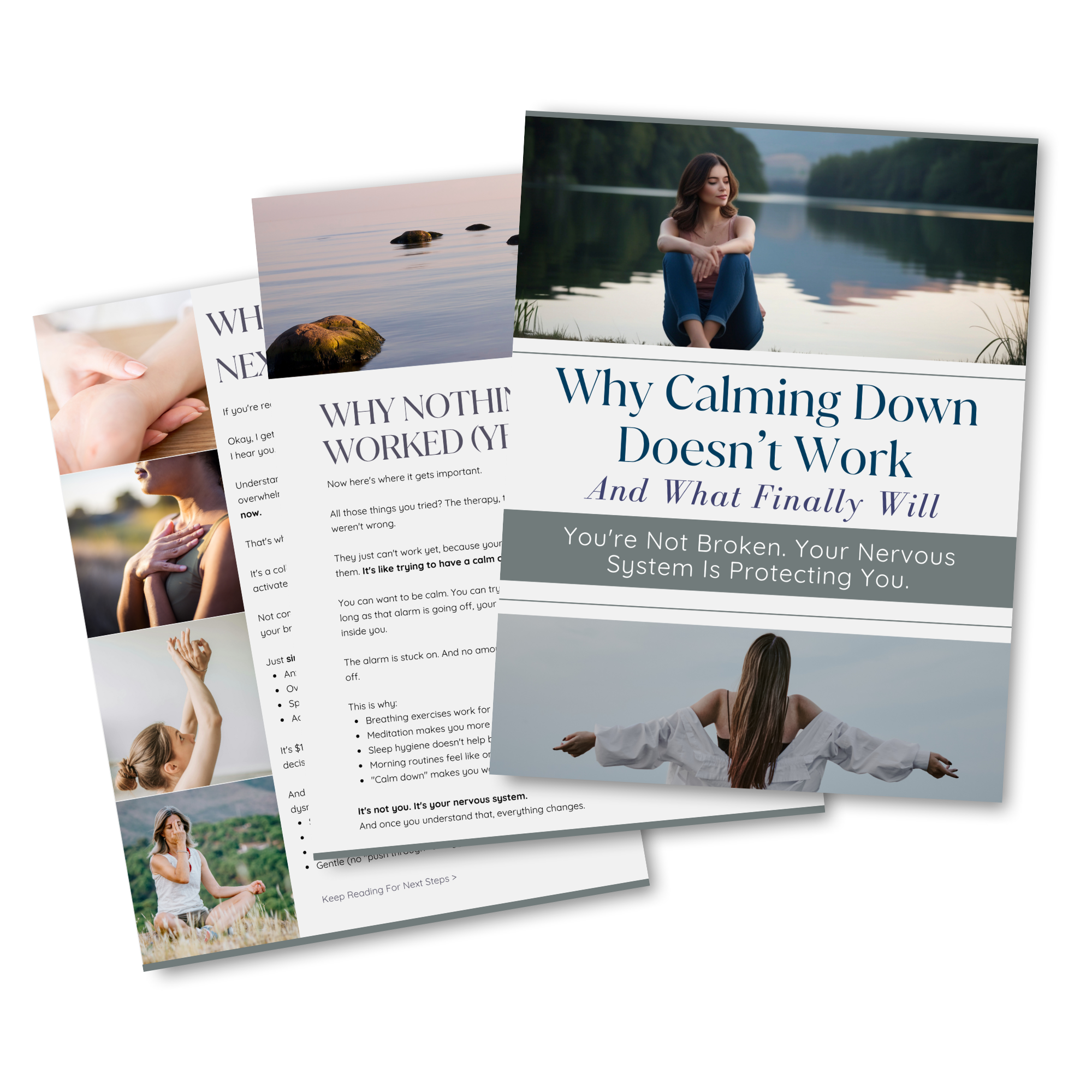
Free Guide: Why Calming Down Doesn’t Work
(And What Finally Will)
You’re Not Broken. Your Body Is Protecting You.
Your inbox stays calm, too. Unsubscribe anytime. We respect your privacy.
5 Gentle Shifts Toward a Slower Pace (No Overhaul Required)
You don’t need to move to a farm or quit your job. Pick one of these, practice it for a week, and let your body learn from it.
1. Breathe Before You Respond

Before answering the next text, the next email, the next “Mom!”, take one slow breath with a long exhale. Extended exhale breathing activates the parasympathetic nervous system within about 90 seconds (Stanford Medicine). The first tool that ever truly worked for me was a version of this: a double inhale through the nose, then a long sigh out through the mouth. Not a magic pill, because none of these are. But it creates a shift you can actually feel, and that proof matters. If you want more tools this small, these somatic exercises for a vagus nerve reset that work in the car are a good place to start.
2. Build In a Daily Reset

The Reset is what our family calls a short, deliberate pause that interrupts overwhelm before it takes over. Ten minutes outside, walking, no phone, no goal. What makes it different from “taking a break” is that everyone in the house can call one, kids included. And it carries zero shame. When I tell my kids “Mom needs a reset, I’m going to go walk,” even ten minutes on our lane resets my entire energy. No expectations of it solving everything. It just brings my system back to a place where I can think clearly and decide what actually needs to happen next.
3. Single-Task One Thing a Day

Pick one ordinary task (the dishes, the school run, folding towels) and give it your full attention, start to finish. Multitasking keeps the scanning habit alive. And the scanning habit is the engine of that hum in your chest. One thing at a time, done with presence, teaches your brain the opposite lesson. It also tends to feel surprisingly good, which is how you know your body was hungry for it.
4. Honor Your Rhythms

Your energy isn’t meant to be identical year-round, and neither is your pace. Winter me wants the fireplace, a cup of tea, and a book with my kids while snow falls outside. Spring me wants dirt under my fingernails. Letting the season set some of the tempo is one of the kindest forms of slow living I know. It quiets the guilt of not performing at summer speed in February. If that idea lands, these gentle spring slow living habits for a sensitive nervous system are a good next read.
5. Let Stillness Count

One summer afternoon, my husband and I paddleboarded to the far side of a lake. We clipped our boards together in the shade and just lay there with our eyes closed. We could have gotten dressed up for dinner and a movie. Lying still on the water was more restorative than either would have been. Rest isn’t wasted time. In one study, grounding practices reduced cortisol levels by 31% in just 30 minutes (Journal of Inflammation Research). Stillness is your system repairing, even when it looks like nothing.
The Resistance Is Real (And It Makes Sense)
I won’t sugarcoat this part: slowing down can feel uncomfortable at first. Maybe even threatening.
For many of us, speed has been a protective pattern. An unconscious way to stay ahead of grief, discomfort, or needs that never got met. If we stop, we might feel too much. I stayed in motion for years for exactly that reason.
So if your first slow afternoon feels itchy and wrong, that isn’t failure. It’s a protective response, and a protective response is normal. The discomfort usually softens with repetition, the same way any new pathway in the brain gets built. You’re not doing it wrong. You’re doing it new.
You’re Allowed to Move Slower

Back to that red light. The text can wait the length of one long exhale. The grocery list will still be there after a single slow breath. That hum in your chest isn’t who you are. It’s a pace your body learned, and your body can learn a different one.
Slow living isn’t a personality or a privilege. It’s permission, taken in ten-minute pieces, on your terms.
📌 Save This For Later
If this post landed for you, save it to your favorite slow living or nervous system board. Pinterest is a great place to keep things like this close.
And if you’d like the body-first version of all of this in one place, the free guide below breaks down why calming down doesn’t work (and what finally will).
Free Guide: Why Calming Down Doesn’t Work
(And What Finally Will)
You’re Not Broken. Your Body Is Protecting You.
Your inbox stays calm, too. Unsubscribe anytime. We respect your privacy.