
Somatic Boundaries for the Holidays: What Is Your Body Telling You?
The text comes in on a Tuesday. “Can you host this year?”
Your thumb types “Of course!” before you’ve taken a full breath.
Then your stomach drops. Your shoulders creep up. And you spend the next three weeks dreading a thing you agreed to in four seconds.
Somatic boundaries are limits you set by reading your body’s signals first, the held breath, the tight stomach, the shoulders that soften or brace, and letting those signals weigh in before you give your answer.
Your body already has an opinion about that invitation. This post is about hearing it in time.
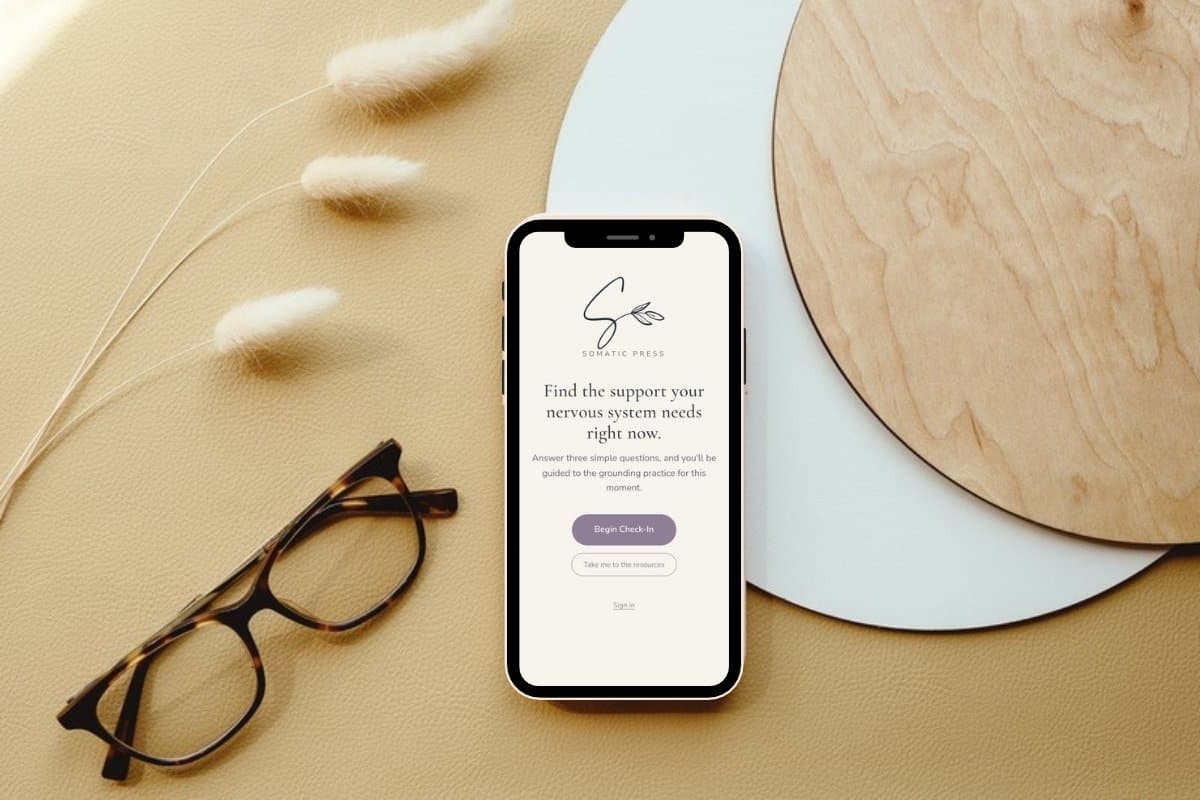
From the Somatic Press app
Find the support your nervous system needs right now.
Answer three simple questions, and you’ll be guided to the grounding practice for this moment.
Why Your Mouth Says Yes Before Your Body Gets a Vote

Most of us know fight, flight, and freeze. Therapist Pete Walker named a fourth one: fawn.
Fawning is when your nervous system keeps you safe by keeping everyone else happy. You agree. You smooth it over. You volunteer before anyone asks. It isn’t a diagnosis, and not every “sure, I’ll bring the rolls” is a trauma response. But if your yes regularly shows up faster than your own opinion does, that’s worth noticing.
It’s not a character flaw. It’s the same thing that happens in the three nervous system states: your body decides before you do. With fawning, the decision just comes out sounding polite.
The holidays turn the volume up. In an American Psychological Association poll, nearly nine in ten adults said something about the season stresses them out, and anticipating family conflict was on the list. More invitations, more history in the room, more people whose feelings you’ve been managing since you were nine.
There’s one more piece. If you’ve been running on fumes since October, your body’s signals get quiet. That’s what survival mode does. The “no” is still being sent. Nobody’s at the desk to receive it.
What a “No” Feels Like in Your Body
Your body says no in contraction. Things get smaller, tighter, further away. Some common ones:
- Your breath stops or goes shallow the moment you read the invite
- Your stomach drops or knots
- Your jaw sets, or your shoulders lift toward your ears
- Your chest feels tight or heavy
- You lean back from the phone, or want to put it face down
- A wave of tiredness shows up out of nowhere
You won’t have all of these. Most people have one or two that show up every time. If your shoulders and neck are your spot, these gentle practices for a neck that won’t relax are a good companion, and where your body stores hidden emotions covers the rest of the map.
What a “Yes” Feels Like in Your Body

A real yes feels like room.
- Your breath drops lower, without you making it
- Your shoulders come down
- Your chest feels soft or warm
- You lean in, or catch yourself smiling at the screen
- There’s a small lift of energy, even when you’re tired
Notice that a yes can be quiet. It doesn’t have to be excitement. Sometimes it’s just the absence of bracing.
The Tricky One: The Yes That’s Actually Relief
This is the part that gets people.
When you fawn, saying yes does feel good, for about ten seconds. The awkward moment ends. Nobody’s disappointed. Your body exhales.
That’s relief. It’s not a yes.
The way to tell them apart is to check what the feeling is about. Relief is about the asking being over. A yes is about the thing itself. So skip past the conversation and picture the actual day: walking in, hour two, the drive home. If your stomach tightens there, the relief was never about the party.
One more honest note. A tight chest isn’t always a no. Nerves and excitement feel a lot alike, and researchers have found that body signals can steer gut decisions well or badly, depending on what the signal is actually tracking. Sometimes the tightness means “this is new,” not “this is wrong.” That’s why the pause matters more than any single sensation.
5 Ways to Check Your Body Before You Answer
None of these take more than a minute. These aren’t assignments. They’re invitations.
1. Buy the pause
“Let me check and get back to you.”
That’s the whole practice. For a body that fawns, the pause is the boundary. Everything else on this list only works if you’ve made room for it. Save the sentence in your phone notes if you need to. I’m serious.
2. Feel your feet, then take one sigh
Press your feet into the floor. One inhale through your nose, a second small sip of air on top, then a long exhale out of your mouth.
You can’t read a signal through static. This turns the static down a notch. More like it in 60-second calming techniques and 21 vagus nerve exercises.
3. Picture the day and check one signal
Not the invitation. The day. See yourself an hour in.
Then ask one question only: did my breath go deeper, or did it stop? A full body scan is a lot to ask in December. One signal is answerable. (If scanning is your thing, body scanning goes deeper.)
And if you check and can’t tell what you’re feeling at all, that’s what I built the Somatic Press check-in for. Three simple questions, and it guides you to a grounding practice for this moment. Do that first. Answer the text second.
4. Calibrate with an easy one
Think of something you’d say yes to without thinking. Coffee with your favorite person. Notice what your body does.
Now think of an obvious no. Notice that too.
Those two feelings are your reference points. Everyone’s are a little different, which is why your own beat anyone’s list, including mine.
5. Name the sensation, not the story
“Tight behind my ribs” is information. “I’m a terrible daughter if I don’t go” is a story.
Stay with the first one a few seconds longer. This is the heart of body mapping, and if you want to see your patterns on paper, the Somatic Body Map Workbook was made for it. A few lines of somatic journaling work too, and the winter prompts have a whole set on boundaries and retreat.
When I first began somatic body mapping, I didn’t even connect the place that I was feeling tension with its actual body part. I was that detached, so don’t be surprised if it takes a little trial and error. I was feeling tension in my cheeks, and only through working through this practice did I discover that that tension was actually in my jaw. Then I was able to find real relief by using somatic jaw release practices.
If you’d like the quick ones in one place you can reach for before you answer, the Somatic Starter Kit is the short list I come back to most.
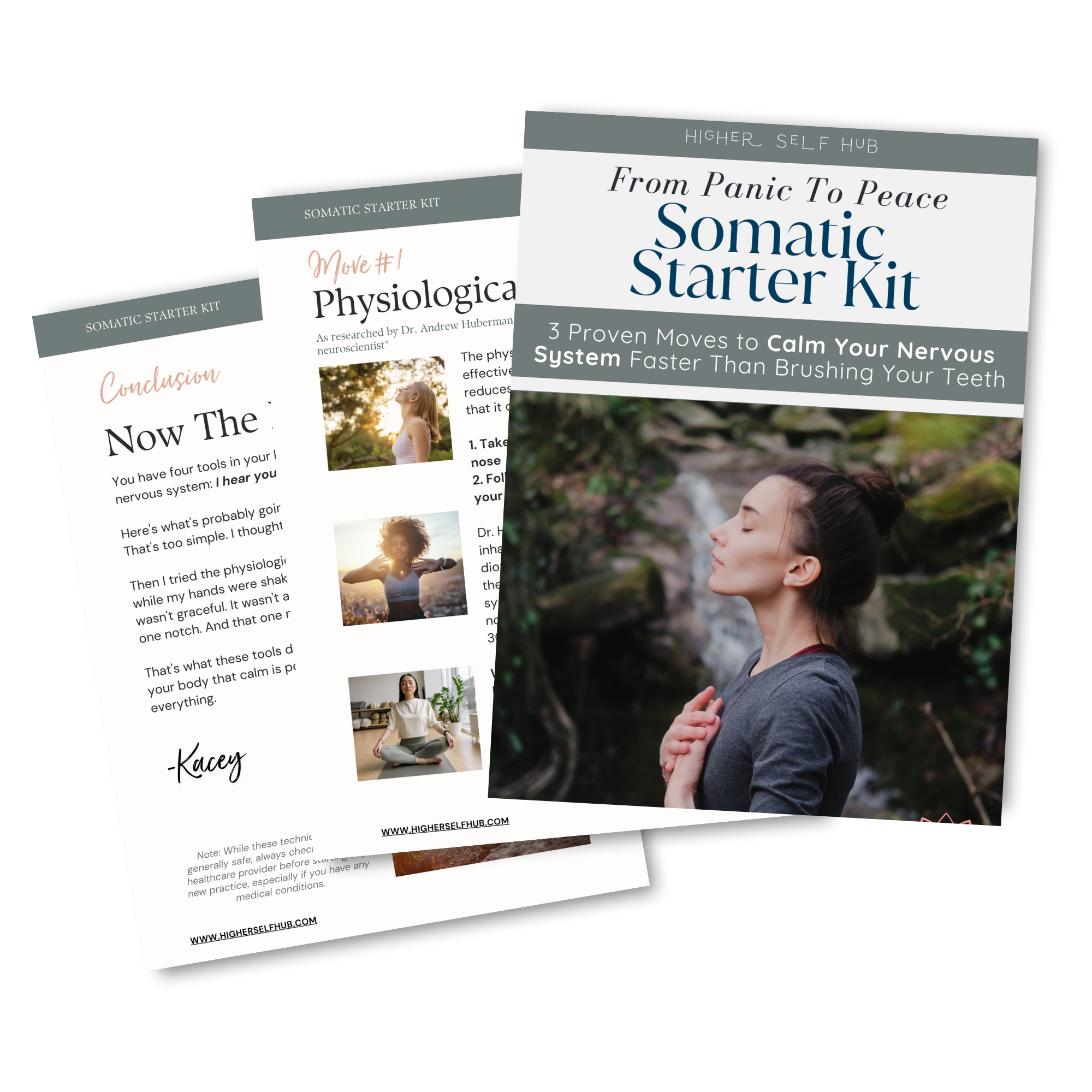
Your Free Somatic Starter Kit
3 science-backed tools to go from panic to peace in under 60 seconds.
Your inbox stays calm, too. Unsubscribe anytime. We respect your privacy.
What to Say When Your Body Says No

You don’t need a speech. You need one sentence you can say without your voice going up at the end.
- The plain no: “We can’t make it this year, but I hope it’s wonderful.”
- The smaller yes: “We’ll come for dessert.” “I can stay for an hour.”
- The different shape: “I can’t host a dinner, but I’d love to do a graze. Everyone brings one thing.” (That one’s from 12 Somatic Ways to Survive the Holidays, and there are more low-key formats in Restorative Galentine’s.)
- The not-yet: “I don’t know yet. I’ll tell you by Friday.”
Then expect the wobble. You hit send, and your heart pounds like you did something wrong.
You didn’t. I keep a notecard in my car that says: This is a protective response. Protective responses are normal. Your body spent years learning that disappointing people is dangerous. One text doesn’t unlearn it. Run cold water over your wrists, hum for a minute, or take what our family calls a reset and walk for ten minutes. There are more options in how to lower cortisol in public without anyone noticing.
From the Somatic Press app
Heart pounding after you hit send?
Open the check-in, answer three simple questions, and you’ll be guided to a grounding practice for this moment. Guided audio. Press play, no reading.
And if your version of people-pleasing looks less like a cheerful yes and more like going blank and nodding, read what functional freeze is. Same protection, different costume.
When You’ve Already Said Yes

Maybe you’re reading this with a full calendar and a knot in your stomach. Two things are true.
You’re allowed to change an answer. “I overcommitted and I need to pull back” is a complete sentence, and most people respect it more than a resentful appearance.
And if you’re going anyway, you can go on your own terms:
- Drive yourself, so leaving is your call
- Decide your end time before you walk in
- Skip the thing before or after it, so it isn’t back to back
- Plan the recovery now: legs up the wall, tea, an early night
The fewer choices you have to make in the moment, the better. Your brain is already doing a lot this month, and decision fatigue is real. If every event this season leaves you emptier than the last, what emotional burnout actually feels like is worth a read before January.
You Don’t Have to Get This Right
You’ll still say yes too fast sometimes. So will I.
Design for your worst day, not your best one. Pick one invitation this week and buy the pause on that one. That’s it.
I set a goal once to walk every day, and on the hard days I stopped asking how to push through and started asking what my body could actually do. I didn’t override it. I collaborated with it. I didn’t feel heroic afterward. I felt trustworthy.
That’s what a somatic boundary builds. Not a perfect December. A body that believes you’ll listen.
One honest caveat: if saying no doesn’t just feel uncomfortable but actually unsafe, that’s bigger than a blog post. Everyday body awareness is yours to practice, and you don’t need a gatekeeper for it. Deeper patterns deserve real support, and somatic therapy is one place to start.
So before you answer the next one: feet on the floor, one sigh, picture the day. What did your breath do?
Start there.
Checking in with your body is easier when something walks you through it. That’s the whole job of the Somatic Press app.
From the Somatic Press app
Not sure what your body is saying?
Three simple questions, then a grounding practice for this moment. Try it before you answer the next invitation.
📌 Save This For Later
If this one landed, save it somewhere you’ll find it the next time an invitation makes your stomach drop. Pinterest is a good place to keep things like this close.
Related Posts
- 12 Somatic Ways to Survive the Holidays
- 3 Nervous System States That Explain Why You Can’t Just “Calm Down”
- What Is Body Mapping? A Somatic Approach to Understanding Your Body’s Signals
- 11 Small Ways to Reconnect With Your Body When You’re in Survival Mode
- 11 Signs You Have a Strong Mind Body Connection